
A million tokens sounds like a fixed unit. In November 2026 it is anything but. The same normalized million tokens, a standard three-to-one mix of input and output, costs $0.10 on Ministral 3B, $4.00 on Claude Sonnet 5.5, and $16.00 on GPT-6.2 Astra or Claude Fable 5.2. That is a 160-fold spread for a unit that pricing pages present in the same font, on the same line, with the same dollar sign.
The spread is the story of the past 12 months. The budget tier collapsed. The frontier tier held, and in some cases moved up. The entry price fell, while the price of the hardest tasks rose. A buyer who benchmarks “cost per million tokens” without naming the tier is measuring an average that no real workload pays.
How we counted
We pulled list prices from the official pricing pages of OpenAI, Anthropic, Google, DeepSeek, xAI and Mistral on 21 November 2026. We used the standard tier, short-context rates, USD, per million tokens. We excluded batch discounts, prompt-cache discounts, negotiated enterprise pricing and regional uplifts. For DeepSeek, which publishes peak and off-peak rates, the table uses the off-peak rate and notes the peak rate. The discounts we excluded are real and often large; we treat them separately below because they change the bill without changing the sticker.
For a single comparison number we used a 3:1 input-to-output blend: three input tokens for every output token. That is a reasonable shape for chat, support and document-review workloads, where the prompt is longer than the answer. It is not universal. A coding agent that writes far more than it reads will weigh output more heavily; a retrieval system with a long fixed prompt will weigh input more heavily. The blend is a lens, not a verdict.
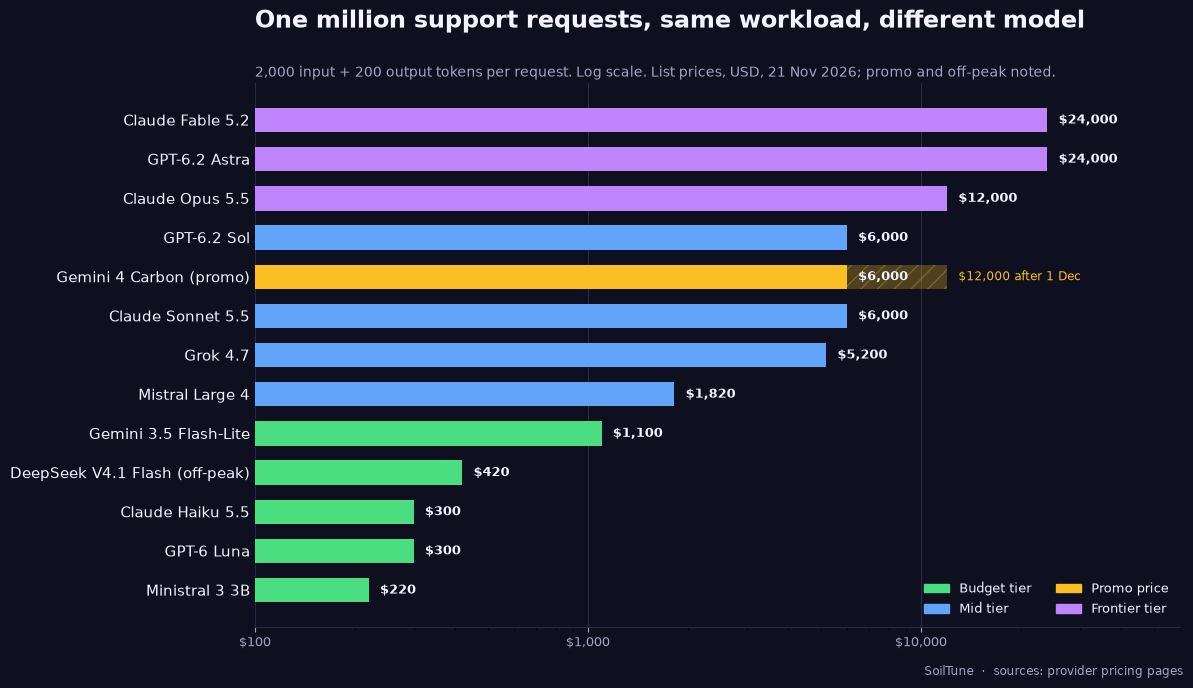
The chart prices a concrete job: one million support requests, each with 2,000 input tokens and 200 output tokens. That is 2,000 million input tokens and 200 million output tokens. The arithmetic is ours; the prices are the providers’.
| Model | Input | Output | Blended | Note |
|---|---|---|---|---|
| GPT-6.2 Astra | $8.00 | $40.00 | $16.00 | Frontier |
| Claude Fable 5.2 | $8.00 | $40.00 | $16.00 | Frontier |
| Claude Opus 5.5 | $4.00 | $20.00 | $8.00 | Frontier |
| GPT-6.2 Sol | $2.00 | $10.00 | $4.00 | Mid tier |
| Claude Sonnet 5.5 | $2.00 | $10.00 | $4.00 | Mid tier |
| Gemini 4 Carbon | $2.00 | $10.00 | $4.00 | Promo; $4/$20 from 1 Dec |
| Grok 4.7 | $2.00 | $6.00 | $3.00 | Under 200k prompt |
| Gemini 3.8 Flash | $0.75 | $3.75 | $1.50 | Promo; $1.50/$7.50 from 1 Jan |
| Mistral Large 4 | $0.70 | $2.10 | $1.05 | Open weights |
| Gemini 3.5 Flash-Lite | $0.30 | $2.50 | $0.85 | Budget |
| DeepSeek V4.1 Flash | $0.15 | $0.60 | $0.26 | Off-peak; $0.30/$1.20 peak |
| Mistral Small 4 | $0.15 | $0.60 | $0.26 | Open weights |
| Claude Haiku 5.5 | $0.10 | $0.50 | $0.20 | Prompts up to 100k |
| GPT-6 Luna | $0.10 | $0.50 | $0.20 | Budget |
| Ministral 3 3B | $0.10 | $0.10 | $0.10 | Open weights |
The bottom fell out
The clearest movement is at the bottom. Claude Haiku 5.5 lists at $0.10 per million input tokens and $0.50 per million output tokens for prompts up to 100,000 tokens. An earlier model, Haiku 4.5, is still on the same page at $1.00 and $5.00. The newer model is 90 percent cheaper on both sides. GPT-6 Luna matches the $0.10/$0.50 pair. Ministral 3B charges $0.10 for input and $0.10 for output. DeepSeek V4.1 Flash is $0.15/$0.60 off-peak and $0.30/$1.20 at peak.
Those prices are not promotional. They are the list. The budget tier has become a utility layer: classification, extraction, routing, moderation, summarization, first-pass support. A year ago, a team that wanted a cheap model accepted a visible quality drop. In 2026, the cheap model is often good enough for the narrow task in front of it, and the gap is small enough that the burden of proof has shifted. The useful question is now “which requests actually need the good model?”
The cause is a stack of improvements that compound: smaller distilled models, mixture-of-experts architectures that activate a fraction of their parameters, better post-training, and competition from open weights. Mistral’s Small 4 is $0.15/$0.60 with open weights. DeepSeek’s Flash is $0.15/$0.60 off-peak. When a capable model is available as a downloadable checkpoint, the hosted price has a ceiling.
The top held its premium
The frontier held its premium. Claude Fable 5.2 and Mythos 5.2 list at $8.00/$40.00; Mythos is offered on a limited-availability basis. GPT-6.2 Astra is also $8.00/$40.00. Claude Opus 5.5 is $4.00/$20.00. Those are the prices for the models vendors position as their most capable general systems, and they are not close to the budget tier.
The generational comparison is more interesting than the absolute number. Claude Opus 4.1, now retired on the first-party API, listed at $15.00/$75.00. Opus 5.5 is 73 percent cheaper per token. That looks like the familiar story of prices falling. But the top of the line moved to Fable and Mythos at $8.00/$40.00, which is still 47 percent cheaper than Opus 4.1 on input and 47 percent cheaper on output. The frontier got cheaper per token while the work it is asked to do got more expensive per task.
OpenAI’s line shows the same churn. GPT-5 listed at $1.25/$10.00. GPT-5.5 moved to $5.00/$30.00. GPT-6.2 Sol is $2.00/$10.00. A buyer who locked in a mental model of “GPT-5 pricing” would have been wrong in both directions. The model name is the stable part; the price is a policy that moves with capability, compute and competition. That competition runs on a constrained supply of accelerators, and US export controls help decide which chips reach which markets. Our explainer on how AI export controls work walks through the rules, the ECCNs and the 2026 changes.
Mistral shows the same pattern from the other direction. Its pricing FAQ still uses $0.50/$1.50 as the worked example for “Mistral Large.” Large 4 lists at $0.70/$2.10, 40 percent more on both sides. It is also a bigger model than Large 3, which had 41B active parameters out of 675B total: Large 4 has 52B active out of 1.05T, a 1M-token context window and open weights. “Open weight” describes the licence, not the cost of serving a model of that size.
Google’s December surprise
The most useful signal for anyone budgeting 2027 is on Google’s pricing page. Gemini 4 Carbon and Gemini 4 Argon are $2.00/$10.00 through 30 November 2026. On 1 December they become $4.00/$20.00. Gemini 3.8 Flash is $0.75/$3.75 through 31 December; on 1 January 2027 it becomes $1.50/$7.50. The batch, flex and priority tiers double with them.
That is a list-price increase of 100 percent, announced in advance, on models that are still current. It is the clearest sign that the promotional era of 2026 is ending. Google is not hiding it: the pricing page shows both columns. The old price has a date attached. The new price is the one without an expiry.
OpenAI is running a similar clock. GPT-5.6 Sol’s promotional pricing is available until 30 November 2026. Anthropic went the other way: the $2.00/$10.00 pricing for Claude Sonnet 5 was introduced as a temporary rate through 31 August 2026, then made permanent. The lesson: a promotional price is a temporary policy, and a budget built on it is a budget with an expiry date.
If you are signing an annual contract, the date on the pricing page matters more than the number. Ask which rate applies in month seven. Ask what happens when the promo ends. Ask for a cap. At scale, $2 versus $4 per million input tokens can decide whether the unit economics work at all.
The sticker price is not the bill
List prices are the beginning of the calculation, not the end. Three discounts change the shape of the bill, and they do not apply equally.
Prompt caching. On Claude Sonnet 5.5, a cache hit costs $0.10 per million input tokens, one-twentieth of the $2.00 base rate. Take the support workload: 2,000 input tokens per request, of which 1,800 are a fixed policy and product catalogue that rarely changes. If the cache stays warm, the input cost falls from $4,000 to $580: 1,800 million cached tokens at $0.10 plus 200 million fresh tokens at $2.00. Output stays at $2,000. The total falls from $6,000 to $2,580, a 57 percent saving. The cache write is not free, but at high volume it is amortized across many reads.
Batch. Anthropic, OpenAI and Google all offer roughly 50 percent off for asynchronous work. The same Sonnet workload drops to $3,000. Batch plus cache drops it to $1,290. If the task can wait minutes or hours, the discount is larger than most negotiated enterprise deals.
Off-peak. DeepSeek prices peak and off-peak separately. Peak hours are 01:00–04:00 and 06:00–10:00 UTC on weekdays; everything else, including weekends and Chinese public holidays, is off-peak at half price. A batch job scheduled for the weekend pays $0.15/$0.60 instead of $0.30/$1.20. That is a 50 percent cut for moving a cron job.
There is a fourth factor that is easy to miss: the tokenizer. Anthropic says Claude 4.7 and later models use a newer tokenizer that produces approximately 30 percent more tokens for the same text. A $2.00 per million input price on a newer Claude model is therefore closer to $2.60 per million relative to an older tokenizer for the same document. Cross-provider comparisons in “tokens” are approximate. The only reliable comparison is cost per task on your own data.
Reasoning tokens are the hidden multiplier
OpenAI, Anthropic and Google bill reasoning or thinking tokens as output. That turns the output price into a variable, not a constant. A model that writes 200 visible tokens but thinks for 1,000 tokens per request produces 1,200 output tokens. At Sonnet 5.5’s $10.00 per million output rate, the output bill for one million requests is $12,000, not $2,000. Add $4,000 for input and the total is $16,000, nearly three times the no-thinking estimate.
A cheaper model that thinks longer can still win. Suppose a budget model emits 3,000 thinking tokens at $0.50 per million output. The output bill is $1,500 for thinking plus $100 for visible text; input is $200. The total is $1,800. That is six times its own no-thinking cost, and still less than a third of the Sonnet no-thinking bill. The ranking depends on how much each model thinks, not just on the price per token.
This is why “reasoning effort” settings matter more than they look. Reducing effort can cut output tokens by half or more. The quality trade-off is task-specific, and it should be measured, not assumed. A support classifier may not need extended thinking at all. A multi-step agent may need it on every turn. The same model can be a bargain on one task and a bad deal on another.
Routing is the biggest lever
The 160-fold spread between the cheapest and most expensive model is larger than any discount a typical buyer can negotiate. That makes routing the highest-leverage cost decision in the stack.
Take the support workload again. Running all one million requests on Claude Sonnet 5.5 costs $6,000. Route 90 percent to Claude Haiku 5.5 at $300 per million requests and 10 percent to Sonnet 5.5 at $6,000 per million. The blended bill is $270 + $600 = $870, an 85.5 percent saving. The hard 10 percent still gets the better model. The easy 90 percent gets an answer that is likely indistinguishable for the task.
The catch is routing accuracy. A misrouted refund request or safety escalation can cost more than the tokens saved. The right design is a measured classifier with a confidence threshold and a fallback: send uncertain cases to the stronger model, and log the decisions so the threshold can be tuned. Good routing supports judgment; it does not replace it. The goal is to stop paying frontier prices for work that does not need frontier reasoning.
What to do before January
1. Recalculate at the post-promotion price. If a model has a date on its discount, model the undiscounted rate for 2027.
2. Measure tokens per task, including thinking tokens. A price sheet without a token count is a hypothesis.
3. Turn on caching for repeated system prompts, policies and documents. Measure the hit rate; a cache that is rarely warm saves little.
4. Batch what can wait. The 50 percent discount is usually larger than the engineering cost.
5. Use off-peak windows for non-urgent jobs where the provider offers them.
6. Route by task difficulty, with a confidence threshold and a fallback.
7. Test an open-weight model on your own evaluation set. The hosted price has a ceiling when the weights are downloadable.
8. Put a price-review clause in annual contracts. The list price is a policy, and policies change.
9. Re-run the comparison when a tokenizer changes. A new tokenizer can move the effective price by 30 percent without a line item changing.
What this means
The AI API market is not converging on a single price. It is separating into layers: a cheap utility layer for narrow, high-volume work, a mid-tier for general production, and an expensive frontier for reasoning, agents and long-context tasks. The entry price can fall while the cost of a frontier task rises. Both statements are true, and neither is useful without the tier attached.
The buyers who win the next year will have measured their own workload, matched each request to the cheapest model that clears the quality bar, and read the expiry date on the discount. Finding the lowest headline rate is the easy part. A million tokens is a unit. The bill is a design decision.
Methodology and caveats
Prices are list rates from provider pricing pages on 21 November 2026, in USD, per million tokens; DeepSeek is shown at its off-peak rate, with peak noted in the table. The blended figure is (3 × input + output) / 4. The support workload assumes 2,000 input and 200 output tokens per request, one million requests, no cache, no batch discount and no reasoning tokens unless stated. Cache, batch and off-peak examples are separate calculations using the providers’ published multipliers. We did not run a quality benchmark; a lower price does not mean a better model. Promotional dates are as published on the same date and can change. Tokenizers differ across providers, so cross-provider token counts are approximate. Enterprise discounts, regional uplifts and data-residency premiums are excluded.
What we added: We normalized 15 models to a common 3:1 blended cost, charted 13 of them, priced the same one-million-request support workload across the charted set, and worked through the cache, batch, off-peak, reasoning-token and routing math. The arithmetic and the scenario are ours; every price comes from a provider page linked below.
Last reviewed: 21 November 2026.
Sources: OpenAI API pricing; Anthropic model pricing; Google Gemini API pricing; DeepSeek models and pricing; xAI model pricing; Mistral API pricing; Mistral Large 4 model card; Mistral Large 3 model card; Mistral pricing FAQ.
Have a tip? Email [email protected] or use the contact form and choose Editorial. We do not promise anonymity.
Read next: What WARN notices say about AI layoffs in 2026, and what they don’t; Baseten’s bison-1 tops the decision-model index without writing a word; Google opens Gemini 4 Carbon to all paying developers; Claude picked a bombed Iranian school as a target in tests. Browse all Artificial Intelligence coverage.