

The most-quoted number in the AI-and-jobs debate this year is 116,175. That is how many announced U.S. job cuts Challenger, Gray & Christmas attributed to artificial intelligence from January through August 2026, about 22% of all announced cuts in its tracker. By October the cumulative figure had reached 121,401. The number is real, it is widely cited, and it does not mean what most headlines imply.
The official layoff filings tell a different and more limited story. California’s Employment Development Department published 594 WARN notices dated between 26 June and 18 November 2026, covering 31,148 workers. Only 18 of those notices, covering 1,637 workers, were filed by employers in the Information sector. Even a deliberately broad count of technology employers, the Information sector plus named chip, software, payments and platform companies filing under other sector codes, reaches 53 notices and 5,003 workers, or 16.1% of the total.
Not one of those notices says artificial intelligence caused the layoff. California’s form does not ask. That is the central fact of this article: the best public record of mass layoffs in the largest tech state does not contain a cause field for AI. Anyone who tells you the WARN data proves AI is or is not replacing workers is telling you something the data cannot support.
What a WARN notice actually records
The federal Worker Adjustment and Retraining Notification Act, and California’s stricter version, require employers to give advance notice of mass layoffs, plant closures and relocations. In California, a covered establishment generally has 75 or more employees and must give 60 days’ notice of a layoff of 50 or more employees in a 30-day period, a closure, or a relocation of 100 miles or more.
The notice is a disclosure about an employment action, not an explanation of it. California’s required fields include the employer and site, the expected separation date, whether the action is permanent or temporary, the job titles affected, the number of employees by title, and whether the employer will coordinate Rapid Response services. The form does not ask why the jobs are going away. A company can file the same form because it lost a contract, because it is moving a factory, because it is bankrupt, or because it bought a robot. The state records the action and the headcount. The cause is left to the company’s press release, if there is one.
That design is not a loophole. WARN laws were written to give workers and local officials time to prepare, not to produce economic statistics. The result is that the WARN system is excellent at answering “where and when” and silent on “why.”
The California picture: 594 notices, 31,148 workers
The EDD’s current detailed report begins with notices dated 26 June 2026 and runs through 18 November. Across that window, the monthly totals rise and then flatten:
| Month (2026) | Notices | Workers |
|---|---|---|
| June (26–30) | 4 | 191 |
| July | 84 | 4,670 |
| August | 130 | 5,168 |
| September | 125 | 6,763 |
| October | 106 | 10,655 |
| November (1–18) | 145 | 3,701 |
| Total | 594 | 31,148 |
October is the outlier: 106 notices but 10,655 workers, the highest monthly total in the window. The reason is a handful of very large filings. AEG Management Oakland filed for 1,605 workers at the Oakland Arena complex. 24Hr Homecare filed for 875. Ojai Valley Inn filed for 751. Three Dreyer’s Grand Ice Cream notices accounted for 715, 448 and 380 workers. The distribution is heavily skewed: the median notice covers 12 workers, the mean is 52.4, and the 79 notices covering 100 or more workers account for 19,545 workers, or 62.7% of the total.
November looks different. There were more notices, 145, but far fewer workers per notice, for a total of 3,701 through 18 November. That is consistent with a wave of smaller actions rather than a few plant-sized ones. It is also an incomplete month, so the total will rise as later notices are added.
The tech slice is smaller than the headlines
Manufacturing is the largest sector in the window by a wide margin: 97 notices and 9,064 workers, or 29.1% of the total. Administrative and support services account for 3,415 workers (11.0%), healthcare and social assistance for 3,186 (10.2%), accommodation and food services for 2,850 (9.1%), and professional, scientific and technical services for 2,452 (7.9%). Information is sixth, with 1,637 workers (5.3%).
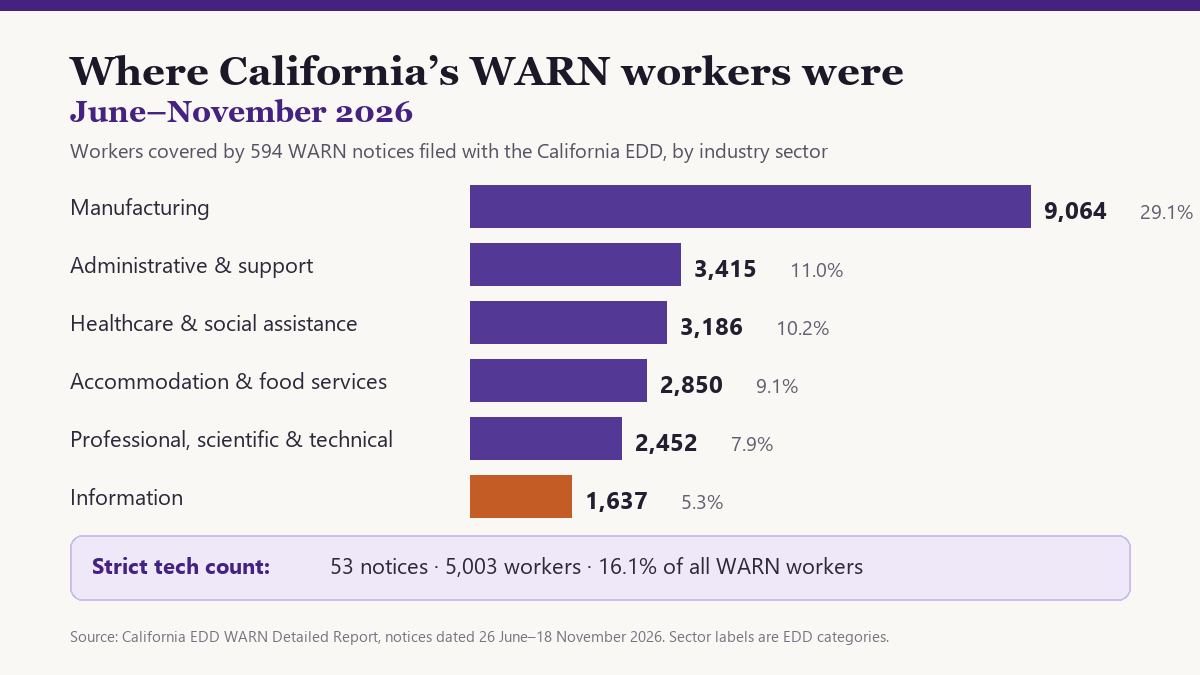
The Information sector is the cleanest official proxy for tech, but it is not the whole industry. Chipmakers, payments companies and platform companies often file under manufacturing, retail or professional services codes. To capture that, we built a named list of technology employers, Qualcomm, Jabil, Visa, Oracle, PayPal, eBay, ServiceNow, Uber, Amazon, Apple, Dropbox and similar, and counted every notice whose employer name began with one of those names. Adding those 35 non-Information notices to the 18 Information notices gives 53 notices and 5,003 workers, or 16.1%.
The largest technology filings in the window were Qualcomm (442 workers, 13 November), Jabil (382, 20 August), Visa (320, 31 July), Oracle (279 on 14 September, plus 99 and 63 at other sites), PayPal (251, 31 August), eBay (229, 21 October), ServiceNow (154 on 28 July, plus smaller filings), Uber (151 on 2 September, plus smaller filings), Amazon (94, 78 and 70 across three sites), Apple (79, 40 and 28 across three sites) and Dropbox (57, 28 October). In the Information sector, the largest were Netflix (267 and 227 in October, plus 59 in August), Airtable (190, 15 October), Workday (142, 29 September), Synopsys (128, 31 August), Comcast (82, 29 October), Salesforce (74, 5 August), Tencent America (68, 29 July), Crunchbase (67, 18 November), Nutanix (65, 4 August) and Frontapp (53, 27 October).
Those are real job losses. They are also not evidence that AI caused them. Qualcomm’s November filing lists 442 workers across several sites; the form does not say why. Visa’s July filing does not say whether the cuts were automation, a reorganisation, or a response to slower spending. Oracle’s filings do not say whether the work moved to cloud operations, to another country, or nowhere. The filings give us the employer, the site, the date and the number. They do not give us the mechanism.
The biggest notices were not AI labs
It is worth sitting with the top of the list. The five largest notices in the window were an arena management company, an aviation security contractor, a home care provider, a resort hotel and an ice cream manufacturer. None is an AI company. None is a model developer. The largest single filing, AEG Management Oakland’s 1,605 workers, is the kind of venue-services employer that rarely appears in AI commentary.
That does not mean AI played no role in any of those jobs. A hotel front desk, a security screening line and a food-production line can all be automated. It means the WARN data does not let you draw that line. If you sorted the 594 notices by headline plausibility, “this one looks like AI”, you would be doing exactly what the form was designed not to do: guessing at cause.
New York asked directly. Almost no one said yes.
New York is the closest thing to a natural experiment. In March 2025, following a directive from Governor Kathy Hochul, the state Department of Labor added a checkbox to its WARN filing system asking whether “technological innovation or automation” contributed to the layoffs. Employers who check the box are asked to name the technology.
In May 2026, the employment law firm Hunton Andrews Kurth reviewed the first year. More than 160 companies had filed WARN notices. Not one had attributed layoffs to AI or automation. The firms’ notices gave other reasons: economic conditions, lost contracts, bankruptcy, a sale, a relocation.
That zero is striking, but it is not a clean measurement. The checkbox was added by directive, not by amending New York’s WARN statute. The law does not define “technological innovation or automation,” does not say whether AI must be the sole cause or a contributing factor, and attaches no specific penalty to leaving the box blank. Employers have every incentive to describe a layoff in the blandest accurate terms. A blank box can mean “AI played no role.” It can also mean “our lawyers preferred not to say.”
The state’s 2026 data contains at least one exception. A Nespresso filing dated 13 January 2026, covering 46 workers in New York City with an effective date of 13 April, lists the reasons as “Relocation of Business, Artificial Intelligence.” One filing is not a trend. It is a proof of concept: when an employer does name AI, the state record can capture it. The question is how many employers will choose to, and whether the form will ever require them to.
Challenger’s number measures something else
Challenger, Gray & Christmas counts something different from WARN. It tracks public layoff announcements and records the reason the employer gives. Its AI category reached 116,175 announced cuts from January through August 2026, about 22% of the 529,914 cuts announced in that period. By October the cumulative AI figure was 121,401, about 20% of 617,189 announced cuts. For comparison, the firm counted 54,836 AI-cited cuts in all of 2025.
Those numbers are useful, but they are not a body count. They are announcements, often spread over multiple quarters, and the reason is self-reported. A company can cite AI because it is true, because investors like the story, or because “restructuring” invites more questions than “efficiency.” Challenger’s own monthly data shows how noisy the category is: AI-cited cuts hit a record 38,579 in May 2026, then fell to 3,462 in August, the lowest monthly total since December 2025, and 1,265 in October, under 3% of that month’s cuts. The year-to-date share stayed around 20%. A single month’s number can move for reasons that have nothing to do with the technology.
The WARN and Challenger datasets are not competing measurements of the same thing. WARN counts filed notices with a date and a headcount but no cause. Challenger counts announced cuts with a cause but no verification. One is a legal record of an action; the other is a running tally of what companies say about the action. Neither is a census of jobs destroyed by AI, and neither can be subtracted from the other to produce one.
California is about to change the form
The most important development is not in the data yet. On 30 September 2026, Governor Gavin Newsom signed Senate Bill 951, which takes effect on 1 January 2027. The law requires California WARN notices for mass layoffs, relocations or terminations caused “in whole or in substantial part” by an AI system or other automated technology to meet four additional requirements: the number, classification and work location of the layoffs; the job functions that will be automated; the specific category or type of technology involved; and a statement at the top of the notice reading “This notice is for a technology displacement.”
The EDD must publish a summary of those notices and a quarterly statewide summary of reported technological displacements. The department must also report to the Legislature by 1 January 2028 on AI’s effects on hiring, including industry and regional trends.
That will create the first official, state-level, cause-specific AI layoff dataset in the country. It will also have limits. The law applies only when an employer is already required to file a WARN notice, and only when AI caused the action “in whole or in substantial part.” A company that replaces two workers with software and lays off 49 will not appear. A company that attributes a larger layoff to “restructuring” may never check the AI box. The dataset will be better than a blank field. It will not be complete.
What would actually count as evidence
If the goal is to know whether AI is reducing employment, three things would help more than another announcement tracker.
First, matched employer-level data. A WARN notice tells you a company cut 400 jobs. Unemployment insurance records tell you which occupations those workers held, whether they found new jobs, and at what pay. Linking the two, with privacy protections, would show whether the cuts hit tasks that AI can do, and what happened to the people afterward. That is the kind of analysis state labor agencies are uniquely positioned to do, and it is much harder than counting press releases.
Second, cause disclosure with a defined standard. California’s new form is a start. The definition of “in substantial part” will matter, as will enforcement. New York’s experience shows that a checkbox without a statutory hook can produce a very clean zero.
Third, task-level data rather than occupation-level data. “Software engineer” is not a task. “Write a test suite,” “review a pull request” and “design a distributed system” are tasks, and AI affects them differently. The WARN form records job titles, not task bundles. Even a perfect AI checkbox will not tell you which part of a job disappeared.
What to watch
The next few months will produce three useful signals. California’s November and December notices will show whether the autumn pace continues. The first SB 951 filings in January will show how employers interpret “in substantial part”, and whether law firms advise them to check the box or avoid it. And Challenger’s monthly AI share will show whether the May spike was a turning point or a one-off.
None of those signals will settle the debate. The honest conclusion from the current data is narrower: California’s WARN filings document a lot of job loss, tech is a minority of it, and the forms do not record why. New York asked and got almost nothing. Challenger got a lot of answers, but they are answers companies chose to give. The missing piece is not another headline number. It is a record that connects a layoff to a cause and a worker to an outcome.
Methodology and caveats
We downloaded the California EDD’s latest detailed WARN report on 21 November 2026 and filtered to notices dated 26 June through 18 November 2026. The report contained 594 rows with a worker count, totaling 31,148 workers. The “workers” figure is the number stated on the notice, not the number of separations that ultimately occurred; notices can be amended, extended or rescinded. The monthly totals reflect notice dates, not effective dates.
The “strict tech” count combines the 18 notices in the Information sector with 35 notices from a named list of technology employers filing under other sector codes. The list included Qualcomm, Jabil, Visa, Oracle, PayPal, eBay, ServiceNow, Uber, Amazon, Apple, Dropbox and similar companies; matching was by employer-name prefix to avoid false positives such as “Francisco” matching “Cisco.” The count is a lower bound on tech employment in the WARN data, not a complete industry census. It says nothing about cause.
New York figures come from the state WARN dashboard and Hunton Andrews Kurth’s 18 May 2026 review. The Nespresso filing is from the state’s 2026 data as reported by the dashboard and secondary trackers; we did not obtain the underlying PDF. Challenger figures come from the firm’s monthly Job Cut Announcement Reports, including the August 2026 report and the October figures as summarized by HRD America. SB 951 details come from the chaptered bill text on the California Legislature’s site.
We did not run a hands-on model test for this article, and we did not interview any of the employers named. The analysis is descriptive. It does not estimate the number of jobs lost to AI, and it should not be used to claim that AI is or is not the cause of any specific layoff.
What we added: We parsed the current California WARN report, built the sector and monthly tables, defined and computed a reproducible strict-tech count, and compared it with New York’s AI checkbox and Challenger’s announcement tracker. The chart, the strict-tech methodology and the comparison are ours; the underlying records are linked below.
Last reviewed: 21 November 2026.
Sources: California EDD WARN program page; California EDD latest detailed WARN report (XLSX); California Labor Code, Chapter 4 (Cal/WARN); SB 951 chaptered text; New York DOL WARN dashboard; Hunton Andrews Kurth, “No AI-Related Layoffs Reported in First Year” (18 May 2026); Challenger, Gray & Christmas job cut reports; Challenger August 2026 report (PDF); HRD America on Challenger’s October figures.
Have a tip? Email [email protected] or use the contact form and choose Editorial. We do not promise anonymity.
Read next: All AI coverage; What the D.C. Circuit’s Anthropic ruling actually says; How AI export controls actually work; Adobe executives on AI speed and human quality; What AI APIs cost per million tokens.