

On 19 November 2026, the US Bureau of Industry and Security published a 30-page interim final rule that changed how advanced AI chips are controlled. A day later, the European Union’s updated dual-use list came into force. On 1 December, the United Kingdom’s amendment takes effect. Three regimes, three dates, one direction: export control is moving from the box that crosses a border to the compute that crosses a network.
AI hardware is not a finished consumer product. A GPU is sold as a component, installed in a server, aggregated into a cluster and rented by the hour to a customer in another country. A rule that checks only the shipping invoice misses the data centre, the cloud contract and the ownership chain. This guide explains the machinery. It is a map, not legal advice.
The words that do the work
Export control is a vocabulary test before it is a legal test. These terms decide most conversations.
| Term | What it means |
|---|---|
| ECCN | Export Control Classification Number. The code that identifies an item on the US Commerce Control List, such as 3A090 for certain advanced computing chips. |
| Licence and licence exception | A licence is permission to export. A licence exception is a pre-authorised route that removes the need to apply, but only if every condition is met. |
| Reexport and transfer (in-country) | A reexport sends a US-origin item from one foreign country to another. A transfer (in-country) changes the end user or end use inside the same country. Both can require a licence. |
| End-use and end-user control | A rule that applies even when the item is not on a list, because of what it will be used for or who will use it. The Entity List is the best-known end-user control. |
| TPP | Total processing performance: 2 x MacTOPS x bit length, aggregated over all processing units on the chip. |
| Performance density | TPP divided by the applicable die area in square millimetres. It separates a small, dense accelerator from a large chip with the same total performance. |
| Country Group D:5 | The US list of arms-embargoed destinations: 22 countries, including China, Russia, Belarus, Iran, North Korea, Syria, Venezuela and Cuba. Macau is treated alongside D:5 in the new rule but is not in the group. |
| Aggregate TPP | The sum of the TPP of all controlled chips in a group, such as a data centre or a set of linked data centres. |
The chip test: TPP and density
The US has controlled advanced computing chips under ECCN 3A090 since 2022. The entry has been rewritten several times, but the logic is stable: measure the chip’s throughput, then measure how much of that throughput is packed into each square millimetre of silicon.
The formula is TPP = 2 x MacTOPS x bit length, aggregated over all processing units on the integrated circuit. MacTOPS is the theoretical peak number of tera multiply-accumulate operations per second. The factor of two reflects the convention that one multiply-accumulate counts as two operations. A chip rated at 375 trillion FP16 floating-point operations per second therefore has a TPP of 6,000: 2 x 187.5 x 16. The same 6,000 can be reached with 750 trillion INT8 operations per second.
Performance density is TPP divided by the applicable die area, counting the logic dies made on a non-planar process node. A chip with a TPP of 4,992 and a die area of 826 square millimetres has a density of about 6.04. A multi-die package with the same TPP but 1,200 square millimetres of logic die has a density of 4.16. The first can be caught by a density-based test; the second may not. That is the point: the rule separates concentrated computing power from chips that spread the same throughput across a much larger area. The same component-level logic is why a workstation card is described by its chip: the RTX PRO 5500 uses the same GB202 configuration as the RTX 5090. The classification follows the chip, not the product name.
The US thresholds sit in two paragraphs. 3A090.a covers a TPP of 4,800 or more, or a TPP of 1,600 or more with a density of 5.92 or more. 3A090.b covers a TPP of 2,400 or more but less than 4,800 with a density of 1.6 or more but less than 5.92, or a TPP of 1,600 or more with a density of 3.2 or more but less than 5.92. Below TPP 4,800, the controls apply only to items designed or marketed for data centres. A chip at TPP 4,800 or above is caught regardless of its marketing.
The EU and UK use 3A501.a.16 and a simpler test. Chips at TPP 6,000 or more are controlled. Chips at TPP 1,600 or more but less than 6,000 are controlled if their density is 5.92 or more and they are designed for data centres. There is no EU equivalent of the 3A090.b lower-density bands. 4A507 then controls computers, electronic assemblies and components containing a chip that meets 3A501.a.16, which is how a server or accelerator card inherits the control from a single chip.
| Regime | Chip entry | Test | Assembly entry | Status |
|---|---|---|---|---|
| United States | 3A090.a | TPP 4,800 or more; or TPP 1,600 or more with density 5.92 or more | 4A090 | In force |
| United States | 3A090.b | TPP 2,400 to under 4,800 with density 1.6 to under 5.92; or TPP 1,600 or more with density 3.2 to under 5.92 | 4A090 | In force |
| European Union | 3A501.a.16 | TPP 6,000 or more; or TPP 1,600 to under 6,000 with density 5.92 or more, data-centre design | 4A507 | In force 20 Nov 2026 |
| United Kingdom | 3A501.a.16 | Same as the EU test | 4A507 | In force 1 Dec 2026 |
One warning: the tests are not interchangeable. A chip can be controlled in the US and not in the EU, or the other way around. A US ECCN cannot simply be copied onto an EU declaration.
The destination test: D:5, Macau and the five countries
The US already required a licence for advanced chips destined for entities headquartered in Country Group D:5 or Macau. The new rule closes the remote-access gap. Under new §744.24, a licence is required when there is knowledge that an advanced AI item will be used in a data centre, anywhere in the world, that provides or will provide access to more than 12,000,000 aggregate TPP to a company headquartered in D:5 or Macau, or whose ultimate parent is headquartered there.
Three details make that control wider than it looks. It applies to exports, reexports and transfers in-country, so a data centre in a neutral country is covered. “Linked data centres” includes digitally linked infrastructure, not just physically connected buildings, so splitting a cluster across borders does not avoid aggregation. And the test is knowledge, not intent: a data centre that declines to provide ownership information creates a red flag that can be treated as knowledge. A data centre already serving D:5 or Macau entities before 19 November had 90 days from the effective date to obtain a licence to continue.
The threshold is high, but not astronomical. Using NVIDIA’s published dense FP16 figure of 312 teraflops for the A100, the TPP works out to 4,992. Dividing 12,000,000 by 4,992 gives about 2,400 A100-class GPUs. The rule counts TPP, not GPUs, and the conversion is illustrative, but it shows the scale: a mid-sized cluster can cross the line.
The rule includes a narrow exception for “commercial recommender systems”: tools exclusively designed and used to rank, filter or suggest commercial products, services or content. It expressly does not cover systems that generate novel text, images, audio, video or software, even if they also recommend. A retail recommendation engine may qualify. A general-purpose chatbot does not.
The second destination change is simpler. The US now requires a licence for advanced chips to Indonesia, Malaysia, Singapore, Thailand and Brazil, five countries BIS identifies as higher-than-normal diversion risks. The requirement does not apply to an end user headquartered in the US, or whose ultimate parent is headquartered in the US, provided the exporter meets the reporting requirements in new §743.10. The exception is about ownership, not geography: a US company’s Singapore subsidiary can qualify; a Singapore company owned by a Chinese parent cannot. Policy can strand inventory even when the product is not banned: the TP-Link Wi-Fi 8 routers stuck outside the US are a reminder that a rule aimed at one market reshapes the whole supply chain. Under the destination-based rules, most D:5 and Macau applications face a presumption of denial, with a narrow case-by-case lane for chips below TPP 21,000 and DRAM bandwidth below 6,500 GB/s destined to end users in China or Macau.
The end-use test: the list is not the whole rule
Even a chip below every threshold can require a licence. The US end-use controls in Part 744 cover advanced computing items destined for supercomputer, advanced-node integrated circuit or semiconductor manufacturing end uses, and the Entity List can impose a licence requirement on a named buyer regardless of the item. The EU has a catch-all in Article 4 of Regulation 2021/821: a licence is required for unlisted items intended for weapons of mass destruction, for military end uses in an arms-embargoed country, or when the exporter is aware of such a use. The UK applies an equivalent catch-all. Most compliance failures happen here: a sales team checks the ECCN, sees that the chip is below the threshold, and ships without checking the buyer, the end use or the ownership chain.
What changed in 2026
The US and EU did not move in the same direction at the same speed. The dates below matter.
| Date | Regime | Change |
|---|---|---|
| 15 Jan 2025 | United States | AI Diffusion Rule published at 90 FR 4544. It created country tiers, a data-centre VEU and a model-weights control. It was never enforced. |
| 15 Nov 2025 | European Union | Delegated Regulation 2025/2003 replaced Annex I and introduced entries 3A501.a.16 and 4A507. |
| 19 Nov 2026 | United States | Interim final rule 91 FR 74970 takes effect. New §744.24 data-centre control; licences for five countries; tighter front-end fab and OSAT presumptions; AI Diffusion Rule rescinded; ECCN 4E091, AIA, LPP and the Data Center VEU removed. |
| 20 Nov 2026 | European Union | Delegated Regulation 2026/2288 replaces Annex I and adds the lower TPP band to 3A501.a.16. Published 19 November; in force the next day. |
| 1 Dec 2026 | United Kingdom | Export Control (Amendment) Regulations 2026 (SI 2026/1150) add the same lower band and the 4A507 assembly control in Great Britain. |
The US rescission is the most misunderstood part. The AI Diffusion Rule was published in January 2025 and never enforced. The November 2026 rule removes the country tiers, the Data Center VEU, License Exceptions AIA and LPP, ECCN 4E091 for model weights and the model-weights foreign direct product rule. What replaces it is not a vacuum: a targeted data-centre end-use control, a five-country destination rule and tighter presumptions for front-end fabs and outsourced assembly and test companies. The policy also reached the capital markets: banks barred Chinese and Hong Kong investors from Anthropic’s IPO over US export controls.
The EU update is narrower but technically precise. The 2025 regulation created 3A501.a.16 and 4A507. The 2026 regulation adds the lower TPP band and a decontrol for chips not designed for data centres. The Commission adopted it on 14 September, published it on 19 November and brought it into force on 20 November. The UK is running a separate list with a shared technical test: its 2026 regulations were made on 29 October, laid before Parliament on 3 November and take effect on 1 December. The dual-use changes apply in Great Britain; Northern Ireland remains under the EU framework.
The five-question screen
The flowchart below reduces the three regimes to a sequence of questions. It is a screening tool, not a legal opinion.
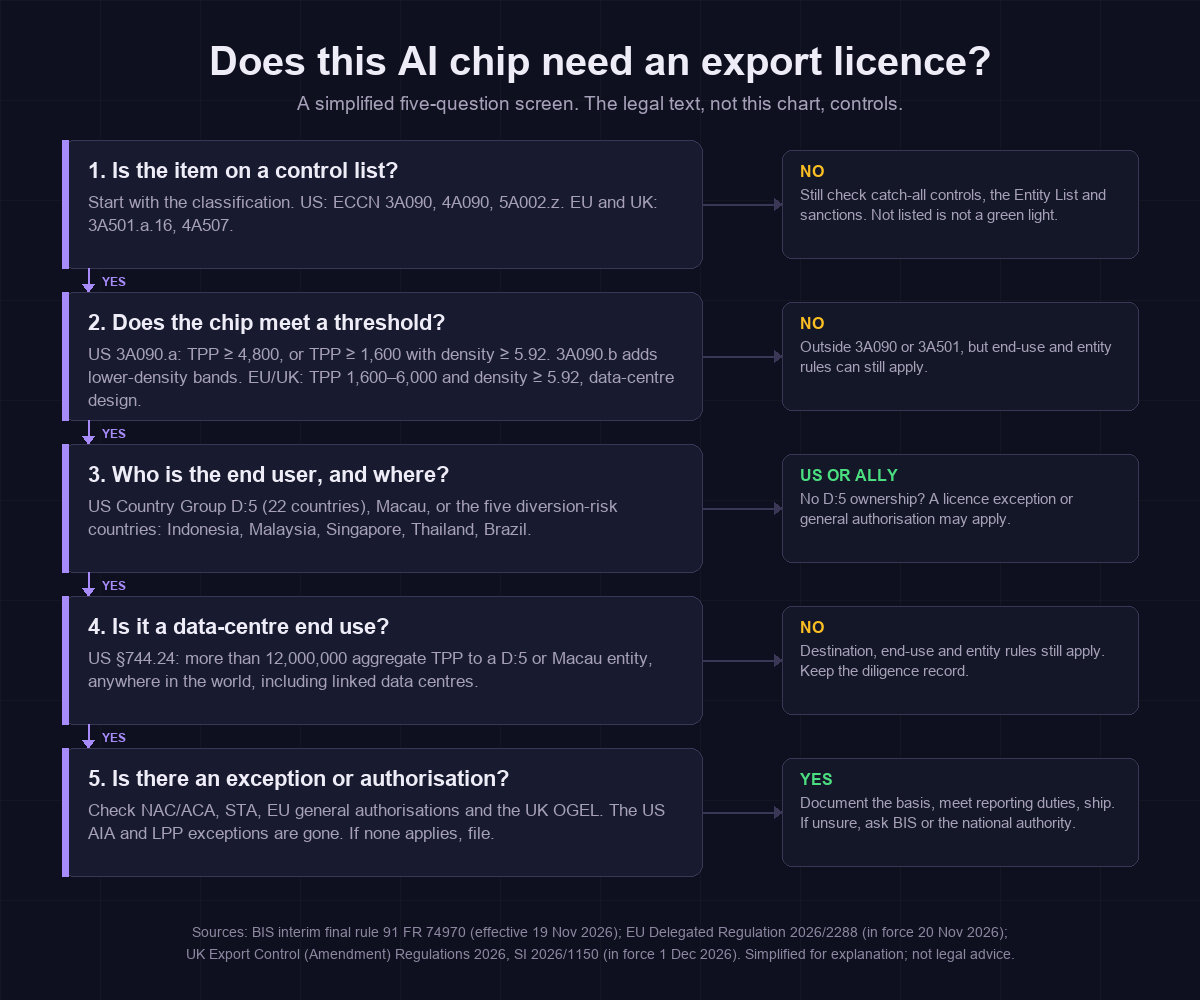
1. Is the item on a control list? 3A090 and 4A090 in the US; 3A501.a.16 and 4A507 in the EU and UK. If not, the catch-all and Entity List questions still apply.
2. Does the chip meet a threshold? Calculate TPP and density from published figures. Use dense performance, not sparse, and check every precision.
3. Who is the end user, and where? Trace ownership to the ultimate parent. A US address can hide a D:5 owner; a Singapore address can hide a US parent.
4. Is it a data-centre end use? More than 12,000,000 aggregate TPP to a D:5 or Macau entity, including through linked data centres.
5. Is there an exception or authorisation? Check the remaining US exceptions, EU general authorisations and the UK open general export licence. AIA and LPP are gone.
Where the regimes diverge
The US regime is the broadest. It reaches reexports, transfers in-country and foreign-made items under the foreign direct product rules. It has an end-use control aimed at data centres serving D:5 entities, the 3A090.b lower-density bands that the EU and UK do not replicate, and the five-country destination rule. A transaction can be outside the EU list and still be caught by the US reexport rule if any US-origin controlled item is involved.
The EU regime is list-based, with a catch-all and national licensing authorities. It has no data-centre end-use rule equivalent to §744.24. Its lower TPP band applies only to chips designed for data centres, and it has no 3A090.b equivalent. That makes the EU narrower on paper for some chips, but the catch-all and 4A507 can still capture the transaction. The UK is technically close but legally separate, and the Great Britain/Northern Ireland split means one warehouse group can face two lists. Classify separately; a licence from one authority does not bind another.
What companies should do now
1. Classify the chip and the assembly separately. A server can be controlled because of one chip inside it.
2. Get TPP, density and die area in writing. Datasheets rarely give density. Ask for the calculation, the process basis and the design intent.
3. Map the ownership chain and screen the end use. Check the ultimate parent, the Entity List and the restricted end uses, not just the customer address.
4. Check all three regimes and the US reexport rule. Do not assume that a non-US export escapes the EAR.
5. Document the analysis and train the front line. Record the classification, the licence decision and the ownership evidence. A support engineer who learns that a customer is training a model for a D:5 entity is part of the compliance chain.
6. Watch the dates. The UK change is 1 December 2026. US comments are due 19 January 2027. The 90-day grace for existing data centres runs into mid-February 2027.
What it means
The chip is no longer the border. The control follows the compute, the contract and the ownership chain. That is harder to administer than a shipping manifest, and it puts more weight on diligence: who owns the buyer, what the cluster is for, and whether the same compute is being rented to someone else. The economics are connected, too: the price of a million tokens is shaped by the price of the chips and the rules that govern where they can go.
The US rescission of the AI Diffusion Rule is not a retreat. It is a re-aim. The old framework was broad, never enforced and politically contested. The new one is narrower in theory but deeper in reach: a worldwide data-centre end-use control, a five-country destination rule and tighter presumptions for the fabs and packagers that make the chips. The EU and UK are converging on the same technical test but have not built the same legal architecture. The next enforcement frontier is likely to be the intermediary layer: cloud resellers, data-centre operators and brokers who never touch the chip but control access to it. The list got shorter; the reach got longer.
Methodology and caveats
This article is based on the primary legal texts in force on 21 November 2026: US interim final rule 91 FR 74970, 15 CFR 774 ECCN 3A090, 15 CFR Part 740 Supplement No. 1, EU Regulation 2021/821 as amended by Delegated Regulation 2026/2288, and UK SI 2026/1150. The TPP and density arithmetic is ours, using the formulas in the technical notes. The A100 conversion is illustrative and is not a regulatory classification. The five-question screen is a simplification; export control depends on the specific item, destination, end user and end use.
What we added: We read the 30-page US interim final rule, the EU’s replacement Annex I entry and the UK statutory instrument, reduced them to a five-question screen, and worked the TPP and aggregate-TPP arithmetic. The flowchart and the A100 conversion are ours; every legal threshold and date is linked to the primary source below.
Last reviewed: 21 November 2026.
Sources: BIS interim final rule, 91 FR 74970 (19 November 2026); BIS press release (16 November 2026); 15 CFR 774, ECCN 3A090 and technical notes; 15 CFR Part 740, Supplement No. 1 (Country Groups); Regulation (EU) 2021/821; Delegated Regulation (EU) 2026/2288; European Commission, 2026 update of the EU control list; UK Export Control (Amendment) Regulations 2026, SI 2026/1150; UK Notice to Exporters 2026/24; NVIDIA A100 datasheet.
Have a tip? Email [email protected] or use the contact form and choose Editorial. We do not promise anonymity.
Read next: What the D.C. Circuit’s Anthropic ruling actually says; Banks bar Chinese and Hong Kong investors from Anthropic’s IPO over US export controls; TP-Link’s Wi-Fi 8 routers are stuck outside the US; The price of a million tokens: 12 months that split the AI API market. Browse all Policy coverage.