August 18, 2026 · 18 min read · Azmi Mhamed
How to Change Hydrangea Color: The Complete pH + Aluminum Protocol for Blue or Pink Blooms
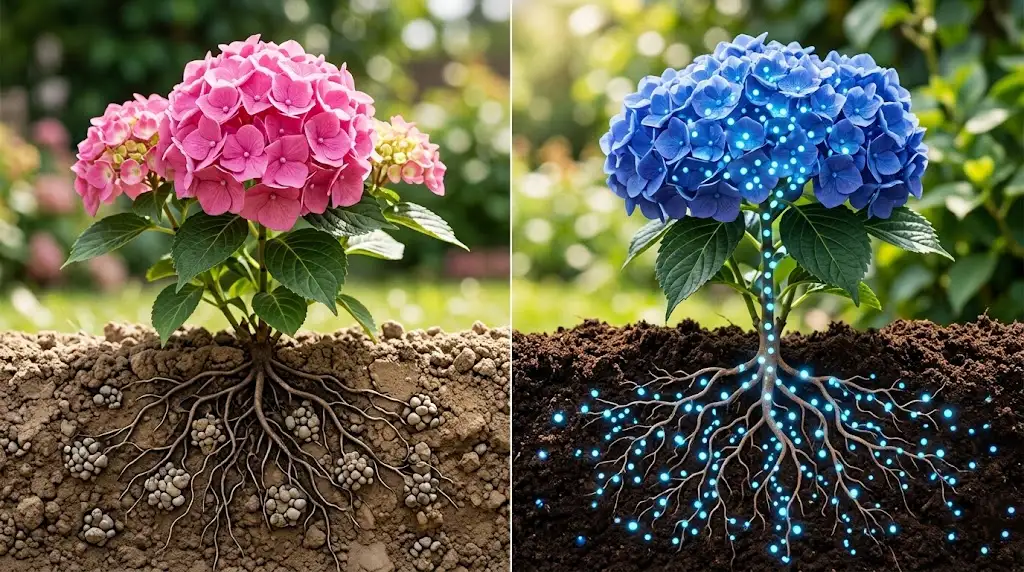
Your hydrangeas bloom the wrong color because two variables are out of balance: soil pH and aluminum bioavailability. To make hydrangeas blue, lower pH to 5.0–5.5 and hold exchangeable aluminum above 40 ppm using aluminium sulphate (labeled aluminum sulfate in the US). To make them pink, raise pH above 6.2 with dolomitic lime so aluminum binds and becomes root-unavailable. Only Hydrangea macrophylla (mophead/lacecap) and H. serrata can shift color, white, paniculata, arborescens, and oakleaf types never change. Below you get exact gram-per-litre doses for every pH band, the Aluminum Mobility Threshold Framework, the Phosphorus Trap fix, a seasonal bud-set calendar, and a root-burn rescue plan.
Table of Contents
- The Science: Why Hydrangea Color Changes
- First: Which Hydrangea Species Can Change Color?
- Testing Your Soil: pH & Aluminum Levels
- The Aluminum Mobility Threshold Framework
- How to Make Hydrangeas Blue with Aluminium Sulphate
- When to Apply: The Seasonal Bud-Set Calendar
- How to Make Hydrangeas Pink
- The Phosphorus Trap: Why Color Changes Fail
- Potted Hydrangeas: Adjusted Doses & Tips
- Aluminium Sulphate vs. Other Acidifying Options
- Toxicity, Root Burn & Rescue
- Timeline: What to Expect Month-by-Month
- Troubleshooting Common Problems
- Conclusion & Key Takeaways
- F&Q
The Science: Why Hydrangea Color Changes
Hydrangea flower color is dictated by soil pH and aluminum bioavailability: acidic soil below pH 5.5 keeps aluminum soluble for blue blooms, while alkaline soil above 6.5 binds aluminum, producing pink blooms (Mississippi State Extension P2574).
This isn’t marketing speculation, it’s coordination chemistry. Hydrangea “petals” are actually sepals, and their color hinges on one metal: aluminum. The anthocyanin pigment delphinidin-3-glucoside in Hydrangea macrophylla and H. serrata sepals forms a complex with aluminum ions. When aluminum is present and bioavailable, the complex appears blue; without it, the anthocyanin stays pink or red. Aluminium sulphate (Al₂(SO₄)₃) is unique among amendments because it does two jobs at once: it lowers soil pH, the master variable behind most plant struggle, as we explain in our ultimate guide to soil reaction (pH), and directly supplies free Al³⁺ ions to the root zone.
The mechanism in one line:
Soil pH < 5.5 → soluble Al³⁺ → root uptake → binds delphinidin-3-glucoside → blue sepals
Soil pH > 5.5 → Al³⁺ locked (insoluble) → no co-pigmentation → pink/purple sepals
The Two-Variable System
Most gardeners fail because they focus on pH alone. You need BOTH conditions:
- Correct pH range (controls aluminum solubility)
- Sufficient aluminum in the soil profile
pH-to-Color Mapping
| Soil pH | Aluminum Status | Bloom Color |
|---|---|---|
| 4.5 – 5.0 | Highly soluble | Deep blue |
| 5.1 – 5.5 | Moderately soluble | Purple-blue |
| 5.6 – 6.0 | Limited solubility | Purple-mauve |
| 6.1 – 6.5 | Mostly bound | Pink-purple |
| 6.6 – 7.0 | Tightly bound | Pink |
| > 7.0 | Insoluble | Deep pink/red |
Key insight: The transition zone (pH 5.6–6.0) produces mixed colors because aluminum bioavailability fluctuates with moisture, temperature, and competing ions.
First: Which Hydrangea Species Can Change Color?
Before you buy a single bag, confirm your plant can respond at all. Only the big-leaf group (mophead and lacecap hydrangeas, H. macrophylla) and the mountain group (H. serrata) carry the pigment chemistry that binds aluminium. If unsure, check flower structure: mopheads form solid globes; lacecaps show a flat ring of showy sepals around a fertile centre.
| Species | Colour-shift possible? | Reliable blue cultivars |
|---|---|---|
| Hydrangea macrophylla (mophead / lacecap) | Yes | ‘Endless Summer’, ‘Nikko Blue’, ‘Blue Wave’ |
| Hydrangea serrata (mountain hydrangea) | Yes | ‘Bluebird’, ‘Kiyosumi’ |
| Hydrangea paniculata (‘Limelight’, ‘Pinky Winky’) | No, white/pink only | n/a |
| Hydrangea arborescens (‘Annabelle’, ‘Incrediball’) | No | n/a |
| Hydrangea quercifolia (oakleaf) | No | n/a |
White hydrangeas stay white. Cultivars genetically locked to white, ‘Annabelle’, ‘Incrediball’, ‘Limelight’, and white macrophyllas such as ‘Madame Emile Mouillere’, lack the pigment machinery for blue. No dose of aluminium sulphate will change them, and trying only risks root burn.
Testing Your Soil: pH & Aluminum Levels
Guessing your soil pH is the fastest route to color-change failure. Every dosing rule in this guide starts with a pH test, not a dose.
Step 1: Choose Your Testing Method
- Professional lab test (recommended): $15–$40; delivers precise pH, aluminum ppm, phosphorus, and cation exchange capacity. Compare professional soil testing vs lab analysis to maximize ROI.
- Home test kit: $10–$25; gives pH range (±0.5 accuracy) but rarely measures aluminum. When choosing the right soil testing kits and meters, see our 2026 lab accuracy test of the top kits to pick a reliable baseline tool.
- Digital pH meter: $30–$150; instant, repeatable readings year after year, but requires calibration and doesn’t detect aluminum.
Step 2: Sample Correctly
- Collect soil from 4–6 locations around the drip line, not just at the stem
- Dig 4–6 inches (10–15 cm) deep, root-zone depth
- Test when soil is moist but not waterlogged
- Mix samples in a clean plastic bucket; remove roots and stones
- Submit 1–2 cups to a lab or test immediately
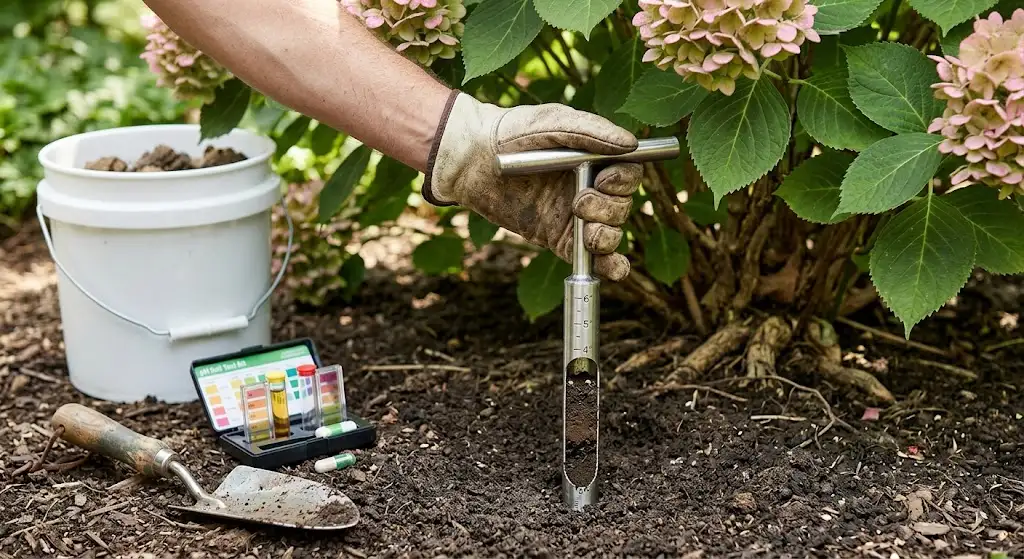 Proper soil sampling technique showing 4-6 inch depth collection around hydrangea drip line
Step 3: Interpret Results
Target values for blue blooms:
- pH: 5.0–5.5
- Aluminum: 40+ ppm (exchangeable)
- Phosphorus: Low to medium (<30 ppm)
Target values for pink blooms:
- pH: 6.2–6.8
- Aluminum: Any level (bound at high pH)
- Phosphorus: Medium to high (irrelevant for pink)
Critical note: If aluminum is below 20 ppm, you must add aluminum sulfate even if pH is correct. pH adjustment alone won’t create blue blooms without aluminum present. Below pH 5.0, stop acidifying entirely, you enter the aluminium-toxicity zone.
The Aluminum Mobility Threshold Framework
This is the proprietary framework that separates successful color changes from failures. Generic guides skip this math.
The Core Equation
Aluminum Mobility Index (AMI) = (Exchangeable Al ppm) × (pH Factor)
Where pH Factor is:
- pH 4.5–5.0: Factor = 1.0 (100% mobility)
- pH 5.1–5.5: Factor = 0.7 (70% mobility)
- pH 5.6–6.0: Factor = 0.3 (30% mobility)
- pH 6.1–6.5: Factor = 0.1 (10% mobility)
- pH > 6.5: Factor = 0.0 (0% mobility)
Threshold Values
Blue Bloom Threshold: AMI ≥ 28
- Example: 40 ppm Al × 0.7 (at pH 5.3) = 28 ✓
- Example: 60 ppm Al × 0.3 (at pH 5.8) = 18 ✗ (fails despite high Al)
Pink Bloom Threshold: AMI ≤ 5
- Example: 30 ppm Al × 0.1 (at pH 6.3) = 3 ✓
- Example: 10 ppm Al × 0.3 (at pH 5.8) = 3 ✓
Practical Application
Scenario 1: Soil test shows 25 ppm aluminum at pH 5.9
- AMI = 25 × 0.3 = 7.5
- Diagnosis: Borderline, will produce purple, not true blue
- Action: Lower pH to 5.4 OR add aluminum sulfate to reach 50 ppm
Scenario 2: Soil test shows 80 ppm aluminum at pH 6.8
- AMI = 80 × 0.0 = 0
- Diagnosis: Aluminum present but completely immobile
- Action: Must lower pH first; adding more aluminum is wasteful
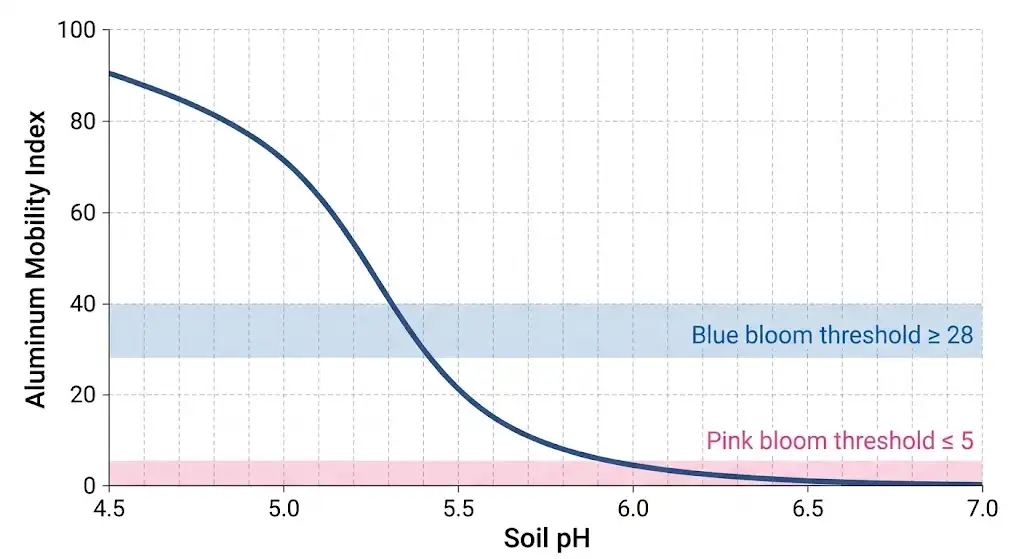 Graph showing Aluminum Mobility Index curves across pH ranges with blue/pink threshold lines marked
The counter-intuitive insight: more aluminum doesn’t compensate for wrong pH. Above about pH 6.5 the aluminium precipitates as insoluble aluminium hydroxide, so extra aluminium in the soil adds no blue at all. Fix pH first, then verify aluminum.
How to Make Hydrangeas Blue with Aluminium Sulphate
To make hydrangeas blue, lower soil pH to 5.0–5.5 with aluminium sulphate or elemental sulfur while holding exchangeable aluminium above 40 ppm (Aluminum Mobility Index ≥ 28).
Most guides hand you one dose for every garden, which is why results disappoint. A plant in pH 5.2 soil needs almost nothing; one in pH 6.8 soil needs a staged, multi-season campaign. Our 4-T Protocol (Test → Target → Treat → Track) replaces guesswork with a matrix: read across your current pH band and take your dose, method, and re-test date out the other side.
The 4-T Dosing Matrix by pH Band
| Current soil pH | Liquid drench dose | Dry granular dose (per mature plant) | Re-test interval |
|---|---|---|---|
| < 5.0 | None, hold treatment | None | 8 weeks |
| 5.0–5.5 (target zone) | 2.5 g/L (≈ 2 tsp/gal), once in spring | 15 g (1 tbsp), once | 6–8 weeks |
| 5.5–6.0 | 4 g/L (≈ 1 tbsp/gal) | 30 g (2 tbsp), split into 2 rounds | 4 weeks |
| 6.0–6.5 | 5 g/L max, two drenches 14 days apart | 45 g (3 tbsp), split into 3 rounds | 4 weeks |
| > 6.5 | 5 g/L max plus elemental sulphur | 60 g (4 tbsp) max/season, split, plus elemental sulphur | 4 weeks |
SAFETY CEILING, Never exceed 5 g per litre (≈ 1¼ tbsp per gallon) in a single liquid drench, or 60 g per plant per season granular. For area-based beds, note that aluminum sulfate at 1 lb per 100 sq ft lowers pH by ~1 point, while elemental sulfur needs only 0.5 lb per 100 sq ft (slower acting).
Step-by-Step Application Protocol
- Pre-water the root zone deeply 24 hours before applying. Never treat bone-dry soil.
- Gear up: gloves and eye protection, aluminium sulphate is a skin and eye irritant.
- Apply in early spring before bud formation:
- Liquid drench: dissolve your 4-T dose fully in warm water; apply 2–3 gallons per plant at the drip line.
- Granular: broadcast evenly under the drip line, keeping granules 15 cm (6 in) away from the stem; never pile against the trunk.
- Post-water with 1–2 inches (5–10 L) of clean water to move product into the root zone.
- Rinse foliage if splash or granules land on leaves, aluminium sulphate causes foliar burn.
- Mulch with a 3–4 inch layer of pine needles, pine bark, or shredded oak leaves; replenish annually.
- Re-test pH after 4 weeks. If still above 5.5, apply a half-rate repeat. Don’t exceed 2 lbs aluminum sulfate per application.
- Maintain with monthly drenches during the growing season: 1 tbsp aluminum sulfate per gallon of water (≈ 4 g/L, inside the safety ceiling).
Granular vs. liquid drench: liquid acts within weeks and is easier to control precisely; granular releases slowly and suits maintenance once target pH is reached. Learn how to use aluminum sulfate to lower soil pH safely across other acid-lovers too.
Fertilizer Selection for Blue Blooms
Use: 24-8-16 or 18-6-12 (low-phosphorus, acidifying formulas)
Avoid: Bloom boosters (high phosphorus like 15-30-15), see The Phosphorus Trap below.
SAFETY CALLOUT: Wear gloves and eye protection, avoid breathing dust, keep children and pets off the bed for 24 hours, and wash hands and tools after handling.
When to Apply: The Seasonal Bud-Set Calendar
Timing matters because of bud-set physiology. Hydrangea macrophylla sets next year’s flower buds on old wood in late summer, so aluminium availability during that bud-set window decides sepal colour the following spring. Applying after bud differentiation is too late for that cycle. Because macrophylla blooms on old wood, prune only right after flowering, never remove next year’s buds.
| Season | Action | Notes |
|---|---|---|
| Early spring (before bud break) | Primary application, full 4-T dose | USDA Zones 5–6 / RHS H4–H5: Mar–Apr; Zones 7–9 / RHS H6: late Feb–Mar |
| Late spring | Optional follow-up drench if re-test shows pH > 5.5 | Half-strength |
| Mid-summer | No application | Heat stress + bud differentiation window; peak root-burn risk |
| Early autumn | Optional light feed as next year’s buds set | Half-strength only |
| Winter (dormant) | No application | Roots inactive; salts leach and waste |
How to Make Hydrangeas Pink
To make hydrangeas pink, raise soil pH above 6.2 using dolomitic lime, which binds aluminum ions and prevents anthocyanin complexation, resulting in pink-red blooms.
Pink is easier than blue because you’re working with natural aluminum binding at higher pH levels.
Materials Required
- Dolomitic lime (preferred) or hydrated lime
- Wood ash (alternative pH raiser)
- High-phosphorus fertilizer (optional, reinforces pink)
- pH test kit; garden gloves and eye protection
Step-by-Step Pinking Protocol
- Test baseline soil pH.
- Calculate lime requirement: Dolomitic lime 1 lb per 100 sq ft raises pH ~0.5 points; hydrated lime 0.75 lb per 100 sq ft (faster but harsher).
- Apply dolomitic lime in fall or early spring: broadcast around the drip line, incorporate into top 2 inches, water thoroughly.
- Re-test after 4–6 weeks (lime acts slower than aluminum sulfate); apply a half-rate repeat if pH remains below 6.2.
- Maintain with 0.5 lb per 100 sq ft each spring; monitor pH quarterly.
- Optional: apply 15-30-15 fertilizer, phosphorus further binds any remaining aluminum.
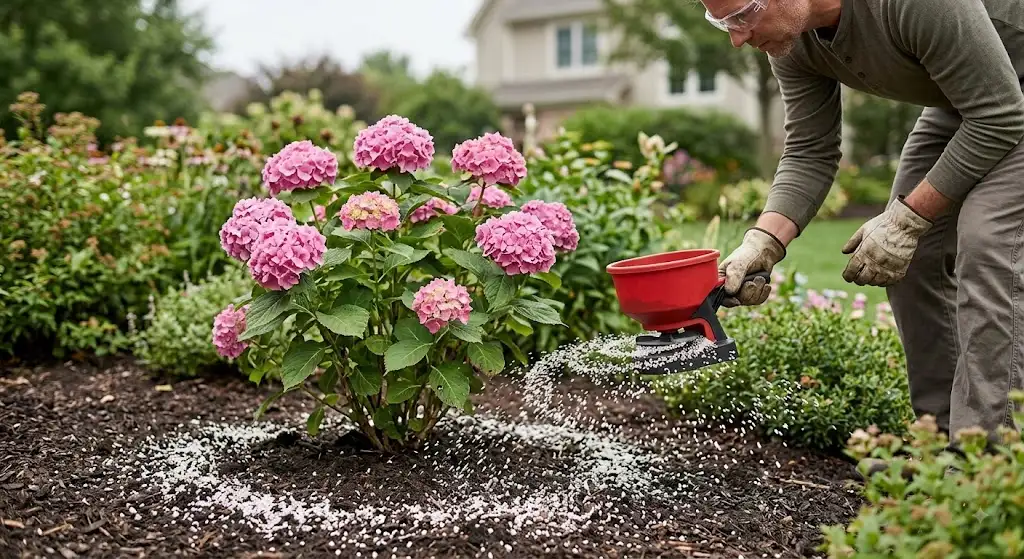 Dolomitic lime application showing broadcast spreader technique around hydrangea planting bed
Why Dolomitic Lime vs. Calcitic Lime?
Understanding calcitic vs dolomitic limestone is critical: hydrangeas benefit from the magnesium carbonate in dolomitic lime for chlorophyll production, and it raises pH more gradually than hydrated lime, reducing root-burn risk.
Pinking Timeline Expectations
- Week 1–2: Lime begins dissolving; pH starts rising
- Week 4–6: pH stabilizes; aluminum binding occurs
- Week 8–12: New flower buds develop pink coloration
- Next season: Full color change on all blooms
Note: You cannot change the color of existing blooms, only new growth responds.
The Phosphorus Trap: Why Color Changes Fail
⚠️ WARNING: The Phosphorus Lockout Effect. High-phosphorus fertilizers (bloom boosters, bone meal, 15-30-15 formulas) create insoluble aluminum phosphate (AlPO₄), permanently locking aluminum even at correct pH. This is the #1 cause of blueing failures.
The Chemistry
When phosphorus exceeds ~40 ppm in acidic soil, it reacts with aluminum: Al³⁺ + PO₄³⁻ → AlPO₄ (precipitate). The precipitate’s solubility product is ~10⁻²¹, essentially zero bioavailability. Your hydrangea can’t access the aluminum, so blooms stay pink despite perfect pH.
Identifying the Trap
- pH is 5.2–5.5 (correct for blue) ✓
- Aluminum sulfate applied regularly ✓
- Blooms remain pink or purple ✓
- Soil test shows phosphorus > 50 ppm ✓ → Diagnosis: phosphorus lockout
Breaking the Lockout
- Option 1, Leaching (6–12 months): Stop all phosphorus inputs; irrigate 2–3 inches/week. Slowest but safest.
- Option 2, Competitive ion addition (3–6 months): Apply iron sulfate (FeSO₄) at 2 lbs per 100 sq ft; iron competes for phosphorus binding, partially freeing aluminum. Faster but monitor closely.
- Option 3, Soil replacement (immediate): Remove top 6–8 inches; replace with low-phosphorus planting mix. Most expensive, fastest.
Prevention Protocol
Never use near blue-seeking hydrangeas: bone meal (0-12-0), bloom boosters (high middle number), composted manure (often high-P), lawn fertilizer runoff.
Safe formulas: 24-8-16, 18-6-12, aluminum sulfate alone. Verify N-P-K ratios with our hydrangea fertilizer blend calculator before application.
Potted Hydrangeas: Adjusted Doses & Tips
Containers buffer far less than open ground, so pH swings faster and salts concentrate quickly, both a benefit and a hazard. Start with ericaceous compost (check the bag for pH 4.5–5.5) and water with rainwater where possible. If you’ve just repotted, expect mild transplant shock: hold all treatment 4–6 weeks while roots re-establish.
Halve the concentration in pots: max 2–2.5 g/L liquid drench, or 15 g granular per 30 cm pot per season. Re-test every 3–4 weeks and flush the pot each spring to prevent salt build-up.
Aluminium Sulphate vs. Other Soil-Acidifying Options
Acidifying soil is a team sport: many experienced growers use elemental sulphur for the long-term baseline pH and aluminium sulphate for the aluminium push that actually blues the sepals.
| Product | Speed | Supplies aluminium? | Relative cost | Best use-case |
|---|---|---|---|---|
| Aluminium sulphate | Fast (weeks) | Yes | Medium | Quick blueing + direct Al³⁺ supply |
| Elemental (garden) sulphur | Slow (3–6 months, microbe-dependent) | No | Low | Long-term pH lowering, pre-planting |
| Ammonium sulphate | Moderate | No (supplies nitrogen) | Low–medium | Maintenance feeding for acid-lovers |
| Ericaceous compost / peat / pine needles | Slow | No | Variable | Mulching, containers, organic programmes |
Pairing slow elemental sulphur with fast aluminium sulphate gives baseline control plus a quick colour response, RHS guidance on acidifying soil backs this split role. For the sulphur side, see our breakdown of elemental sulphur fertilizer vs. sulphate forms and how to lower soil pH fast and safely.
How Much Is Too Much? Toxicity, Root Burn & Rescue
WARNING: Aluminium sulphate is a salt. Over-applied, it scorches roots, stalls growth, and triggers nutrient lockout, especially phosphorus and iron. More product never means bluer flowers; it means a dying plant.
Symptoms of over-application:
- Leaf-margin necrosis, brown, scorched edges creeping inward
- Wilting despite moist soil (damaged roots can’t drink)
- Stunted new growth; short, browned roots
- Yellowing between leaf veins (iron/phosphorus lockout)
- White salt crust on the soil surface
Rescue steps if you’ve over-applied:
- Stop all aluminium sulphate and acidifying feeds immediately.
- Flush the root zone with 15–20 L (4–5 gal) of water over an hour to leach excess salts.
- Raise pH in severe cases: work 50–100 g of garden lime into topsoil at the drip line to lock remaining Al³⁺ out of solution, our safe garden liming guide has full rates.
- Remove crusted mulch or surface soil carrying visible salt; wait 4 weeks before re-testing and cut future rates by 30%.
- Withhold treatment until a re-test confirms recovery and new growth looks healthy.
Timeline: What to Expect Month-by-Month
Color change isn’t instant, only new growth responds. Here’s the realistic progression:
Month 1: Application Phase
Week 1: Apply aluminium sulphate or lime. Week 2–3: pH shifts (±0.3 points). Week 4: Re-test; apply half-rate if target missed. Visible change: none on existing blooms.
Month 2: Stabilization Phase
Week 5–8: pH stabilizes; aluminum mobility adjusts (blueing) or binding occurs (pinking). Possible leaf chlorosis if pH dropped too fast (apply iron chelate); existing blooms unchanged.
Month 3: Bud Development Phase
Week 9–12: New buds form with adjusted chemistry; sepals (not petals) show the first color shift.
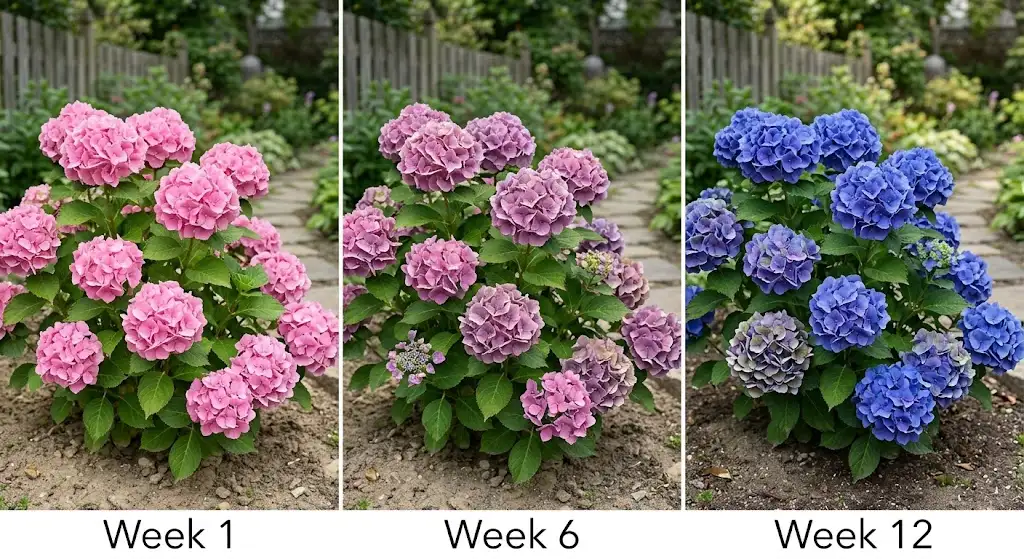 Three-panel photo progression showing hydrangea buds at week 1 (pink), week 6 (purple transition), week 12 (blue)
Month 4–5: Bloom Expression Phase
Week 13–20: Flowers open with new color, 60–80% change on new blooms, with some within-plant variation from micro-environments.
Month 6+: Full Expression
100% color change on all new growth; consistent color across the plant. On alkaline soils (pH > 6.5), expect a full, even blue to take 2–3 growing seasons of staged treatments.
Documented Timeline Example
Case Study: H. macrophylla ‘Nikko Blue’, Starting pH 6.4, pink blooms. Week 0: 1.5 lbs aluminum sulfate per 100 sq ft. Week 4: pH 5.8. Week 5: 0.75 lbs half-rate. Week 8: pH 5.4, Al 42 ppm. Week 12: purple-blue buds. Week 16: true blue blooms. Total: 16 weeks.
Troubleshooting Common Problems
Problem: Blooms Stay Pink Despite Low pH
Work this checklist before increasing any dose:
- ✓ pH below 5.5? (If no, acidify first, the #1 cause of “failed” treatments)
- ✓ Aluminum > 40 ppm? (If no, add aluminum sulfate)
- ✓ Phosphorus < 30 ppm? (If no, see Phosphorus Trap)
- ✓ Using low-P fertilizer? (If no, switch formula)
- ✓ Correct species? H. paniculata, H. arborescens, H. quercifolia, and locked-white cultivars cannot turn blue, ever.
Problem: Blooms Turn Blue Then Revert to Pink
Cause: pH drift upward, natural buffering, decomposing organic matter, or hard tap water (calcium/magnesium push pH back up between treatments; many municipal sources are pH 7.5–8.0).
Solution: Switch to rainwater where possible; test irrigation water pH; resume monthly maintenance drenches (1 tbsp/gal); mulch heavily with acidic organic matter.
Problem: Leaves Yellow After Amendment
Cause: pH dropped too quickly → iron/manganese lockout.
Solution: Apply iron chelate (EDDHA formula) as foliar spray; cut next amendment rate 50%; water deeply to dilute soil solution.
Problem: Only Part of Plant Changes Color
Cause: pH micro-zones from uneven application, drainage differences, or root competition.
Solution: Broadcast amendments across the entire drip line + 1 ft beyond; core aerate; test soil from multiple locations.
Problem: No Change After One Season
Causes: insufficient time (full blue takes 2–3 seasons on alkaline soil); treatment applied after late-summer bud-set missed that bloom cycle; granules never watered in or applied to dry soil.
Solution: Follow the bud-set calendar, pre- and post-water every application, and track readings on your 4-T sheet.
Conclusion & Key Takeaways
Changing hydrangea color requires manipulating two variables, soil pH and aluminum bioavailability. Neither works alone.
- Blue blooms need pH 5.0–5.5 AND aluminum > 40 ppm (Aluminum Mobility Index ≥ 28); dose by your pH band, never a flat label rate.
- Pink blooms need pH > 6.2 via dolomitic lime, aluminum binds automatically at high pH.
- Only H. macrophylla and H. serrata respond; paniculata, arborescens, quercifolia, and locked-white cultivars are immune.
- The Phosphorus Trap destroys blueing efforts, avoid bone meal and bloom boosters.
- Respect safety ceilings: max 5 g/L drench, 60 g/plant/season; halve doses in pots.
- Time applications to bud-set (early spring primary, no mid-summer/winter) and watch hard tap water.
- Timeline is 12–16 weeks per cycle; 2–3 seasons for full blue on alkaline soil.
- Test → Target → Treat → Track: log every reading so doses are decided by data, not mood.
The difference between purple frustration and blue success is measuring the right variables and respecting the chemistry.
Sources
- Growing Tips: Hydrangeas, Color and Fertilizing, University of Massachusetts Amherst Extension; backs To make hydrangeas blue, lower pH to 5.0–5.5 and hold exchangeable aluminum above 40 ppm using aluminium sulphate (labeled aluminum sulfate in the US)..
- How Are Hydrangea Flower Colors Determined? (FS309E), Washington State University Extension; backs Blue blooms need pH 5.0–5.5 AND aluminum > 40 ppm (Aluminum Mobility Index ≥ 28); dose by your pH band, never a flat label rate..
- Acidifying Soil for Blueberries and Ornamental Plants in the Yard and Garden, Oregon State University Extension; backs How to Make Hydrangeas Blue with Aluminium Sulphate To make hydrangeas blue, lower soil pH to 5.0–5.5 with aluminium sulphate or elemental sulfur while holding exchangeable aluminium above 40 ppm (Aluminum Mobility Index ≥ 28)..
- How To Change Your Soil's pH, Iowa State University Extension and Outreach; backs Calculate lime requirement: Dolomitic lime 1 lb per 100 sq ft raises pH ~0.5 points; hydrated lime 0.75 lb per 100 sq ft (faster but harsher)..
Frequently Asked Questions
How long does it take to change hydrangea color?
Color change takes 12-16 weeks from initial soil amendment application to full bloom expression. pH shifts begin within 2-3 weeks, but flower buds need 8-12 weeks to develop with the new soil chemistry. Existing blooms won’t change color, only new growth responds to pH adjustments. [Colorado State University Extension]
Can I use vinegar to change hydrangea color?
Vinegar (acetic acid) temporarily lowers soil pH but isn’t recommended for hydrangea color change. It requires frequent reapplication (every 2-3 weeks), provides no aluminum, and can harm soil microbiology. Aluminum sulfate is superior because it lowers pH AND adds bioavailable aluminum in one application. [University of Minnesota Extension]
Why won't my hydrangeas turn blue even with aluminum sulfate?
Three common causes: (1) Soil pH still too high, aluminum becomes insoluble above pH 6.0; (2) Phosphorus lockout, high phosphorus levels bind aluminum into insoluble aluminum phosphate; (3) Insufficient aluminum concentration, need 40+ ppm exchangeable aluminum. Re-test soil for all three factors before applying more amendments.
Do all hydrangeas change color with pH?
No. Only Hydrangea macrophylla (mophead and lacecap varieties) change color based on soil pH and aluminum. White hydrangeas, oakleaf hydrangeas (H. quercifolia), panicle hydrangeas (H. paniculata), and smooth hydrangeas (H. arborescens) bloom white, cream, or pink regardless of soil chemistry. Check your species before attempting color change.
What's the fastest way to make hydrangeas blue?
The fastest method combines aluminum sulfate application (1 lb per 100 sq ft) with low-phosphorus fertilizer (24-8-16) and acidic mulch (pine needles). Apply in early spring before bud formation, water deeply, and follow with monthly drenches (1 tbsp aluminum sulfate per gallon). Expect first color change in 12 weeks, full blue by 16 weeks.
How much aluminium sulphate should I use to make hydrangeas blue?
Dissolve 4 g of aluminium sulphate per litre of water (about 1 tablespoon per gallon) and apply as a soil drench at the drip line in early spring. Never exceed 5 g/L per drench or 60 g per plant per season, and re-test pH after four weeks.
Why didn't my hydrangea turn blue after using aluminium sulphate?
The usual causes are soil pH still above 5.5, phosphorus lockout from high-P fertilizers, exchangeable aluminum below 40 ppm, hard tap water raising pH between treatments, or owning a species that cannot turn blue. Re-test pH, aluminum, and phosphorus, and check irrigation water hardness before re-dosing.
Can white hydrangeas turn blue?
No. White cultivars such as ‘Annabelle’, ‘Incrediball’, ‘Limelight’, and white macrophyllas lack the delphinidin-3-glucoside pigment pathway that binds aluminum, so no dose changes their color. Only Hydrangea macrophylla and Hydrangea serrata cultivars with pink or blue genetics respond to pH and aluminum manipulation.
Is aluminium sulphate safe for potted hydrangeas?
Yes, at halved strength: use a maximum 2–2.5 g/L liquid drench or 15 g granular per 30 cm pot per season. Start in ericaceous compost, water with rainwater where possible, re-test every 3–4 weeks, and flush the pot each spring to prevent salt build-up and root burn.
Numbers and claims in this guide were last checked on 28 September 2026: how we check our sources.