October 3, 2026 · 8 min read · Azmi Mhamed
Lime, Gypsum and Sulfur Prices: What Soil Amendments Actually Cost
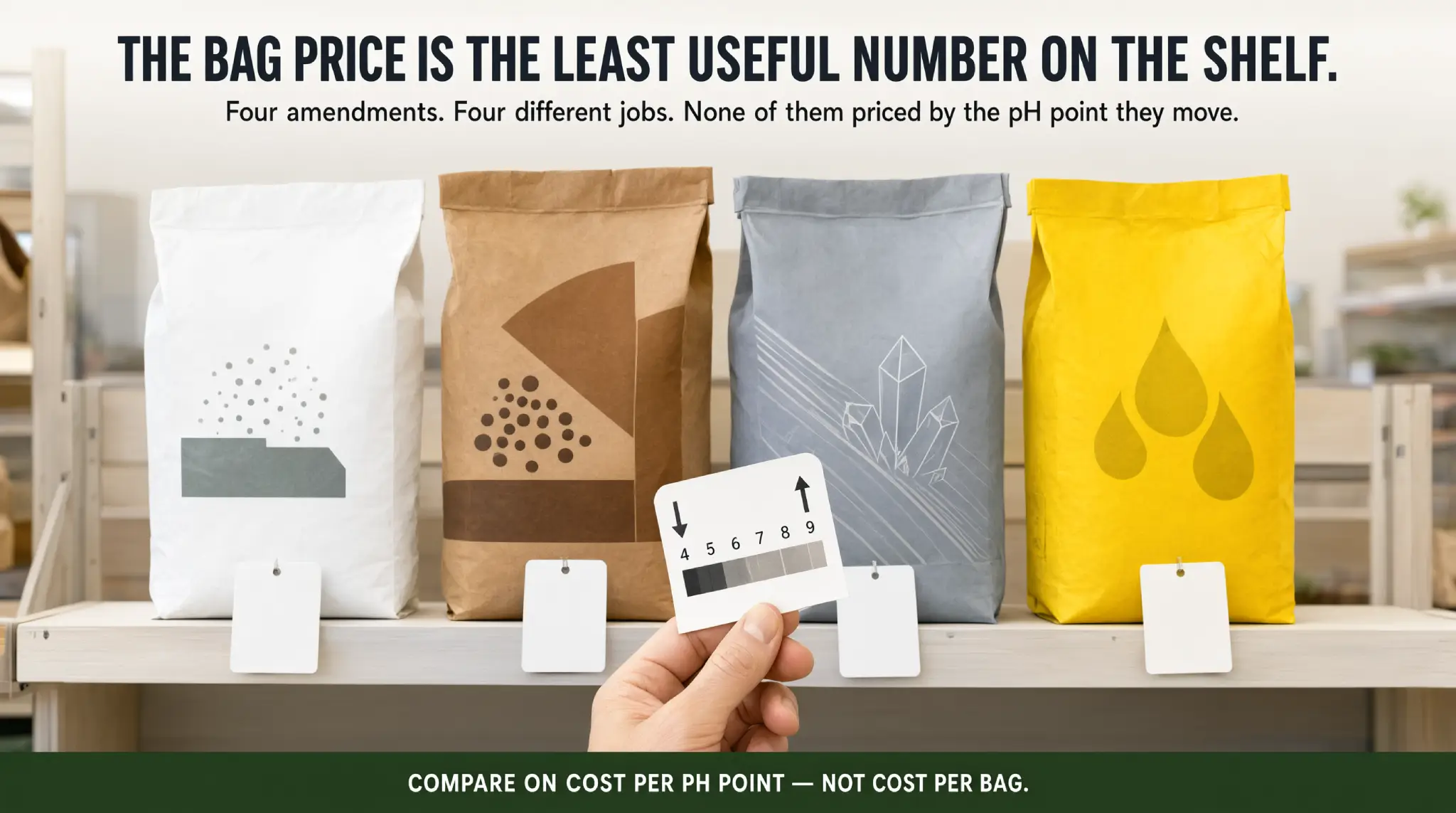
Bag prices for pelletized lime, agricultural lime, gypsum and elemental sulfur are the least useful number on the shelf, because the four materials do different jobs and none of them is priced by the work it does. A $7 bag of pelletized lime can be the most expensive thing you buy all season, and a $12 bag of sulfur can be the cheapest, if you end up applying the wrong one. This guide explains what each amendment is actually for, how to turn a bag price into a cost per 1,000 square feet, and how to get to the only number that compares anything: the cost of one pH point moved on your soil.
Prices below are worked examples, not quotes. Retail lime and sulfur prices swing by region, delivery distance and season, and a bag price that is accurate this month will be wrong next spring. Work the method with the number on your own shelf.
What you are actually buying
Liming material (calcitic or dolomitic limestone, ground and sold as ag lime or pelletized lime) neutralises soil acidity. It is sold by the ton in bulk and by the 40 or 50 pound bag at retail, and it is the only one of the four that raises pH in an acid soil.
Gypsum is calcium sulfate. It supplies calcium and sulfur and it is useful on sodic soil, but it does not neutralise acidity at all. It is the amendment most often bought for the wrong reason.
Elemental sulfur lowers pH. Soil bacteria oxidise it to sulfate, which takes weeks to months, so a sulfur application is a slow lever rather than a quick fix.
Aluminum sulfate lowers pH faster than elemental sulfur but needs roughly six times the material to do it, and it adds aluminium to the soil. It is not a bulk amendment: see aluminium sulfate for soil pH for what it is actually good for.
Why lime prices are not comparable
Two bags can both say “50 lb” and deliver very different amounts of neutralising work, because the useful fraction depends on purity and on how finely it was ground. The effective neutralizing value (ENV) is a way to quantitatively evaluate limes based on both purity and particle size. Bagged products print an ECCE or ENP figure on the label, typically between about 55 and 100 percent, and that figure is the multiplier you must apply before any price comparison means anything.
All published lime rates assume a standard agricultural lime. If your product lists an ENV of 0.60, you need more of it, pound for pound, than a product at 0.95, so a cheaper bag at half the neutralising value is not cheaper at all.
| Material | What it moves | Example retail band | Compare using |
|---|---|---|---|
| Ag lime, bulk | pH up | Lowest cost per ton, delivery extra | Cost per ton ÷ ENP |
| Pelletized lime | pH up | Highest cost per pound | Cost per pound ÷ ENP |
| Gypsum | Nothing pH-related | Mid range | Cost per ton of Ca + S supplied |
| Elemental sulfur | pH down | High cost per pound, very low rate | Cost per pH point, with a buffer test |
Cost per 1,000 square feet
Work it in three steps. First, take the rate from your soil test, not from the bag: extension labs report lime in tons per acre or pounds per 1,000 square feet, and 1 ton per acre is about 46 pounds per 1,000 square feet. Second, divide the bag price by the pounds in the bag to get a price per pound. Third, multiply the price per pound by the rate.
A worked example: a 40 pound bag at an example price of $10 is $0.25 per pound. A rate of 40 pounds per 1,000 square feet costs $10 per 1,000 square feet for that application; the same rate on a bulk order at an example $35 per ton is $0.0175 per pound, or $0.70 per 1,000 square feet. The bag is convenience priced, and on a 5,000 square foot lawn the difference is real money.
Pelletized lime costs more per pound because it is granulated so it will run through a spreader without dust or bridging. That is a legitimate reason to buy it on a small lawn with a broadcast spreader, and no reason at all to buy it on an acre. The mechanics of the application itself (rates, timing, split doses and what goes wrong) are covered step by step in how to apply lime to a garden.
The only number worth comparing: cost per pH point
pH change per pound is not linear. A soil at pH 5.0 needs far more lime to reach 6.0 than a soil at 5.5 needs to reach 6.0, and a heavy clay needs more than a sand at the same starting pH, because clay and organic matter buffer the change. That is why two lawns can be limed at the same rate and end up a point apart.
Compare amendments on cost per pH point instead of cost per bag:
- Take the lime requirement from a soil test with a buffer pH reading.
- Apply the ENP of the product you are buying to that rate.
- Add the material cost only. Spreading, delivery and your time are separate lines.
- Retest after the material has had a full season to react, then divide the spend by the points you actually gained.
If you do not have a buffer figure yet, you are guessing. A lab test costs a few dollars more than a kit and comes back with the number the whole calculation hangs on, and the lime requirement calculator turns that report into a rate in pounds per 1,000 square feet.
Gypsum: the amendment that does not move pH
Gypsum is bought most often by people trying to raise pH on acid soil or “break up” clay. It does neither. Gypsum is not a liming material. The sulfate ion in gypsum does not decrease soil pH or reduce soil alkalinity. In a home garden the clay-loosening promise is equally empty: Gypsum does not reduce or prevent soil compaction, dissolve hardpan, soften clay soils, or convert clay to loam.
What gypsum genuinely does is supply calcium and sulfate, and replace sodium on the exchange complex of a sodic soil. If your soil test shows high sodium, gypsum is the correct purchase and often the cheapest fix available. If it does not, gypsum is a bag of calcium sulfate you did not need. See gypsum vs lime for soil for the full comparison, and the gypsum requirement calculator if a test does show sodium.
Sulfur: cheaper per application, slower and split
Elemental sulfur is the safest option; it is relatively inexpensive and available via local agriculture suppliers and garden centers. It is cheap per application because the rate is low (pounds per 1,000 square feet rather than tens of pounds), but it works slowly, because soil bacteria have to oxidise it before the soil solution acidifies.
Split it. If more is required, use split applications of 20 lb S/1,000 sq ft and apply in succeeding years. Heavy single applications risk salt damage and root burn, and the extra material sitting unreacted in the soil buys you nothing. For a fast, local correction (a container of blueberries, one bed of azaleas), the precision pH-down calculator works from a measured pH instead of a guess.
Buying mistakes that cost the most
- Ignoring ENP. The cheapest bag per pound can be the most expensive per point moved.
- Buying gypsum to fix pH. It will not change the reading on your meter.
- Applying one oversized dose. Over-liming is slower and more expensive to undo than doing it in two seasons.
- Skipping the test. Every amendment decision downstream depends on a starting pH, a buffer pH and a texture estimate.
- Comparing bag to ton without the delivery line. Bulk lime is cheap material with a delivery charge attached; run the arithmetic for your actual acreage.
The cheapest correct sequence
Test first, get a buffer pH, work the lime requirement in pounds per 1,000 square feet, apply the ENP of the product in front of you, buy bulk if the area and access justify it, and split anything large over two seasons. Buy gypsum only when a test shows sodium. Buy sulfur only when the target is downward, and split it. The amendment is rarely the expensive part: the expensive part is applying the wrong one and retesting a year later.
Sources
- Soil Acidity and Liming for Agricultural Soils, NC State Extension; backs The effective neutralizing value (ENV) is a way to quantitatively evaluate limes based on both purity and particle size..
- Soil pH and Lime Requirement, University of Wisconsin-Madison Extension; backs If more is required, use split applications of 20 lb S/1,000 sq ft and apply in succeeding years..
- How To Change Your Soil’s pH, Iowa State University Extension and Outreach; backs Elemental sulfur is the safest option; it is relatively inexpensive and available via local agriculture suppliers and garden centers..
- Nevada Soil Amendment Myths, University of Nevada, Reno Extension; backs The sulfate ion in gypsum does not decrease soil pH or reduce soil alkalinity..
- Using Soil Amendments in Yolo County Gardens, University of California Agriculture and Natural Resources; backs Gypsum does not reduce or prevent soil compaction, dissolve hardpan, soften clay soils, or convert clay to loam..
Frequently Asked Questions
How much does it actually cost to raise soil pH by half a point?
Take the rate from a soil test with a buffer pH, apply the ENP of the product on the label, multiply by the price per pound of that product, and you get a cost per 1,000 square feet for that application. Work the example with the number on your own bag rather than a published average, because lime prices vary by region and by delivery distance, and the neutralising value of the bag in front of you decides the real cost as much as the price does.
Is pelletized lime worth the extra money over bulk ag lime?
On a small lawn with a broadcast spreader, usually yes: it flows, does not dust, and is easy to apply evenly. On an acre or more, no: bulk ag lime costs far less per ton and the spreading is done with equipment that handles fines. Compare the two on cost per neutralising unit after applying the ENP printed on each label, not on the bag price.
Does gypsum lower soil pH?
No. Gypsum is calcium sulfate and is not a liming material, so it will not raise or lower soil pH, and it will not soften clay, dissolve hardpan or convert clay into loam. It supplies calcium and sulfur, and it is genuinely useful when a soil test shows high sodium, because the calcium replaces sodium on the exchange complex.
How much sulfur can I apply at one time?
Split it. Where a larger correction is needed, extension guidance is split applications of 20 lb elemental sulfur per 1,000 square feet in succeeding years rather than one heavy dose, because a single large application risks salt damage while the bacteria work through it. Sulfur takes weeks to months to act, so there is no advantage in rushing it.
Should I buy lime in bags or have it delivered in bulk?
Run the arithmetic for your actual area. Bulk lime is dramatically cheaper per ton but carries a delivery charge and needs somewhere to put it and a way to spread it; bags cost more per pound and are the sensible choice for a few thousand square feet. Add the delivery line before comparing, then apply the ENP of each material so the two figures describe the same amount of neutralising work.
Numbers and claims in this guide were last checked on 28 September 2026: how we check our sources.