October 3, 2026 · 8 min read · Azmi Mhamed
Nutrient Deficiency Chart: Leaf Symptoms by Deficiency
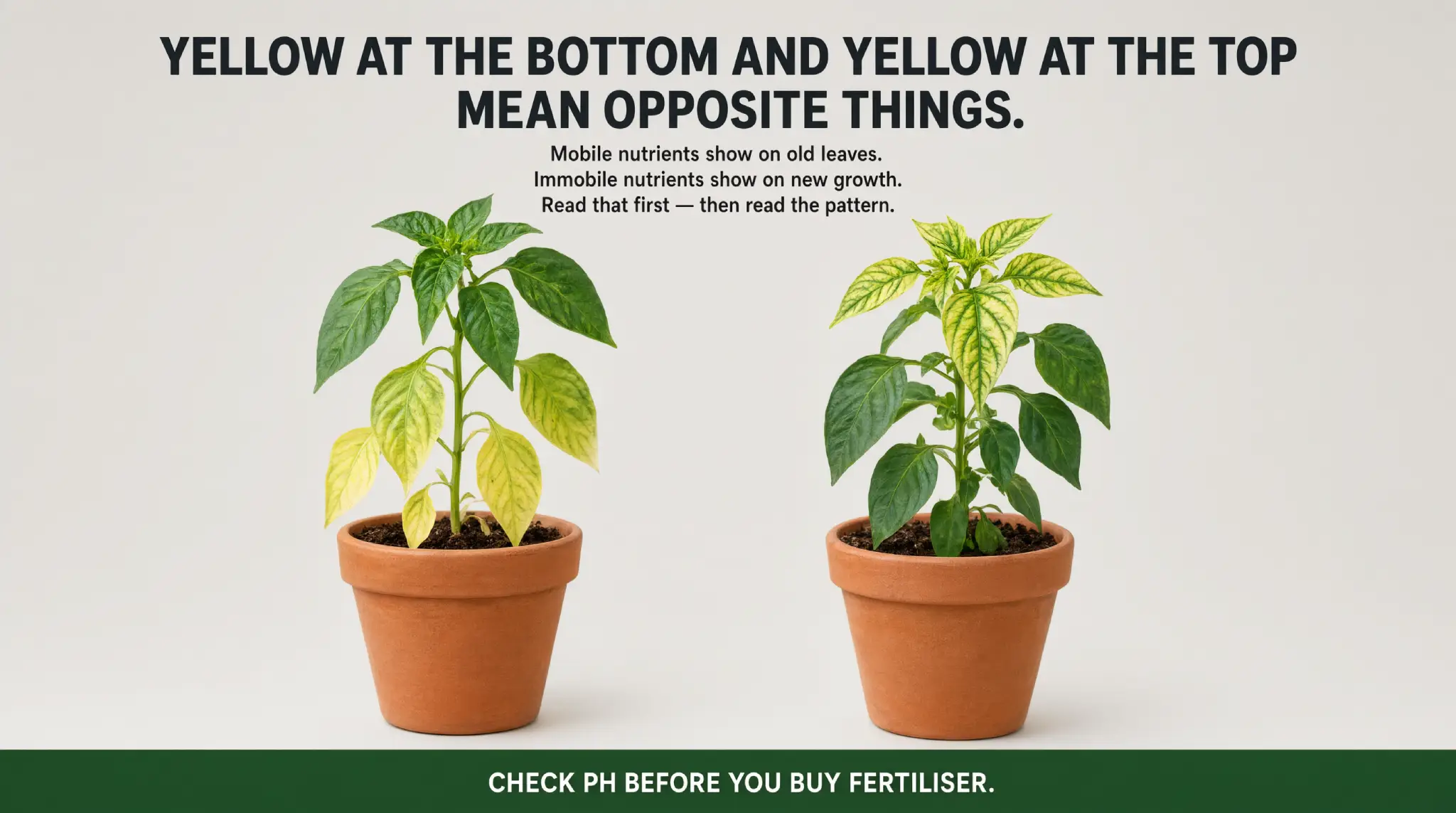
A nutrient deficiency chart tells you which leaf to look at before it tells you what is wrong. Yellowing at the bottom of the plant and yellowing at the growing tip mean almost opposite things: one says the plant moved an element out of old tissue to feed new tissue, the other says the element could not get into the new tissue at all. Read the chart in that order (where the symptom starts, then what it looks like) and you narrow twelve possible deficiencies down to two or three before you touch a bag of fertiliser.
Visual diagnosis is a starting position, not a verdict. Drought, salt burn, herbicide drift and root disease all produce yellow leaves, and treating a pH problem with fertiliser wastes the money and delays the fix. This guide gives the chart, the reasoning behind it, the common lookalikes, and the test to run before you act.
The rule that lets you read any deficiency chart
Plants can move some elements from old tissue to new tissue when supply runs short, and cannot move others. Those are the mobile and immobile nutrients, and mobility decides where the first symptom appears. Deficiency symptoms of mobile nutrients will appear first in older parts of the plant, while symptoms for immobile nutrients will be seen first in new growth.
In practice: deficiency symptoms for mobile nutrients in plants like nitrogen, phosphorus, potassium and magnesium are first expressed in older leaves. Calcium, iron, manganese, zinc, boron and copper are immobile, so their symptoms show on the youngest leaves and the growing points, where the plant cannot cannibalise a substitute. Sulfur behaves like an immobile nutrient, showing up on young leaves first, which is what separates it from nitrogen in the field.
Nutrient deficiency chart
| Nutrient | Mobility | Starts on | What you see | Confirm with |
|---|---|---|---|---|
| Nitrogen (N) | Mobile | Old, lower leaves | Uniform pale green to yellow, whole plant stunted, oldest leaves yellow then brown | Soil test N or tissue test |
| Phosphorus (P) | Mobile | Old, lower leaves | Dark green with purple or reddish tint on leaves and stems, short spindly growth | Soil test P; check pH first |
| Potassium (K) | Mobile | Old leaf margins | Marginal scorch, brown edges rolling inward, weak stalks | Soil test K |
| Magnesium (Mg) | Mobile | Old leaves | Interveinal chlorosis with a green arrowhead along the midrib | Soil test Ca:Mg ratio |
| Sulfur (S) | Immobile | Young, upper leaves | Uniform pale yellow, no spots, whole plant pale | Tissue test; soil S |
| Calcium (Ca) | Immobile | New leaves, tips, fruit | Distorted new growth, hooked tips, blossom-end rot | Soil pH and irrigation |
| Iron (Fe) | Immobile | Newest leaves | Interveinal chlorosis, veins stay dark green | Soil pH: usually too high |
| Manganese (Mn) | Immobile | New leaves | Interveinal chlorosis with mottling and small dead spots | Soil pH and tissue test |
| Zinc (Zn) | Immobile | New leaves | Small leaves, short internodes, rosetted shoots, striping | Tissue test |
| Boron (B) | Immobile | Growing points | Terminal bud dies, brittle hollow stems, deformed fruit | Tissue test |
| Copper (Cu) | Immobile | New leaves | Pale tips, wilting of new growth, dieback | Tissue test |
| Molybdenum (Mo) | Immobile | Old then middle leaves | Cupped, scraggly leaf development | Soil pH: usually too low |
Macronutrient symptoms in detail
Nitrogen is the most common deficiency and the easiest to misread, because uniform yellowing also happens when a plant is waterlogged. The tell is position: nitrogen shows on the oldest leaves first and moves up, and in cereals the yellowing runs back from the leaf tip in a V shape. Legumes that started slowly and never developed nodules show it too, even on ground that tests adequate.
Phosphorus produces dark green leaves with a purple or red cast, most visible on stems and leaf undersides in cool spring weather. Purple colour alone is not a diagnosis: cold soil blocks uptake even when the test is fine, and the colour fades as roots catch up.
Potassium burns from the edge inward. Margins go chlorotic then necrotic, spots cluster along the edge, and stalks lodge. Because potassium is mobile, the damage starts on the older leaves while the growing point stays green.
Magnesium is the classic interveinal chlorosis with a difference: the veins and midrib stay green in an arrowhead or Christmas-tree pattern on the oldest leaves. It shows up in sandy soils and in pots that have been leached for a season.
Sulfur looks like nitrogen on the wrong leaves. Sulfur deficiency shows as young leaves that are pale green or light yellow without any spots, and the symptoms resemble those of nitrogen deficiency. Young leaves first is the whole difference, and it is why a tissue test is worth the fee before you spread elemental sulfur.
Calcium does not move at all, so the damage is structural: distorted new leaves, hooked tips, growing points that stall, and blossom-end rot in fruit that is not calcium-hungry so much as irregularly watered. Soil pH and irrigation consistency decide calcium uptake more than the amount in the soil.
Micronutrient symptoms in detail
Iron is the one growers meet most often, because it is pH-controlled rather than quantity-controlled. Iron deficiency is common early in the year and in basic (high pH) soils. The pattern is sharp: newest leaves go yellow between the veins while the veins stay dark green, with no brown spotting. Raising the pH of an alkaline soil, or chelating the iron, fixes it; broadcasting more iron sulfate does not.
Manganese mimics iron but messier, with mottling and small necrotic spots inside the yellow area, and it appears on slightly acid to alkaline soils too. Zinc shows as small leaves, shortened internodes and rosetted shoots, common in fruit trees and corn on high pH ground. Boron kills the terminal bud first, which is unmistakable once you have seen it. Copper wilts and pales the newest growth. Molybdenum is the exception that runs backwards: it is less available in acid soil, so a pH that is too low can induce it.
What it is not: the lookalikes
Deficiencies tend to form symmetrical patterns, where both sides of the leaf or plant part show the same pattern. Disease and spray damage are usually lopsided or scattered, and they follow the lesion rather than the vein. Beyond that:
- Salt or fertiliser burn browns leaf margins with a yellow halo, separated from green tissue, starting wherever the granules landed.
- Drought wilts uniformly and picks up from the growing point once water returns; it does not leave a clean interveinal pattern.
- Herbicide damage distorts growth in ways no deficiency does: cupped, strapped, fern-like or swollen tissue with no chlorosis that follows the veins.
- Root disease and compaction yellow the whole plant at once, because the entire root system is compromised rather than one element.
Confirm before you treat
Three checks, in this order. First, read the position of the symptom and narrow the chart to one or two candidates. Second, test the soil, pH especially, because a pH outside the availability window makes an adequate soil look deficient and no amount of fertiliser will fix it. Third, if the candidate still looks likely, run a plant tissue test: it measures what actually got into the plant, which is the question a soil test cannot answer. Where the two disagree, the CEC calculator shows how much the soil can hold and release in the first place, and what a lab analysis adds that a home kit cannot explains why the paid test is the one worth acting on.
Keep the sample honest while you do it. Take several plants from the affected area and several from healthy ground nearby, wash off dust, and send the tissue in a paper bag rather than plastic, because a sample that rots in transit tells you nothing. If more than one nutrient is short at the same time, or the plant is also under water or pest pressure, the visual pattern will be misleading and the lab numbers are the only thing worth acting on.
Work the target band from the soil pH by crop reference table or from a species record in the plant pH database, and pick the tool with the right test for the job. Where the fix is a foliar or a sulfate, iron sulfate and elemental vs sulfate sulphur cover the difference between correcting pH and feeding the plant.
Sources
- Identifying Nutrient Deficiencies in Ornamental Plants, University of Delaware Cooperative Extension; backs Deficiency symptoms of mobile nutrients will appear first in older parts of the plant, while symptoms for immobile nutrients will be seen first in new growth..
- Diagnosing Nutrient Deficiencies, University of Missouri Integrated Pest Management; backs deficiency symptoms for mobile nutrients in plants like nitrogen, phosphorus, potassium and magnesium are first expressed in older leaves..
- Plant Nutrient Deficiency Symptoms, Montana State University Extension; backs Iron deficiency is common early in the year and in basic (high pH) soils..
- Nutrient Deficiencies in Plants, West Virginia University Extension; backs Sulfur deficiency shows as young leaves that are pale green or light yellow without any spots, and the symptoms resemble those of nitrogen deficiency..
- Guide to Symptoms of Plant Nutrient Deficiencies, University of Arizona Cooperative Extension; backs Deficiencies tend to form symmetrical patterns, where both sides of the leaf or plant part show the same pattern..
Frequently Asked Questions
How do I tell nitrogen deficiency from sulfur deficiency?
By where it starts. Nitrogen is mobile, so the plant strips it from the oldest leaves and the yellowing begins at the bottom and moves up. Sulfur behaves like an immobile nutrient, so the pale yellowing begins on the youngest leaves at the growing tip. Both produce an overall pale plant with no spotting, so position is the only reliable field difference between them.
Why are my new leaves yellow with green veins?
That pattern, interveinal chlorosis on the newest growth, points at iron first and then manganese or zinc. Iron uptake is controlled by pH rather than by how much iron is in the soil, so check pH before buying anything: above about 7.5 the iron in the soil is present but unavailable. Waterlogged roots produce the same look on any plant, so rule that out too.
Can I diagnose a nutrient deficiency from leaf colour alone?
Not safely. Drought, salt burn, herbicide drift, root disease and cold soil all produce yellow or purple leaves, and more than one nutrient can be short at the same time. Read the position first to narrow the chart, then confirm with a soil test that includes pH, and use a plant tissue test when the soil test and the symptoms disagree.
Why have my lower leaves turned purple or dark red?
Phosphorus is the usual cause, but cool soil blocks phosphorus uptake even when the test reads adequate, which is why seedlings go purple in spring and recover as it warms. A genuine phosphorus deficiency shows as dark green leaves with a purple or reddish tint on stems and older leaves, plus stunted, spindly growth that does not improve with warmth.
Does a standard soil test show nutrient deficiencies?
A soil test shows what is in the soil and, more importantly, the pH that decides whether the plant can reach it. It does not show what actually got into the tissue, which is why a plant tissue test is the confirmation when symptoms persist on a soil that tested adequate. Use both: soil test to fix the environment, tissue test to check the plant.
Numbers and claims in this guide were last checked on 28 September 2026: how we check our sources.