October 3, 2026 · 9 min read · Azmi Mhamed
Perlite vs Vermiculite: Which Soil Amendment Does Your Mix Need?
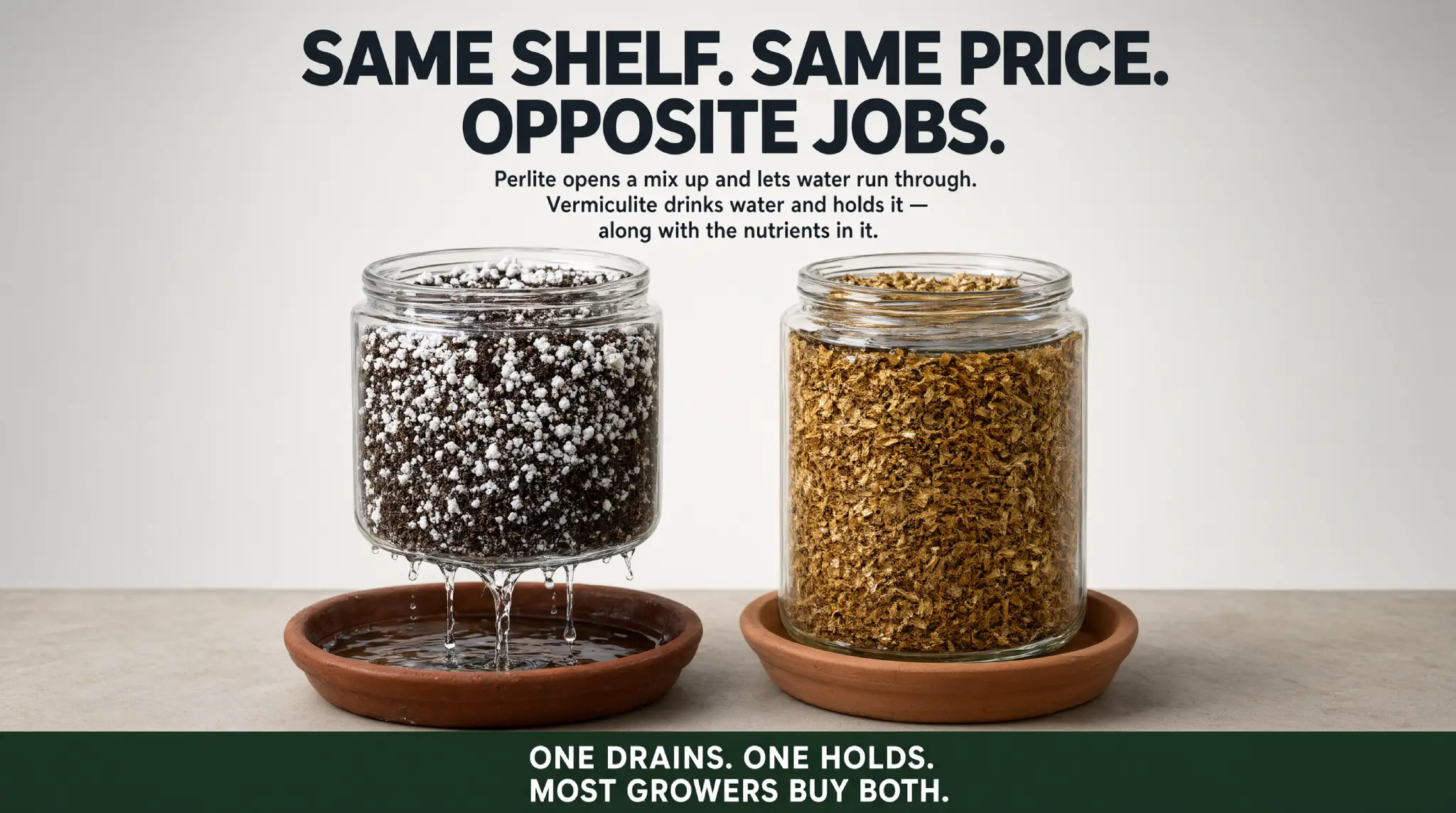
Perlite and vermiculite sit next to each other on the same shelf, cost about the same per bag, and do almost opposite things once they are in the mix. Perlite is the white, crunchy, Styrofoam-looking grit that opens a mix up and lets water run straight through. Vermiculite is the gold-brown, flaky material that drinks water and holds on to it, along with the nutrients dissolved in it. Choosing between them is a question about water: does your mix need to drain faster, or hold on longer?
This guide covers what each material actually is, the properties that make them behave differently, which jobs each one is right for, and three mixes you can copy. It also covers the two mistakes that send people back to the garden centre: a mix that stays too wet because it got the wrong grade of vermiculite, and a seed tray where the perlite floated to the surface on the first watering.
What perlite actually is
Perlite is a volcanic glass. Miners crush the ore to a set particle size, then heat it hard enough that the trapped water in the grain flashes to steam and puffs the particle open like popcorn. Perlite ore is heated to between 1,800 and 3,200 degrees Fahrenheit, which expands it to between four and twenty times its original volume. What comes out is a sterile, white, closed-cell grit full of tiny pores, with a neutral pH around 6.5 to 7.5 and a bulk density of roughly 6 to 9 pounds per cubic foot.
Its useful property is mechanical, not chemical. The angular particles hold a mix apart, so air pockets stay open and excess water drains away, and water that does stay sits on the outside of the grain rather than inside it. Perlite adds drainage and aeration and then gets out of the way. Components with low CEC include sand, perlite, polystyrene beads, rock wool, and non-composted organic materials such as rice and peanut hulls. Perlite therefore holds no nutrient charge and will not resist a pH change. It does not rot, does not break down in the bag, and can be reused after steam pasteurising if you are careful with it.
What vermiculite actually is
Vermiculite is a mica-family silicate. Ore is heated to around 2,000 degrees Fahrenheit, and the layers of the mineral pop apart into an accordion structure that behaves like a stack of microscopic sponges. It is graded from fine to coarse the same way perlite is, and that grade matters more than most buyers realise: fine vermiculite wicks water well in a seed tray but collapses into a dense layer in a pot over one season.
Where perlite is inert, vermiculite is active. It carries potassium, magnesium and calcium on its exchange sites, it buffers pH, and it holds water inside the particle as well as around it. Perlite retains water around the granules rather than in them, while vermiculite granules retain water in their air spaces. Vermiculite attracts nutrients such as calcium, magnesium, potassium and phosphorous because it stays wet, while perlite is mainly used to aerate and improve drainage in potting mixes. That single difference decides which one you want, and it is also why vermiculite used on its own, especially in a fine grade, can hold a root system wet long enough to rot it.
Perlite vs vermiculite at a glance
| Property | Perlite | Vermiculite |
|---|---|---|
| What it is | Expanded volcanic glass | Expanded mica |
| Water | Drains. Water sits on the grain | Holds. Water sits inside the grain |
| Aeration | High, permanent | Lower, and fine grades compact |
| Nutrient holding (CEC) | None | High; holds K, Mg and Ca |
| pH | Neutral, about 6.5–7.5 | Neutral to alkaline, commonly 6.3–7.8 |
| Weight dry / wet | Very light / stays light | Light / heavy once saturated |
| Typical grades | 0–2 mm, 1.5–3 mm | Fine, coarse, 4–8 mm horticultural |
| Best job | Drainage, aeration, seed trays | Water and nutrient retention, rooting |
| Watch out for | Floating, dust, washing downhill | Waterlogging, compaction |
Grades matter more than the bag tells you
Both materials are sold by grade, and the grade on the label is usually the only quality signal you get. Fine perlite (0 to 2 mm) belongs in seed trays and plug cells, where the small particles keep a small seed from rocking in a large gap. Coarse perlite (1.5 to 3 mm and up) belongs in pots and raised beds, where it has to keep a larger volume of mix open for a full season.
The same split applies to vermiculite, and the consequence of getting it wrong is worse. A fine grade in a deep pot settles into a dense, waterlogged layer at the bottom of the container within a few months. A coarse grade in a seed tray leaves gaps around small seed and dries at the surface between waterings. Bagged horticultural grades are labelled fine, medium or coarse more often than they are labelled for a job, so match the grade to the container depth rather than to the plant name.
Colour tells you nothing useful. Perlite is white because it is expanded glass; vermiculite is gold-brown because it is expanded mica. Neither indicates purity, age or water-holding quality, and the difference in bag price between two grades of the same material is usually packaging and grade size rather than anything in the mineral.
Which one does your job need?
Seed starting: perlite, or a fine vermiculite used as a thin top dressing only. The seed needs air at the surface and fast drainage after watering. A mix that stays saturated at 2 cm down is how damping-off starts. Seed and cutting mixes built for acid-lovers follow the same rule.
Houseplants that hate wet feet: perlite, at 20 to 40 percent of the mix. Aroids, succulents, cacti and anything in a decorative pot without a drainage hole need the mix to dry on a predictable schedule.
Seedlings, cuttings and moisture-lovers: vermiculite. It keeps a cutting in contact with water while roots form, and it holds the ammonium and potassium released from a light feed instead of washing it out on the second watering.
Raised beds and heavy clay in the ground: perlite, and in many cases compost or coarse grit does the same job for less money. Vermiculite in a raised bed is expensive water storage in a place that rarely needs it.
Acid-loving plants: both are close to neutral, so neither moves pH. Change colour or growth with the soil reaction instead: the soil pH by crop reference table has the target bands, and the plant pH database covers individual species.
Hydroponics and inert media: perlite is the choice that keeps oxygen at the root zone in a recirculating system, where it is chemically inert and adds no charge to the solution. Vermiculite belongs in a soilless mix only in a small fraction, because it releases potassium, magnesium and calcium into the feed and holds water the system is already supplying on a timer. Whichever you use, the medium’s baseline EC decides what the roots see, so set the target with the ppm and EC calculator before you blame the aggregate.
Three mixes you can copy
- General houseplant mix: 2 parts peat or coco coir, 1 part perlite, 1 part fine compost. Drainage without turning the pot into a sieve.
- Seed and cutting mix: 2 parts peat or coir, 1 part fine vermiculite, 1 part fine perlite. The vermiculite keeps the surface damp, the perlite keeps air at the seed.
- Lightweight container mix: 1 part compost, 1 part coir, 1 part perlite, with a handful of vermiculite per gallon if the containers dry out in a day.
Both materials are inorganic and sterile, so they add nothing in the way of fertility. Feed separately, and start from a soil test rather than from a guess: picking the right test tool matters more than the ratio above. There is no single correct recipe. A mix of peat moss, vermiculite or perlite, and compost or organic fertilizers can provide a suitable environment with sufficient water-holding capacity, nutrient content, and aeration for plant growth and development. The ratio between the two aggregates is what you adjust from there.
The four mistakes that cost a season
- Using vermiculite as the whole mix. It holds water to saturation. Alone in a pot it produces waterlogged roots, bacterial growth and a plant that never dries between waterings.
- Using the wrong grade. Fine vermiculite in a tall container settles into a dense layer that reduces aeration instead of adding it. Coarse grades belong in pots; fine grades belong in trays.
- Letting perlite float away. It is so light that a hard watering lifts it to the surface, where it washes to the edge of the tray. Pre-wet the mix, water with a fine rose, and avoid flood-and-flush watering with perlite-only media.
- Breathing the dust. Dry perlite throws a fine silica dust when you pour it. Wet it before you mix it, and wear a mask if you are opening a bale indoors.
The short answer
If the problem is that water leaves too fast, or roots are suffocating in a dense mix, you want perlite. If the problem is that the mix dries out, or nutrients leach out on every watering, you want vermiculite. Most experienced growers end up buying both: perlite for structure, vermiculite where moisture and nutrients need to stay put, and a soil test to decide how much of anything else the mix actually needs.
Sources
- Evaluating Container Substrates and Their Components, Purdue Extension; backs Perlite ore is heated to between 1,800 and 3,200 degrees Fahrenheit, which expands it to between four and twenty times its original volume..
- Evaluating Container Substrates and Their Components, Purdue Extension; backs Components with low CEC include sand, perlite, polystyrene beads, rock wool, and non-composted organic materials such as rice and peanut hulls..
- Vermiculite vs Perlite, Oregon State University Extension; backs Perlite retains water around the granules rather than in them, while vermiculite granules retain water in their air spaces..
- Potting Media and Plant Propagation, Penn State Extension; backs A mix of peat moss, vermiculite or perlite, and compost or organic fertilizers can provide a suitable environment with sufficient water-holding capacity, nutrient content, and aeration for plant growth and development..
- Perlite vs. Vermiculite, Virginia Tech Journal of Applied Research in Agriculture; backs Vermiculite attracts nutrients such as calcium, magnesium, potassium and phosphorous because it stays wet, while perlite is mainly used to aerate and improve drainage in potting mixes..
Frequently Asked Questions
Is perlite or vermiculite better for seed starting?
Perlite, unless you are only dressing the surface. Seeds need air and fast drainage at depth; a fine layer of vermiculite over the top holds the surface damp between waterings, while the mix underneath should be perlite-rich so it drains after every watering. A 2 parts peat or coir, 1 part fine vermiculite, 1 part fine perlite mix covers both needs.
Can I use perlite and vermiculite together in the same mix?
Yes, and most growers do. Perlite supplies permanent structure and drainage, vermiculite supplies water and nutrient retention. Typical houseplant mixes run 20 to 40 percent perlite with a smaller share of vermiculite; seed and cutting mixes use roughly equal parts of each.
Does vermiculite change the pH of my soil?
Not in any way that matters at normal rates. Expanded vermiculite is neutral to slightly alkaline, commonly around 6.3 to 7.8 depending on the source, and the amount used in a pot or tray will not move an established soil pH. Perlite is neutral at roughly 6.5 to 7.5 for the same reason. If pH is the problem, fix it with lime or sulfur rather than by choosing one aggregate over the other.
Why does my perlite float to the surface when I water?
It is light enough to be lifted by a hard stream. Pre-wet the mix before you pot up, water with a fine rose or a gentle spray, and avoid flood-style watering in seed trays. In containers the layer is usually cosmetic; in a tray it can leave bare patches where seed was displaced.
Does vermiculite break down over time?
It does not rot or decompose, but fine grades do compact under repeated wetting and settling, which reduces the air space you bought it for. That is the main reason to use coarse grades in pots and reserve fine grades for seed trays, where the short cycle ends before compaction matters.
Numbers and claims in this guide were last checked on 28 September 2026: how we check our sources.