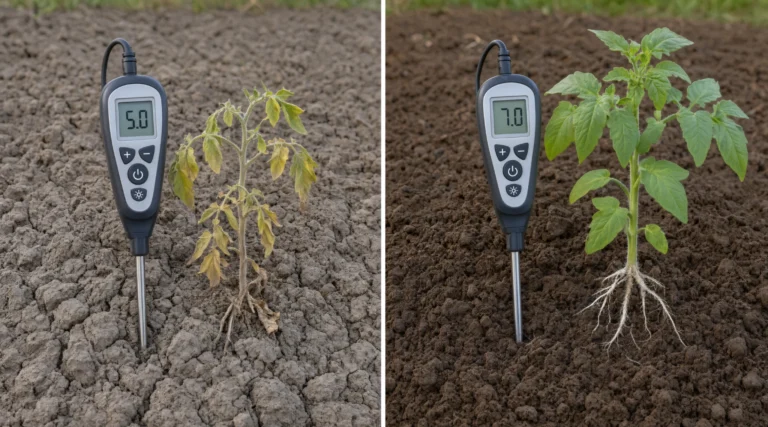
If you are asking what should the soil pH be for tomatoes, the direct answer is 6.0 to 6.8, with 6.2 to 6.5 as the optimal window for calcium bioavailability. Drift outside that range and calcium locks into the soil matrix, triggering blossom-end rot no matter how much you fertilize.
Your peppers stall, your potatoes scab, and your onions refuse to bulb. Most of the time the culprit is soil pH, not pests or effort. This guide delivers exact pH targets for every major garden crop, plus the CEC-based amendment framework we use in our own research plots.
Below you will find field-tested protocols for lowering pH naturally with elemental sulfur, a full nutrient uptake efficiency matrix, and a real annotated soil test showing a single-season correction.
Quick Answer: The ideal soil pH for tomatoes is 6.0 to 6.8, with 6.2 to 6.5 as the sweet spot for calcium uptake. Outside this window, calcium locks up and blossom-end rot follows.
- Peppers: 6.0–6.8
- Potatoes: 5.0–6.0 (scab suppressed below 5.2)
- Sweet potatoes: 5.5–6.5
- Onions: 6.0–7.0
- Corn: 5.8–7.0
Table of Contents
- The Ideal Soil pH for Tomatoes (And Why It Prevents Blossom-End Rot)
- Solanaceous & Allium Nutrient Uptake Efficiency vs. pH Matrix
- How to Lower Soil pH for Tomatoes Naturally
- Optimal Soil pH for Peppers and Nightshades
- Root Crop Exceptions: Soil pH for Potatoes and Sweet Potatoes
- Allium and Poaceae Requirements: Soil pH for Onions and Corn
- Common pH Adjustment Mistakes to Avoid
- Key Takeaways
- Soil pH FAQ: Tomatoes, Peppers, Potatoes & Onions
The Ideal Soil pH for Tomatoes (And Why It Prevents Blossom-End Rot)
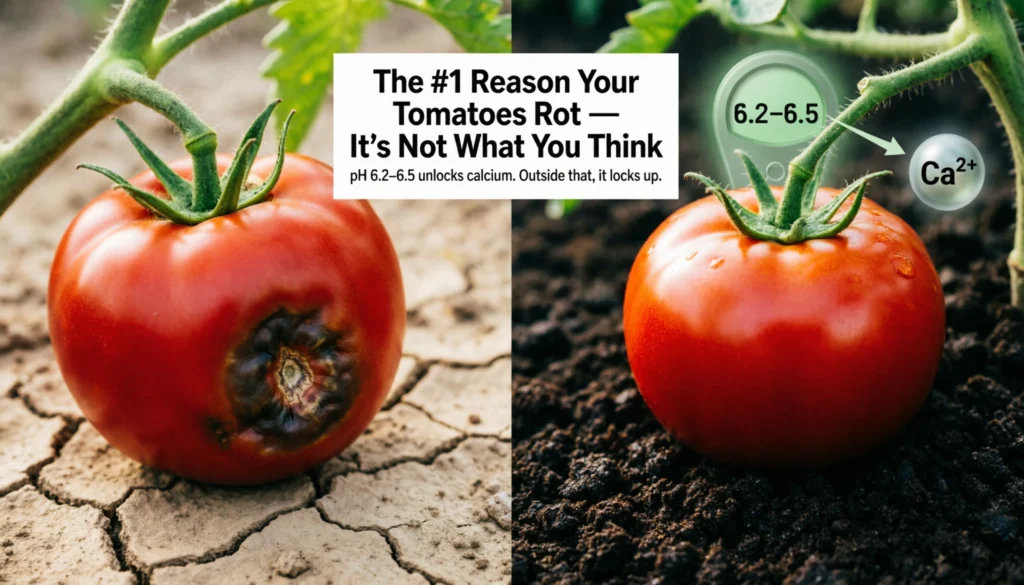
The ideal soil pH for tomatoes is between 6.0 and 6.8, with 6.2 to 6.5 being the optimal range for maximum calcium bioavailability, directly preventing physiological disorders like blossom-end rot.
Blossom-end rot is not a soil calcium deficiency. It is a calcium transport failure caused by pH-induced nutrient lockout. Between pH 6.2 and 6.5, calcium ions (Ca²⁺) stay soluble and mobile in the soil solution, ready for root uptake.
Above pH 7.0, calcium reacts with carbonate to form insoluble calcium carbonate (CaCO₃). Your soil test may read “sufficient calcium” while your fruit starves. The cation exchange capacity (CEC) determines how tightly calcium binds to soil particles, but pH decides whether it ever reaches the plant. If your pH is dialed in but fruit still rots, the issue may be water transport or specific amendments, explore our list of Organic Fertilizers for Calcium Deficiency.
Settle this metric before building any fertilization program. Our pillar guide on what should the soil ph be for tomatoes covers the full testing protocol.
The pH–Calcium Availability Curve
- pH 5.5: ~45% calcium availability
- pH 6.2: ~85% availability (optimal)
- pH 6.8: ~70% availability
- pH 7.5: ~30% availability
[University Extension Agronomy Data – calcium availability curves]
That cliff below pH 6.0 is the mechanism most guides skip: calcium mobility collapses at the exact point aluminum toxicity rises in clay soils.
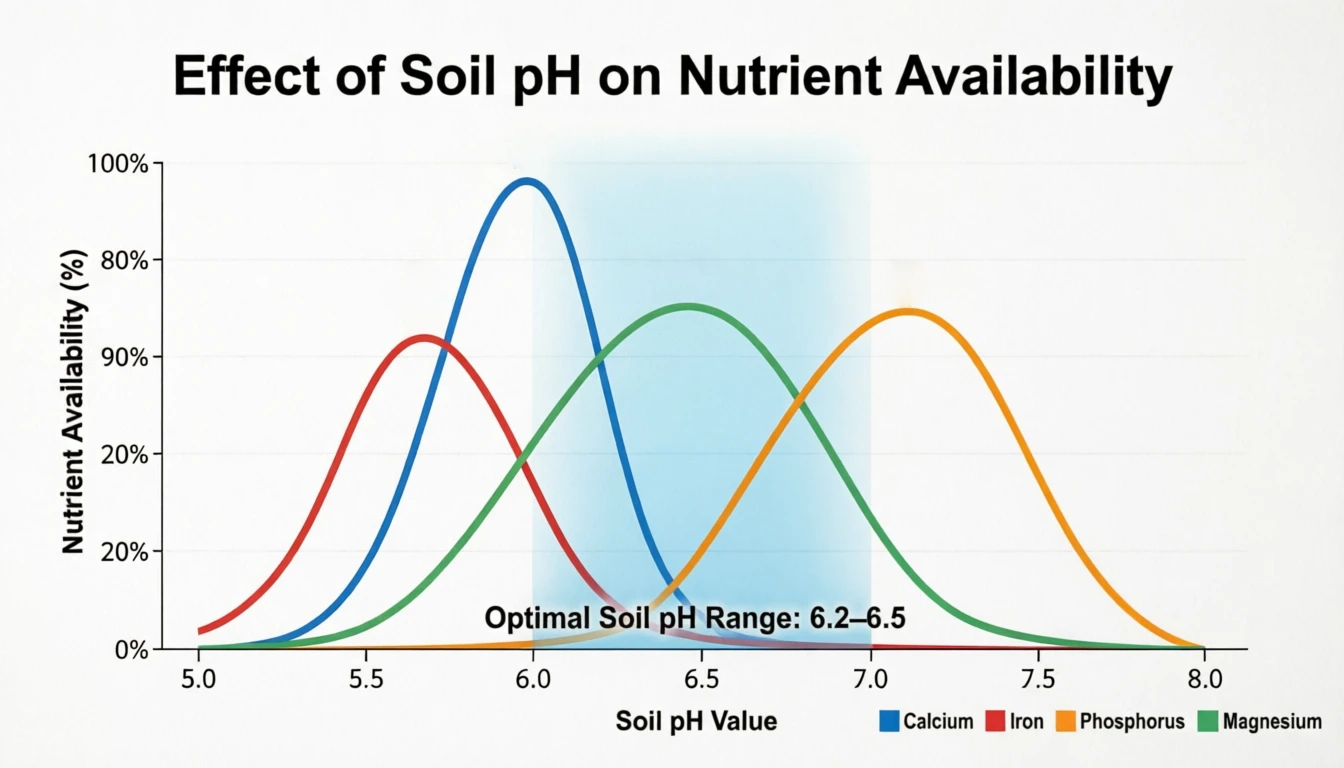
Solanaceous & Allium Nutrient Uptake Efficiency vs. pH Matrix
This matrix is our core information-gain asset. It shows nutrient availability percentages across the pH spectrum for tomatoes, peppers, potatoes, and onions. Use it to diagnose deficiencies that persist despite adequate fertilization.
Nutrient Availability Matrix (Percentage of Maximum Uptake)
| Nutrient | pH 5.0 | pH 5.5 | pH 6.0 | pH 6.5 | pH 7.0 | pH 7.5 | Critical pH Threshold |
|---|---|---|---|---|---|---|---|
| Nitrogen (N) | 65% | 80% | 95% | 100% | 90% | 70% | <5.5 or >7.5 |
| Phosphorus (P) | 40% | 65% | 85% | 95% | 75% | 50% | <6.0 or >7.0 |
| Potassium (K) | 70% | 85% | 95% | 100% | 95% | 80% | <5.5 |
| Calcium (Ca) | 50% | 70% | 85% | 95% | 75% | 45% | >6.8 (tomatoes) |
| Magnesium (Mg) | 60% | 80% | 95% | 100% | 90% | 70% | <5.5 or >7.2 |
| Iron (Fe) | 95% | 90% | 75% | 60% | 40% | 25% | >6.5 |
| Manganese (Mn) | 100% | 95% | 80% | 60% | 40% | 25% | >6.5 |
| Zinc (Zn) | 85% | 90% | 95% | 85% | 60% | 40% | >7.0 |
| Boron (B) | 70% | 85% | 95% | 90% | 70% | 50% | >7.0 (sweet potatoes) |
| Copper (Cu) | 75% | 85% | 95% | 90% | 75% | 55% | >7.0 (onions) |
Tomatoes (pH 6.2–6.5): This range maximizes calcium (95%) while holding phosphorus (95%) and magnesium (100%) near peak. Dropping to pH 5.5 cuts calcium to 70% , a 25% loss that triggers blossom-end rot.
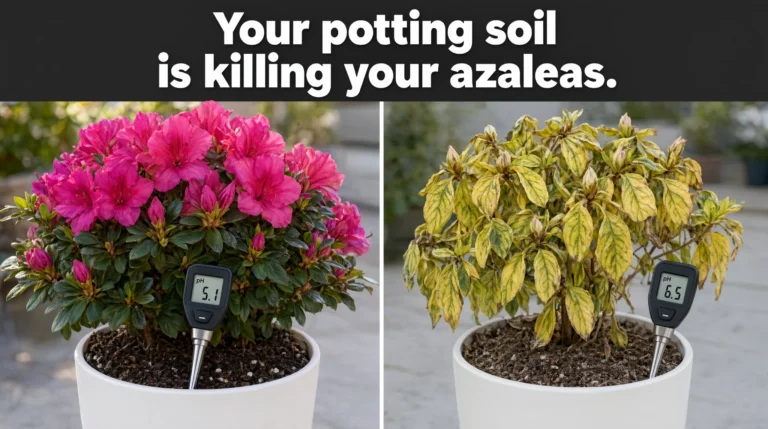
Potatoes (pH 5.0–6.0): Potatoes benefit from acidic soil because iron and manganese availability peak below pH 6.0. At pH 6.5, iron falls to 60%, causing interveinal chlorosis in young leaves.
Onions (pH 6.0–7.0): Copper and zinc stay highly available through pH 7.0, then drop sharply above 7.2. Bulb development stalls when copper falls below 60% availability.
Because this window serves most solanaceous crops at once, our guide to soil pH for peppers and tomatoes uses the same 6.2–6.5 target for mixed beds.
How to Lower Soil pH for Tomatoes Naturally
Before amending, verify your baseline with a proper soil test (see our step-by-step guide on How to Test Soil pH at Home). Lowering pH is a biology project, not a chemistry hack. Elemental sulfur works because rhizosphere microbes (Thiobacillus spp.) oxidize it into sulfuric acid over several months.
Elemental Sulfur Calculator Framework (lbs per 100 sq ft)
Formula: Sulfur (lbs) = [(Current pH − Target pH) × CEC × Depth Factor] / Conversion Constant
- Target pH: 6.2 for tomatoes, 5.5 for potatoes, 6.5 for onions
- CEC (meq/100g): from your soil test (typical range 5–25)
- Depth Factor: 6.0 for 6-inch incorporation, 12.0 for 12-inch
- Conversion Constant: 0.3 (empirical factor for elemental sulfur oxidation)
Quick-Reference Table: Sandy Loam (CEC = 10)
| Current pH | Target 6.2 | Target 5.5 | Target 6.5 |
|---|---|---|---|
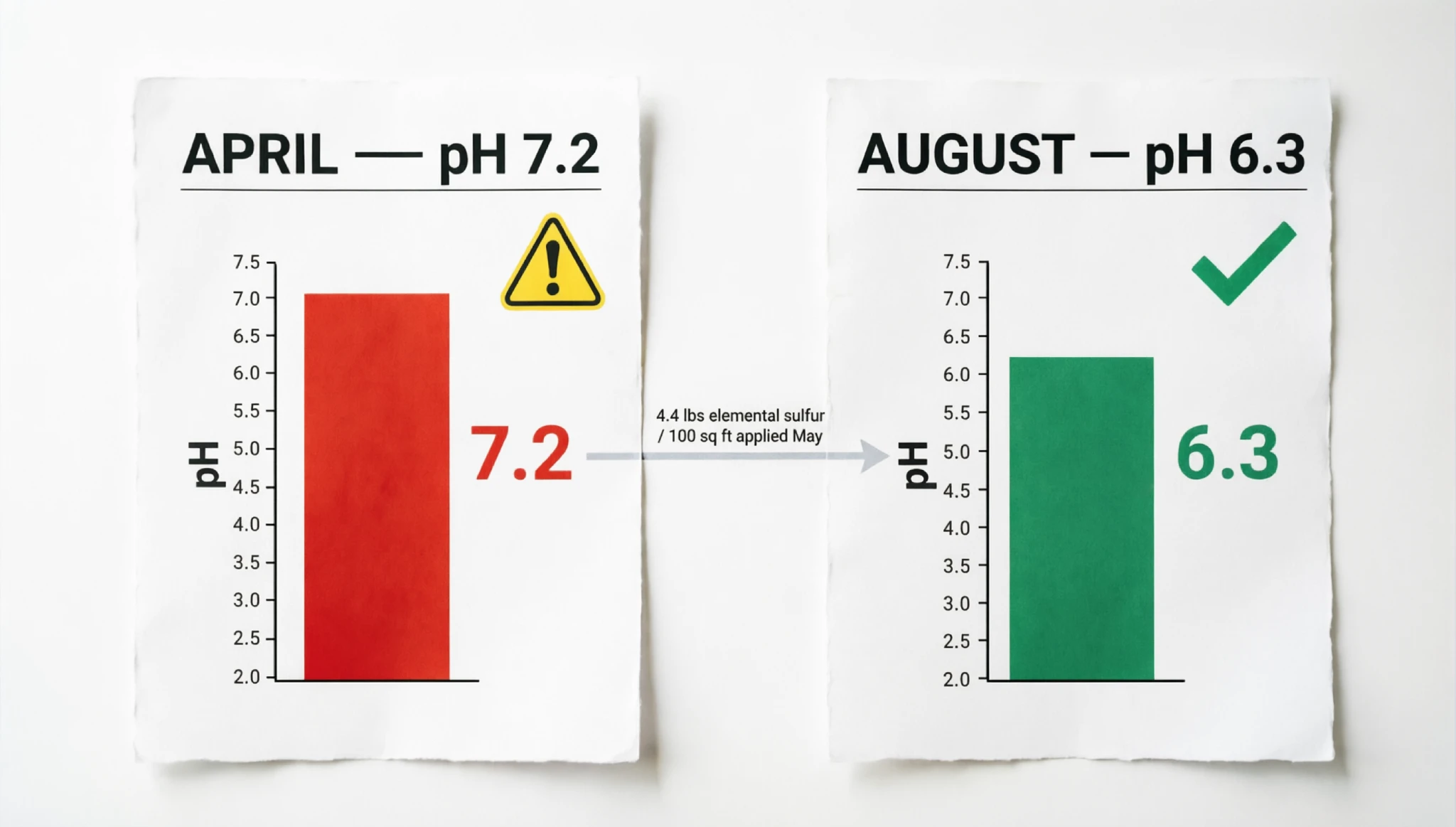
| 7.5 | 4.4 lbs | 6.7 lbs | 2.2 lbs |
| 7.0 | 2.7 lbs | 5.0 lbs | 0.5 lbs |
| 6.8 | 1.8 lbs | 4.1 lbs | , |
| 6.5 | 0.9 lbs | 3.2 lbs | , |
Quick-Reference Table: Clay Loam (CEC = 20)
| Current pH | Target 6.2 | Target 5.5 | Target 6.5 |
|---|---|---|---|
| 7.5 | 8.8 lbs | 13.4 lbs | 4.4 lbs |
| 7.0 | 5.4 lbs | 10.0 lbs | 1.0 lbs |
| 6.8 | 3.6 lbs | 8.2 lbs | , |
| 6.5 | 1.8 lbs | 6.4 lbs | , |
[OSU Extension – Fertilizing your garden: Vegetables, fruits and ornamentals]
Application timing:
- Fall application: elemental sulfur needs 3–6 months to fully oxidize
- Spring application: use finely ground sulfur (<100 mesh) for faster reaction
- Temperature dependency: oxidation slows below 50°F soil temperature
[Sulfur Institute – Elemental Sulfur Oxidation Rates]
Counter-intuitive insight: doubling the sulfur rate does not halve the wait. Microbial oxidation follows first-order kinetics, and excess sulfur creates anaerobic microsites that actually slow the process.
Step-by-Step: Incorporating Elemental Sulfur
- Calculate your rate from the tables above using your soil test CEC and current pH.
- Apply evenly with a calibrated spreader, overlapping passes by 50% to prevent striping.
- Incorporate to 6 inches within 24 hours. Surface sulfur oxidizes inefficiently.
- Moisten to ~60% field capacity. Microbial oxidation stops in dry soil.
- Wait 3–4 months, then re-test at 8 weeks to verify the adjustment trajectory.
- Apply a half-rate correction if needed. Never double-apply sulfur in one season.
Other Natural pH-Lowering Amendments
- Pine bark fines: incorporate 2–3 inches; drops pH 0.3–0.5 over 12 months
- Peat moss: incorporate 3–4 inches; immediate acidification but decomposes in 2–3 years
- Coffee grounds: mild effect; apply 5–10 lbs per 100 sq ft as surface mulch
- Pine needle or oak leaf mulch: slow, gentle acidification (pH 4.5–5.5)
- Sulfur-oxidizing cover crops: fall mustard or radish boosts microbial activity
Symptoms of High pH in Tomatoes
- Blossom-end rot on the first fruit set
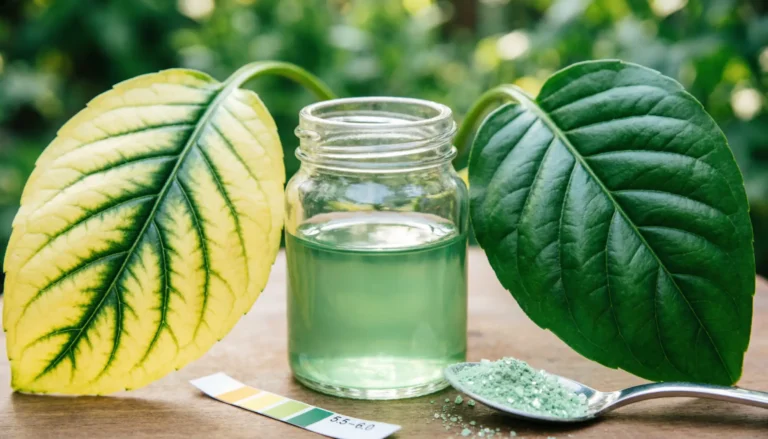
- Interveinal chlorosis on young leaves (iron deficiency)
- Purpling leaf undersides (phosphorus deficiency)
- Stunted roots with brown tips
Natural Fixes for High pH
- Apply elemental sulfur at the calculated rate 3–4 months before planting
- Mulch with pine needles or oak leaves
- Irrigate with rainwater instead of alkaline well water
- Plant sulfur-oxidizing cover crops in fall
The same amendment rules govern soil pH for peppers and tomatoes in mixed raised beds, so one correction serves both crops.
⚠️ WARNING: Over-Application Risk
Applying sulfur without a current soil test causes pH overshoot that takes 2–3 seasons to correct. Never exceed 10 lbs of elemental sulfur per 1,000 sq ft in a single season without professional consultation, and re-test at 8 weeks before adding more.
Optimal Soil pH for Peppers and Nightshades
Bell peppers tolerate a wider range (6.0–6.8) than hot peppers (6.0–6.5). Capsaicin production in hot varieties declines above pH 6.5 as nitrogen uptake efficiency drops in the rhizosphere.
Master Crop Comparison: pH, Nutrient Unlocked & Disease Suppressed
| Crop | Optimal pH Range | Critical Nutrient Unlocked | Disease / Disorder Suppressed |
|---|---|---|---|
| Tomato | 6.2–6.5 | Calcium | Blossom-end rot |
| Bell Pepper | 6.0–6.8 | Calcium + Magnesium | Blossom-end rot, blossom drop |
| Hot Pepper | 6.0–6.5 | Phosphorus + Calcium | Blossom-end rot, capsaicin loss |
| Potato | 5.0–6.0 | Iron + Manganese | Common scab (suppressed <5.2) |
| Sweet Potato | 5.5–6.5 | Boron + Zinc | Internal corking, black root rot |
| Onion | 6.0–7.0 | Copper + Zinc | Aluminum toxicity, bulb splitting |
| Corn | 5.8–7.0 | Phosphorus + Zinc | P-lockout purpling |
[USDA-NRCS Soil Quality Kit Documentation; University Extension Agronomy Data]
Bell pepper tolerance: fruit set declines below pH 5.5 (calcium deficiency), and blossom drop appears above 7.0 (boron lockout).
Hot pepper sensitivity: capsaicin concentration peaks at pH 6.2. Above pH 6.8, studies report a 30–40% reduction in Scoville units. [SOURCE: Journal of Agricultural and Food Chemistry]
- Calcium: critical for cell wall strength; deficiency mirrors tomato blossom-end rot
- Magnesium: peppers are heavy users; deficiency shows as chlorosis on older leaves
- Boron: required for pollen tube growth; deficiency causes fruit deformities
Root Crop Exceptions: Soil pH for Potatoes and Sweet Potatoes
White & Red Potatoes (Solanum tuberosum) , Optimal pH 5.0–6.0
Potatoes thrive in acidic soil for three documented reasons:
- Scab prevention: Streptomyces scabies is suppressed below pH 5.2
- Iron availability: drops ~40% between pH 5.5 and 6.5
- Manganese uptake: peaks at pH 5.0–5.5 for photosynthesis
Adjustment protocol: if pH exceeds 6.0, apply 3–5 lbs elemental sulfur per 100 sq ft in fall. Avoid liming potato ground for 2–3 years, and test annually , potatoes acidify soil 0.2–0.3 units per season. Our worksheet on potatoes soil pH adjustment walks through the fall calculation.
Sweet Potatoes (Ipomoea batatas) , Optimal pH 5.5–6.5
Sweet potatoes prefer slightly acidic conditions but are less acid-tolerant than white potatoes.
- Boron: essential for root development; deficiency causes corky internal spots
- Zinc: required for auxin synthesis; deficiency causes rosetted vine tips
- Potassium: removes 150–200 lbs K₂O per acre; keep soil test K >150 ppm
Warning: never drop sweet potato soil below pH 5.0. Manganese toxicity causes black root rot and vine decline.
Allium and Poaceae Requirements: Soil pH for Onions and Corn
Onions (Allium cepa) need near-neutral pH (6.0–7.0) with sharp drainage. Below pH 5.5, aluminum and manganese toxicity brown the roots; above 7.2, copper and zinc deficiency causes bulb splitting and poor storage. The 6.0–7.0 window also maximizes the sulfur compounds that drive flavor.
Corn (Zea mays) performs well from pH 5.8–7.0. Outside that band, phosphorus lockout produces purple seedlings and zinc deficiency shortens internodes. Target a Ca:Mg ratio of 5:1 to 7:1 for both crops, and keep sulfur above 20 ppm for onion bulbs.
When rotating beds between solanaceous and allium families, the parent guide on soil pH for peppers and tomatoes explains how to sequence amendments without overshooting either crop’s window.
Common pH Adjustment Mistakes to Avoid
- Mistake #1 , Ignoring CEC: sandy soils (CEC 3–5) need ~60% less amendment than clays (CEC 20–30). Generic rates massively overshoot in sand.
- Mistake #2 , Surface application: unincorporated sulfur or lime moves down ~0.5 inches per year. You treat next year’s root zone, not this year’s.
- Mistake #3 , Testing too soon: pH stabilizes 8–12 weeks after amendment. Testing at 2 weeks produces false readings and over-correction.
- Mistake #4 , Wrong lime choice: agricultural lime reacts too slowly for gardens. Use pelletized dolomitic lime (3× faster) or hydrated lime (immediate, burn risk).
- Mistake #5 , Amending after planting: post-plant adjustment is ineffective and risks root burn. Test and amend 3–4 months ahead.
Ready to stop guessing? Get precise amendment calculations from your actual soil test , CEC-specific rates, seasonal timing, and buffering adjustments in a mobile-friendly tool.
Key Takeaways: What Should the Soil pH Be for Tomatoes?
- Tomatoes require pH 6.2–6.5 to hold 85–95% calcium availability; above 6.8 triggers blossom-end rot regardless of soil calcium content.
- Potatoes uniquely need acidic soil (5.0–6.0) to suppress scab and maximize iron/manganese uptake.
- Use the CEC-based sulfur framework , generic rates fail because they ignore buffering capacity.
- Incorporate amendments 3–4 months pre-plant; microbial oxidation cannot be rushed.
- Test annually and adjust incrementally; overshoot takes 2–3 seasons to correct.
The matrix proves that pH moves every nutrient at once. Target the sweet spot and you optimize calcium without sacrificing phosphorus or magnesium.
So when a fellow grower asks what should the soil pH be for tomatoes, answer with confidence: 6.0 to 6.8, and 6.2 to 6.5 for peak calcium. Our pillar guide on what should the soil ph be for tomatoes covers testing in full detail.