Growing weed pH drift, not weak genetics or cheap fertilizer, triggers most mystery deficiency symptoms in mid-flower cannabis. Leaves yellow between green veins, growth stalls, and the feed you just paid for stays stranded in the rootzone.
That combination signals nutrient lockout, a rootzone chemistry failure you can reverse in 48 to 72 hours. This guide gives you exact soil and soilless pH targets, a runoff diagnostic matrix, and a field-tested flush SOP.
Quick answer: how to fix nutrient lockout in soil cannabis
- Stop all nutrient feeding immediately.
- Flush the medium with 3x pot volume of pH-balanced (6.2–6.5) water.
- Measure runoff EC to confirm salt removal (target <200 ppm over input).
- Reintroduce light nutrients after 48 hours.
What Is Cannabis Nutrient Lockout?
Nutrient lockout in cannabis means rootzone pH has drifted so far that roots cannot absorb minerals already present in the medium. The nutrients exist; your plant simply cannot reach them. Correcting pH, not adding more feed, solves the problem.
Cannabis nutrient lockout occurs when rootzone pH drifts outside the optimal 5.8–6.8 range, causing cation exchange imbalances that prevent the uptake of essential minerals like calcium, magnesium, and iron, despite their presence in the medium. [Commercial Cultivation Rootzone Chemistry Standards, 2026]
The Chemistry of Lockout: Cation Exchange Capacity
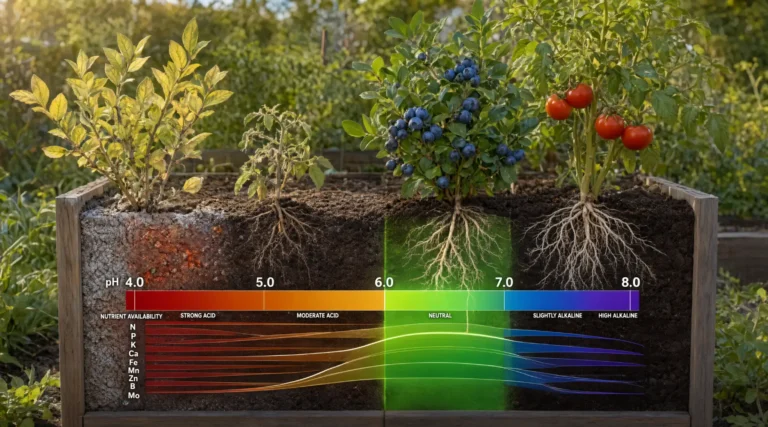
The rootzone works like an electrochemical marketplace. Calcium (Ca²⁺), magnesium (Mg²⁺), potassium (K⁺), and ammonium (NH₄⁺) compete for binding sites on clay and organic matter, and cation exchange capacity (CEC) sets how many sites exist.
Above pH 7.0, hydrogen ion concentration drops and cations bind too tightly for roots to retrieve them. Below pH 5.5, aluminum and manganese toxicity displace essential nutrients instead.
Electrical conductivity (EC) adds the second half of the diagnosis. EC counts total dissolved salts but cannot tell available ions from locked ones, so a high EC reading alongside deficiency symptoms confirms salt accumulation without uptake.
Calcium-Magnesium Antagonism in the Rootzone
The calcium-magnesium antagonism is the most common lockout pattern we diagnose in commercial grows. These two cations share uptake channels, so when calcium dominates above pH 7.0 magnesium starves, and when magnesium dominates below pH 5.8 calcium uptake fails.
Amendment choice sets your baseline ratio before you ever mix a feed: calcitic vs. dolomitic sources dictate whether the calcium-magnesium antagonism starts solved or pre-loaded into your medium.
In our facility, antagonism flares when growers switch between hard water and reverse osmosis water. The sudden calcium shift disrupts rootzone chemistry equilibrium and prints deficiency symptoms within 5 to 7 days.
Why pH Beats Nutrient Concentration
Novice growers answer deficiency symptoms with stronger feed, and lockout accelerates. Nutrient availability follows a bell curve against pH, so doubling concentration at pH 7.5 cannot overcome chemical unavailability.
Chelated iron proves the point. Iron stays soluble only between pH 5.5 and 6.5; above that window it precipitates as insoluble ferric hydroxide no matter how much you apply. That is why iron deficiency headlines high-pH lockout.
Optimal pH for Weed Grow: Soil vs. Soilless Targets
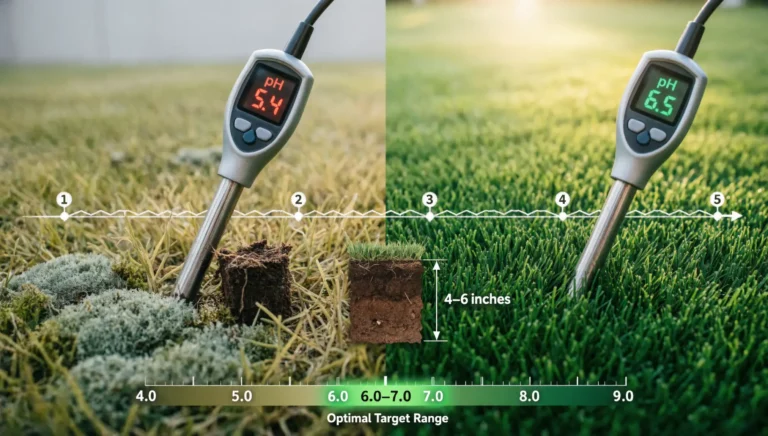
Every reliable growing weed ph target starts with one variable: your medium’s cation exchange capacity. Soil and soilless substrates buffer hydrogen ions differently, so they demand different set points.
Cannabis plants in soil require a pH of 6.2–6.8 to optimize cation exchange capacity, while soilless mediums require 5.8–6.2.
Soil pH Targets for Cannabis (6.2–6.8)
Living soil and amended mixes carry CEC values of 10–30 meq/100g, so their negatively charged sites hold cations tightly and need the higher window. Within pH 6.2–6.8 you get:
- Phosphorus fully soluble, peaking near pH 6.5
- Calcium and magnesium in a balanced uptake ratio
- Micronutrients (iron, manganese, zinc) chelated and accessible
- Beneficial microbes thriving in their preferred window
Below pH 6.0, soil turns acidic enough to release aluminum and manganese toxicity. Above pH 7.0, phosphorus binds with calcium into insoluble calcium phosphate, manufacturing a phosphorus deficiency despite perfect feeding. When corrective action cannot wait, our how to lower ph in soil weed master guide ranks elemental sulfur, aluminum sulfate, and citric acid routes by speed and root safety.
[USDA NRCS soil chemistry documentation on phosphorus availability and pH , insert citation]
Soilless and Hydroponic pH Targets (5.8–6.2)
Coco coir, rockwool, and hydroponic systems hold minimal CEC (0–5 meq/100g), so nothing buffers pH and set points drop to 5.8–6.2 for maximum solubility. Drift happens fast in these inert mediums.
Coco adds a twist: its lignin structure binds calcium and magnesium aggressively. Even at perfect pH, coco demands cal-mag supplementation at 2–3x soil rates.
| Parameter | Soil (Organic/Amended) | Soilless (Coco/Hydro) |
|---|---|---|
| Optimal pH range | 6.2 – 6.8 | 5.8 – 6.2 |
| Cation exchange capacity | High (10–30 meq/100g) | Low (0–5 meq/100g) |
| pH buffering | Strong , resists rapid change | Weak , requires constant monitoring |
| Cal-mag requirement | Standard (2:1 Ca:Mg) | Elevated (3:1 Ca:Mg for coco) |
| Phosphorus peak availability | pH 6.5 | pH 6.0 |
| Iron availability window | pH 5.5–6.5 | pH 5.5–6.2 |
| Runoff pH tolerance | ±0.5 from input | ±0.2 from input |
Track your rootzone chemistry like a pro. Our printable logging sheet records input vs. runoff pH/EC, flags drift patterns before lockout starts, and documents post-flush recovery day by day.
Vegetative vs. Flowering Stage pH Adjustments
Vegetative plants favor slightly lower soil pH (6.0–6.5) for ammonium uptake, while flowering plants favor 6.5–6.8 for phosphorus. The availability curves behind those stage targets are the same ones plotted in our crop-range charts later in this guide.
We still recommend stable pH over stage chasing. Frequent swings stress roots more than a suboptimal but steady set point, and stability keeps pH drift from compounding into lockout.
Signs of High pH in Weed Plants & Visual Diagnostics
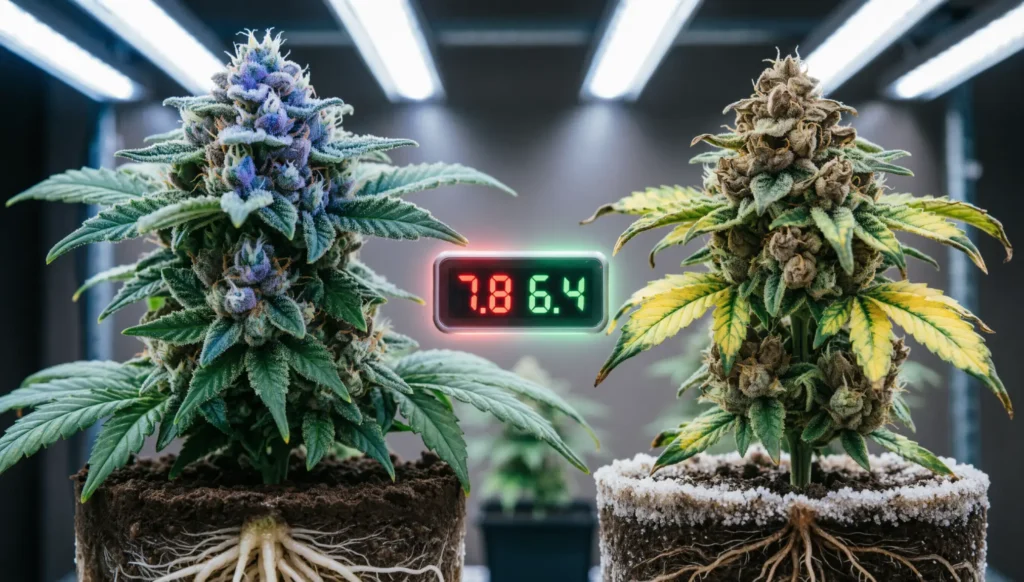
Visual nutrient lockout signs mimic true deficiencies, so sequence tells the story. High pH lockout (>7.0) unfolds in a predictable order:
- Iron deficiency first: interveinal chlorosis on newest growth, yellow leaves with green veins, progressing to bleaching
- Manganese deficiency: similar chlorosis plus brown speckling on middle-aged leaves
- Phosphorus deficiency: dark green or purple leaves, stunted growth, delayed flowering
- Calcium deficiency: distorted new growth, tip burn, necrotic spots on young leaves
- Magnesium deficiency: interveinal chlorosis and rust-colored spots on older, lower leaves
If interveinal chlorosis persists after flushing, our signs of high ph in weed plants rescue guide pairs each symptom above with a chelated iron fix that works while rootzone chemistry recovers.
Low pH lockout (<5.5) prints a different signature: manganese toxicity with brown speckling and crinkled leaves, reddish petioles from magnesium excess, and fast calcium deficiency with root tip dieback.
Runoff testing settles the argument. Water with a pH-corrected solution, collect 50–100 ml of runoff, and measure immediately:
- Record input pH and EC
- Collect runoff in a clean container
- Measure runoff pH and EC within minutes
- Compare deltas against the thresholds below
- Runoff pH >7.5 with symptoms = high pH lockout
- Runoff pH <5.0 with symptoms = low pH lockout
- Runoff EC >3.0 mS/cm = salt accumulation, flush required
- Runoff EC <0.5 mS/cm with high input EC = root uptake failure
Pair these thresholds with our cannabis rootzone pH lockout chart and a calibrated meter from our growing weed ph equipment guide for repeatable readings.
How to Cure Nutrient Lockout: The 3-Step Flush Protocol
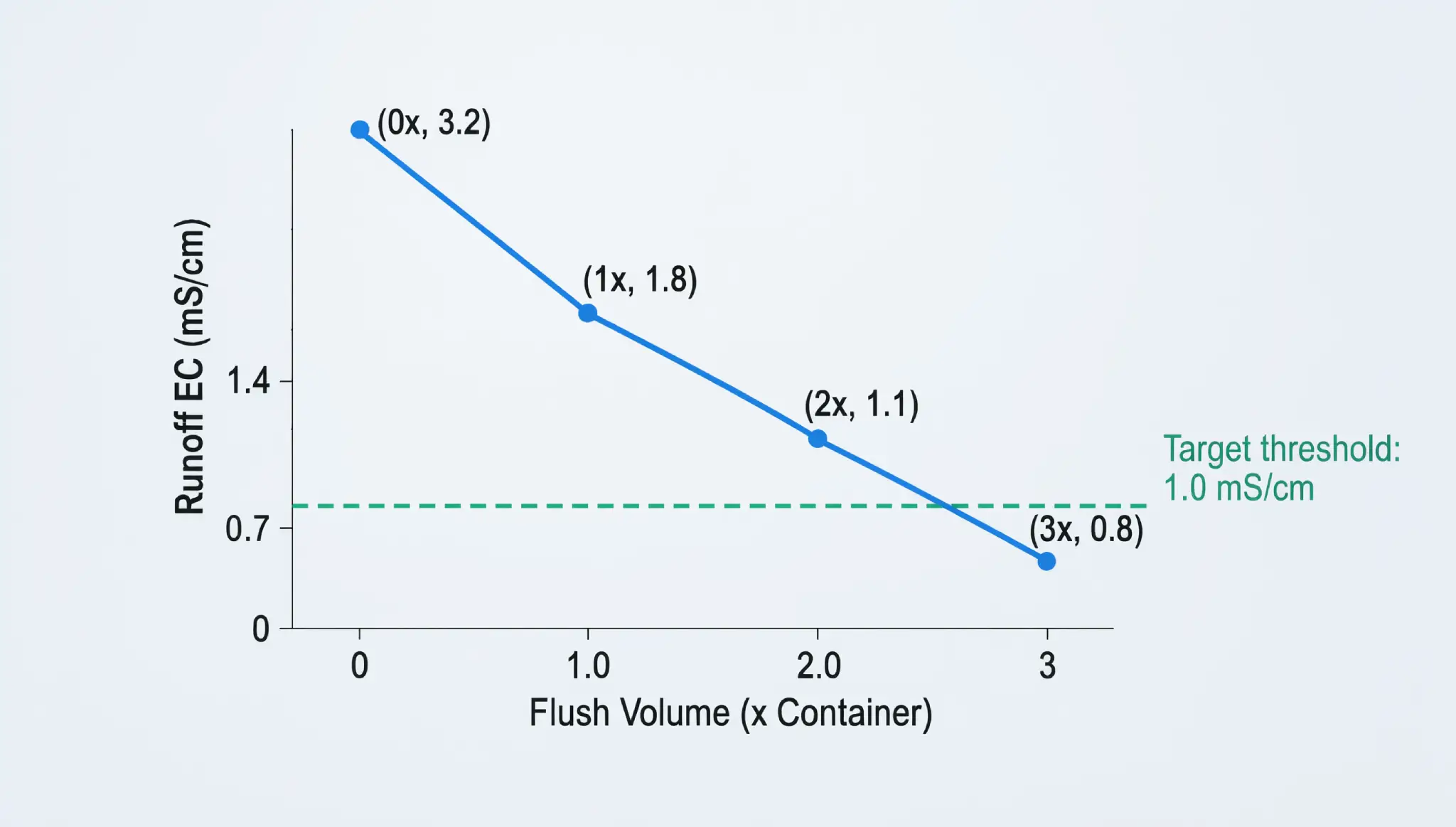
Flushing leaches excess salts and resets rootzone pH, but sloppy flushing damages roots and stalls recovery. This 3-step flushing SOP restores chemistry within 48 to 72 hours while keeping plant stress low.
Step 1: Pre-Flush Preparation (Hour 0)
- Calibrate your pH meter with 4.0 and 7.0 solutions; a 0.5 unit error deepens lockout
- Calculate volume: 3x container volume for soil, 2x for coco/hydro, 2.5x for containers over 10 gallons
- Mix flush water at 0.2–0.4 mS/cm: pH 6.0–6.2 for alkaline lockout, pH 6.5–6.8 for acid lockout
- Add 1 ml/L humic acid to chelate residual salts; add zero nutrients or supplements
Size every corrective acid dose to the milliliter before you mix: our how to lower ph in soil for cannabis workflow automates the dilution math so you never overshoot into acid lockout.
Step 2: Execute the Flush (Hours 0–2)
Apply the flush slowly over 30–45 minutes in a circular pattern, center outward, with 5-minute rests between passes. Rapid flooding carves channels and leaves salt pockets untouched.
Measure runoff after every 25% of volume. You want runoff pH within ±0.3 of your flush solution and runoff EC under 1.0 mS/cm. If pH stays high after 2x volume, pause 30 minutes for diffusion before resuming.
Step 3: Post-Flush Recovery (Hours 24–72)
Elevate pots and allow 12–24 hours of drainage and air exchange. Root hypoxia kills more plants than lockout itself.
- Hour 24: pH-corrected water only
- Hour 48: 25% nutrient strength at optimal pH
- Hour 72: 50% strength
- Day 5: 75% strength
- Day 7: full strength if runoff EC stabilizes
Rebuild the rhizosphere with mycorrhizal fungi (1 g/L drench), Bacillus subtilis, and Trichoderma harzianum, because flushing strips beneficial microbes along with salts.
Flushing Checklist
- pH meter calibrated with 4.0 and 7.0 solutions
- Flush volume calculated (2–3x container size)
- Flush water pH-corrected to target range
- Runoff EC measured after each 25% volume pass
- Final runoff pH within ±0.3 of input
- Final runoff EC < 1.0 mS/cm
- 12–24 hour drainage period completed
- Root inoculants applied post-flush
- Gradual feeding schedule initiated
Nutrient Lockout in Organic Soil: Special Considerations
Organic systems stack a second problem on top of chemistry. Organic soil amendments release nutrients only after microbial mineralization, so pH drift suppresses both availability and the microbes that create it.
⚠️ Critical warning: Never apply synthetic pH down (phosphoric acid) to living organic soil. It kills beneficial microbes and collapses the nutrient cycling ecosystem. Use organic adjusters only: citric acid or vinegar to lower pH, dolomite lime to raise it.
High-quality organic soil buffers hard (CEC 30–50 meq/100g), so lockout arrives rarely but corrects slowly. Expect 7–14 days to rebuild microbial populations after a flush, versus 48–72 hours in synthetic systems.
Watch for slow growth without classic deficiency, white surface mold (fungal dominance below pH 5.5), slimy biofilm (bacterial dominance above 7.5), and deficiencies that ignore top dressing because microbes cannot mineralize kelp or bone meal at extreme pH.
Modified organic flush protocol:
- Flush with aerated compost tea at pH 6.5 instead of plain water
- Drench within 2 hours using mycorrhizal fungi (5 g/L), Bacillus species (2 g/L), and actinomycetes (1 g/L)
- Top dress with dolomite lime (acidic soil), elemental sulfur (alkaline soil), or 10% biochar for long-term stability
When weed soil ph too high readings persist in living soil, choose elemental sulfur over sulfate salts, our form comparison explains why microbes tolerate one and not the other.
Long-term, test monthly with a 1:2 soil slurry, hold moisture at 60–70% field capacity, and rotate carbon-rich and nitrogen-rich amendments to keep substrate salinity and pH in equilibrium.
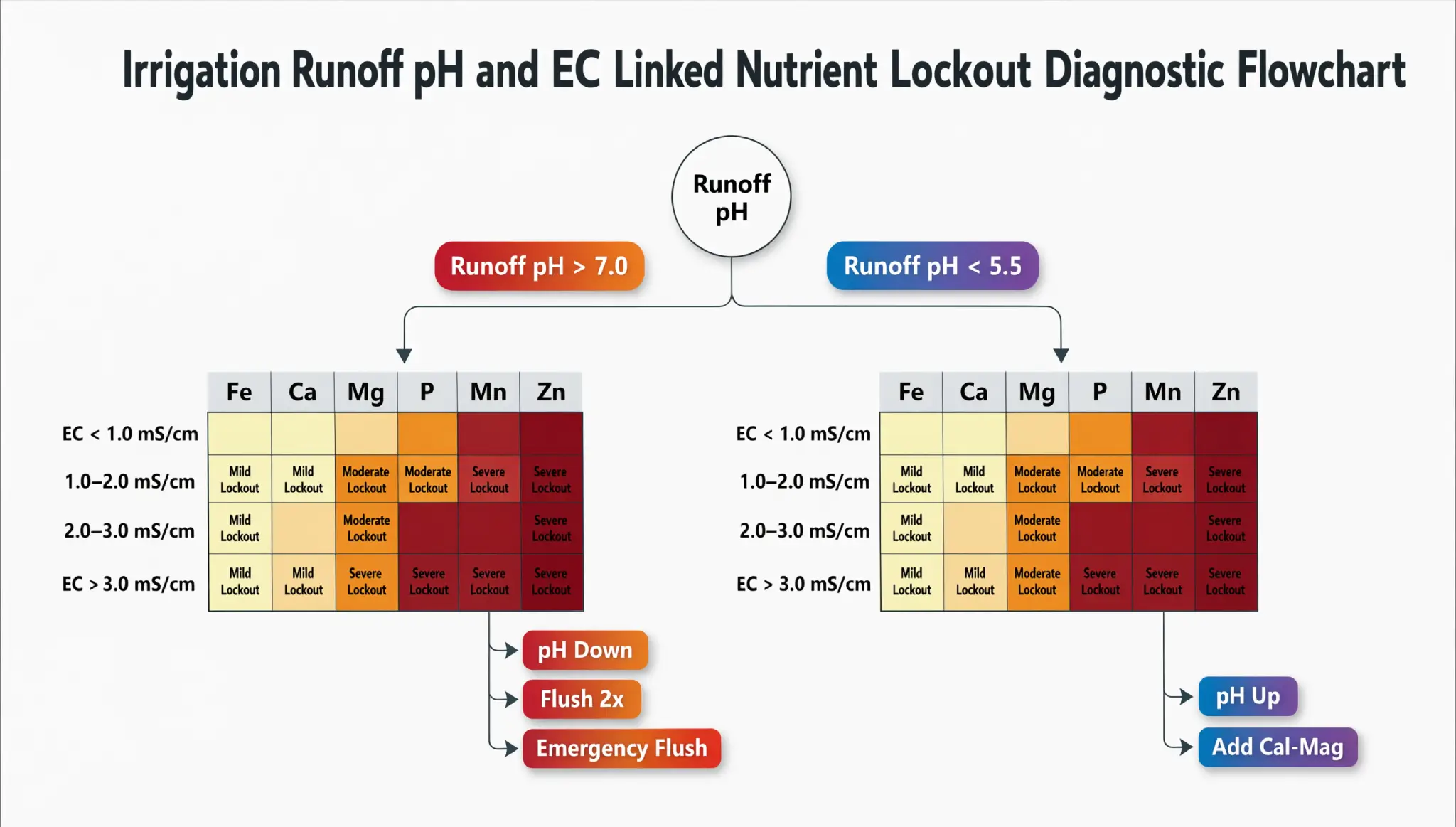
Cannabis Nutrient Lockout Diagnostic Matrix
This matrix is the information gain asset behind our consulting work: it correlates measurable runoff pH and EC deviations with the specific nutrients they lock. Generic deficiency charts cannot do that.
How to Use the Diagnostic Matrix
- Measure runoff pH and runoff EC with calibrated meters
- Locate your value pair in the grid
- Identify the primary locked nutrient (bold)
- Note secondary deficiencies (regular text)
- Execute the matching flush protocol from the previous section
| Runoff pH Range | Runoff EC Range | Primary Locked Nutrient | Secondary Deficiencies | Rootzone Condition | Immediate Action |
|---|---|---|---|---|---|
| 7.2 – 7.5 | 1.0 – 2.0 mS/cm | Iron (Fe) | Manganese, Phosphorus | Mild alkaline drift | pH down to 6.5, monitor 48 hrs |
| 7.5 – 8.0 | 2.0 – 3.5 mS/cm | Iron (Fe), Phosphorus (P) | Manganese, Zinc, Copper | Moderate lockout | Flush with pH 6.0 water, 2x volume |
| > 8.0 | > 3.5 mS/cm | Ca, Mg, Fe, P (Multiple) | All micronutrients | Severe alkaline lockout | Emergency flush + root inoculant |
| 5.0 – 5.5 | 1.0 – 2.5 mS/cm | Calcium (Ca) | Magnesium, Molybdenum | Mild acidic drift | pH up to 6.2, add Cal-Mag |
| 4.5 – 5.0 | 2.0 – 4.0 mS/cm | Calcium (Ca), Magnesium (Mg) | Phosphorus, Potassium | Moderate acid lockout | Flush with pH 6.5 water, 3x volume |
| < 4.5 | > 4.0 mS/cm | Mn/Al Toxicity + Ca/Mg Lockout | Root damage, all nutrients | Critical acid toxicity | Emergency flush + root rebuild |
| 6.2 – 6.8 (Optimal) | > 4.0 mS/cm | None (Salt Stress) | Osmotic stress symptoms | Overfeeding without lockout | Flush with pH-corrected water |
Counter-Intuitive Insights From the Matrix
High EC does not equal lockout. High runoff EC at optimal pH (6.2–6.8) means salt accumulation without chemical lockout; the fix is flushing, not pH adjustment. True lockout requires pH deviation plus deficiency symptoms.
Ca:Mg ratio outweighs absolute values. Between pH 6.5 and 7.0, calcium stays available while magnesium locks, because magnesium’s smaller ionic radius binds weaker. Hold a 2:1 to 3:1 Ca:Mg feed ratio to defuse the antagonism.
Phosphorus locks at both extremes. Below pH 6.0 it binds iron and aluminum; above pH 7.0 it binds calcium. That narrow bell curve explains phosphorus deficiency in both acidic and alkaline lockout.
Common Diagnostic Errors
Testing input water only. Input pH says nothing about the rootzone; runoff pH does. Always test runoff.
Ignoring EC trends. Track 7–14 day trends: rising runoff EC on stable input EC means salt accumulation; falling runoff EC on high input EC means root uptake failure.
Misreading nitrogen. Nitrogen stays available from pH 5.0–8.0, so uniform yellowing at optimal pH is a true N deficiency, not lockout. Cross-check symptoms against the flush protocol above before you change feed strength.
Preventing pH Drift and Cation Imbalance
Prevention is where growing weed ph management pays its biggest dividends. Drift starts in three places: your water source, your feed formula, and your aging medium.
Water Source Management
- Municipal water: aerate 24 hours, test alkalinity (KH >100 ppm resists adjustment), lower pH with citric or phosphoric acid
- Reverse osmosis water: add cal-mag (2 ml/gallon minimum) plus potassium bicarbonate (0.5 g/gallon) to rebuild buffering
- Well water: test annually for calcium hardness (50–150 ppm), magnesium (25–75 ppm), bicarbonates (50–100 ppm), and sodium (<50 ppm)
Fertilizer Salt Management
Measure input and runoff EC at every watering and track the delta:
- Delta EC <0.3: normal consumption
- Delta EC 0.3–0.8: mild accumulation, monitor closely
- Delta EC >0.8: severe buildup, flush now
Avoid formulas with ammonium above 25% of total N, high potassium without cal-mag, or vegetative phosphorus over 100 ppm. Rebalance late-flower Ca:K ratios with a blend-calculator workflow before nutrient lockout during flower prints onto your canopy.
Medium Degradation and Re-Amendment
Container media lose buffering on a schedule: months 1–3 optimal, months 4–6 moderate drift (±0.5), months 7–9 severe drift (±1.0), month 10+ CEC exhaustion.
At month 6, re-amend with dolomite lime (2 tbsp/gallon), gypsum (1 tbsp/gallon), and a 20% compost top dress to restore CEC.
Advanced Rootzone Management for Commercial Grows
Rootzone Oxygenation
Dissolved oxygen under 5 ppm cuts uptake efficiency and feeds anaerobic pathogens. Add 20–30% perlite or pumice to soil, keep coco coarse, and hold hydroponic DO above 8 ppm with air stones.
Chelated Micronutrients: EDTA vs. EDDHA
EDTA chelates collapse above pH 6.5. For alkaline systems, switch to EDDHA-chelated iron, stable to pH 9.0: dose EDTA-Fe at 2–5 ppm below pH 6.5, and EDDHA-Fe at 5–10 ppm above it.
Foliar Feeding as a Lockout Bypass
Severe nute lock weed scenarios justify foliar support while rootzone chemistry recovers. Use chelated micronutrients only, 0.1% surfactant, pH 6.0–6.5, applied at lights-off or early morning.
Foliar cannot replace root uptake for calcium, magnesium, or phosphorus. Treat it as emergency support, not a feeding route.
Mycorrhizal Inoculation
Arbuscular mycorrhizal fungi extend the absorption zone 100–1000x and secrete organic acids that solubilize locked phosphorus. Inoculate at transplant, use endomycorrhizal species, keep phosphorus under 50 ppm for 14 days, and re-inoculate after every flush.
Conclusion: Mastering Growing Weed pH Management
Growing weed ph management is a solvable chemistry problem, not a plant disease. Hold soil at 6.2–6.8 and soilless at 5.8–6.2, log runoff pH and EC at every watering, and flush with 2–3x container volume the moment the matrix flags drift.
- Lockout is chemistry, not deficiency: correct pH before adding nutrients
- Soil 6.2–6.8, soilless 5.8–6.2: never share one target across mediums
- Runoff beats input: diagnose with runoff pH/EC deltas, not feed guesses
- Flush 2–3x volume, then rebuild roots with mycorrhizal inoculants
- Organic soil needs 7–14 days and compost tea, never plain water
- Prevent with monitoring: log every watering, re-amend media at month 6
Verify meter drift against lab benchmarks with our growing weed ph kit-vs-lab comparison. Master these rootzone habits, and a 0.5 pH swing never costs you a harvest again.