When it’s time to raise your soil’s pH, neutralize acidic soil, and bring your lawn back to life, you are immediately faced with a choice at the garden center. Do you buy the cheap, dusty bags of powdered agricultural lime, or do you pay a premium for the clean, easy-to-spread pellets? If you look purely at the price tag on the shelf, the decision seems obvious. But smart homeowners, landscapers, and farmers know that the sticker price is only a fraction of the actual expense.
To make the right choice, we need to look beyond the bag price. We need to calculate the True Cost Matrix, a comprehensive breakdown that factors in material costs, equipment rentals, physical labor time, safety gear, and the hidden headaches of dust cleanup. By the end of this guide, you will know exactly which lime to buy based on your specific lawn size, your equipment, and your willingness to sweat. (Pro Tip: Before buying anything, use our free Lime Rate Calculator to determine exactly how many pounds of lime your specific soil test requires.)
Types of Lawn Lime: The Chemical Difference
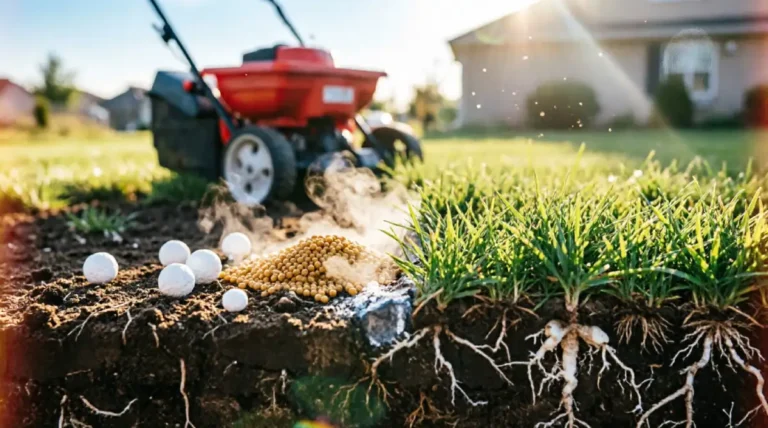
Before we talk about money and muscle, let’s clear up the chemistry. When exploring the different types of lawn lime, such as calcitic vs. dolomitic lime, the physical form (powder vs. pellet) doesn’t change the active ingredient. Chemically speaking, there is zero difference between the two physical forms we are discussing today. Both agricultural and pelletized lime are made from crushed limestone (calcium carbonate) and will effectively raise soil pH. They share a similar Calcium Carbonate Equivalent (CCE), meaning their neutralizing power is identical.
Understanding agricultural lime vs pelletized lime requires recognizing that you are paying for physical convenience, not a better chemical reaction. Pulverized lime acts slightly faster out of the gate because its fine powder has a higher surface area exposed to soil moisture. However, pelletized lime breaks down and dissolves just as rapidly once it gets wet. The end result for your grass, garden, or crops is exactly the same.
The “True Cost Matrix”: Breaking Down the Real Expenses
To find the real cost, we have to look at the four pillars of lawn care application: Material, Equipment, Labor, and Cleanup. Let’s break them down.
1. Material Costs (The Bag Price)
If you look purely at the ag lime cost per bag, pulverized agricultural lime is the undisputed winner. A standard 40-pound bag of pulverized lime typically costs between $5 and $7. In contrast, the pelletized lime price usually ranges from $10 to $15 per 40-pound bag. For a large property, this upfront savings on material is massive.
2. Equipment, Rental Fees & Safety Gear
This is where the math starts to shift. Pelletized lime flows beautifully through a standard, push-style broadcast spreader that most homeowners already own in their shed. Cost: $0.
Pulverized lime, however, is a nightmare for push spreaders. The fine powder clumps, clogs the holes, and distributes unevenly. To apply pulverized lime effectively, you need a tow-behind spreader with an agitator. If you don’t own a riding mower or ATV to pull it, you will have to rent one. Expect to pay between $50 and $75 for a one-day rental.
The Hidden Equipment Cost: Pulverized lime creates a massive amount of airborne dust. If you are applying it manually or loading a tow-behind, you must factor in the cost of Personal Protective Equipment (PPE). You will need a high-quality N95 respirator mask and safety goggles to prevent severe eye and lung irritation. Pelletized lime requires zero PPE.
3. Labor Time & Physical Effort
The debate of pulverized lime vs pelletized is ultimately a debate about your back and your weekend. Hauling 40-pound bags is required for both, but the application process is vastly different.
- Pelletized Lime: Pour it into your push spreader and walk. It’s clean, fast, requires minimal physical exertion, and allows for precise spreader calibration.
- Pulverized Lime: You are hauling heavy, awkward bags to a tow-behind spreader. You have to pour the fine powder into the hopper without spilling it. When the hopper inevitably clogs due to humidity, you have to reach in and clear it with your hands (while wearing gloves and a mask). The physical labor time is easily tripled compared to pellets.
4. The Hidden Cost: Dust Cleanup & Environmental Runoff
This is the most overlooked factor. Pulverized lime is essentially fine white dust. When it blows onto your driveway, it leaves a chalky white residue that requires intense sweeping and hosing to remove. If it blows onto your house siding, dark windows, or car paint, it can cause staining and etching if not washed off immediately. Furthermore, heavy dust application near sidewalks can wash into storm drains, altering the pH of local waterways. The “dust-cleanup cost” includes your water bill, the physical time spent sweeping hardscapes, and the potential cost of repainting or detailing.
Quick Glance: Pros and Cons
| Feature | Pelletized Lime | Pulverized Ag Lime |
|---|---|---|
| Upfront Bag Cost | Higher ($10-$15/bag) | Lower ($5-$7/bag) |
| Application Equipment | Standard push broadcast spreader | Tow-behind spreader with agitator |
| Dust & Mess | Virtually dust-free | Highly dusty, requires PPE |
| Speed of Application | Fast and easy | Slow, labor-intensive |
| Best For | Residential lawns & gardens | Farms, pastures, & 1+ acre properties |
Understanding Pelletized Lime vs Ag Lime Rates
A common misconception is that you need to apply more of one type than the other. When comparing pelletized lime vs ag lime rates, the chemical application rate (e.g., 50 lbs per 1,000 sq ft) remains identical because their Calcium Carbonate Equivalent (CCE) is the same. Your soil test dictates the poundage, not the physical form. However, your spreader calibration rate will differ. Pellets flow through a broadcast spreader much faster and more evenly than fine powder, meaning you won’t have to double-back over your lawn to fix clumps and uneven distribution.
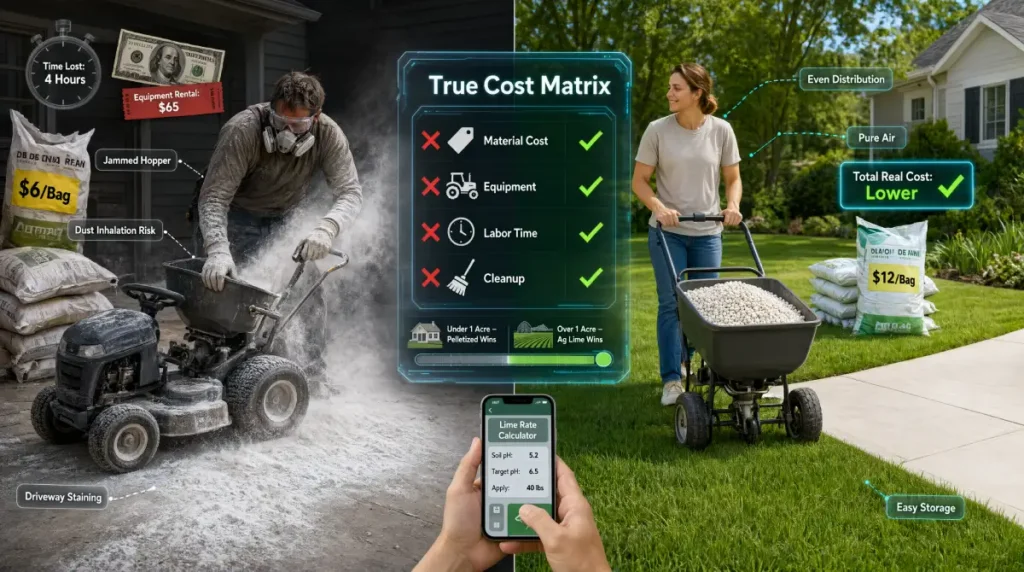
The True Cost Matrix: By the Numbers
Let’s put this into perspective with a real-world scenario. Imagine you have a 5,000 square foot lawn that requires a standard application of 50 lbs of lime per 1,000 sq ft (Total: 250 lbs, or roughly seven 40-lb bags).
| Cost Factor | Pelletized Lime (Push Spreader) | Pulverized Ag Lime (Tow-Behind Rental) |
|---|---|---|
| Material Cost (7 bags) | $84.00 (at $12/bag) | $42.00 (at $6/bag) |
| Equipment & PPE Cost | $0.00 (Use existing push spreader) | $85.00 ($65 rental + $20 for mask/goggles) |
| Labor Time | 45 Minutes (Easy walking) | 2.5 Hours (Hauling, loading, unclogging) |
| Cleanup Time | 10 Minutes (Rinse spreader) | 1 Hour (Sweep driveway, wash siding) |
| Total Out-of-Pocket Cost | $84.00 | $127.00 |
| Total Time Invested | Under 1 Hour | 3.5 Hours of hard labor |
As the matrix reveals, for a smaller lawn, pulverized lime actually costs significantly more out of pocket once you factor in the equipment rental and safety gear, and it costs you hours of grueling physical labor.
The Verdict: Which Lime Should You Choose Based on Lawn Size?
So, when does the cheap bag price of pulverized lime actually outweigh the costs of equipment and labor? The answer comes down entirely to the square footage of your property. Remember, use our Lime Rate Calculator to input your soil test results and get your exact tonnage requirements before deciding.
Under 5,000 Sq. Ft.: The Pelletized Winner
If you have a standard suburban property, always choose pellets for a pelletized lime lawn application. The material savings of pulverized lime will be completely wiped out by the cost of renting a tow-behind spreader and buying PPE. Furthermore, the physical labor and dust cleanup are simply not worth the $40 you might save on bags. Save your back and your weekend; buy the pellets.
5,000 to 10,000 Sq. Ft.: The Tipping Point
This is the gray area. If you already own a riding mower and a tow-behind spreader, pulverized lime starts to make financial sense here because your equipment cost is $0. However, if you have to rent the equipment, or if your property features a lot of hardscaping, patios, and dark-sided houses that will show the white dust, stick to pelletized. If you have a massive, open, obstacle-free yard and don’t mind sweating, go with pulverized.
Over 1 Acre: The Ag Lime Champion
Once you cross the one-acre threshold (43,560 sq ft), the math flips entirely in favor of agricultural lime. At this size, buying 100+ bags of pelletized lime will cost you a small fortune. Instead, you can have a bulk ton of pulverized ag lime delivered directly to your driveway for a fraction of the cost. You will need to rent a heavy-duty tow-behind spreader, or hire a local landscaping company with a lime truck to blast it across your property in minutes. For acreage, the sheer volume of material makes the low ag lime cost per ton the only logical choice.
Pro Tips for Getting the Most Out of Your Lime Application
Regardless of which side of the matrix you fall on, follow these rules to ensure your lime actually works:
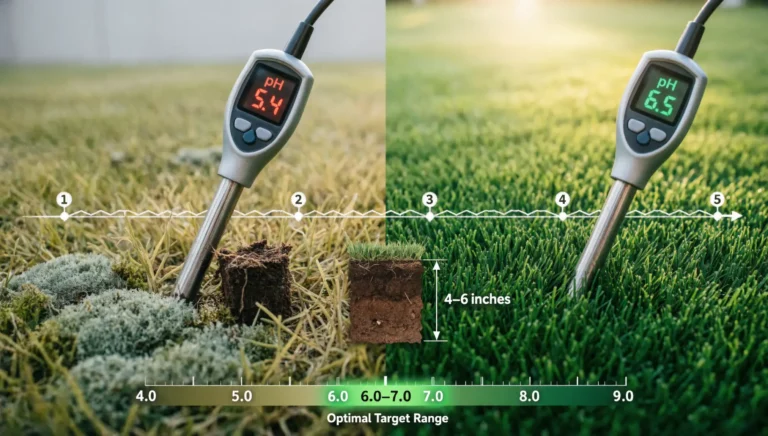
- Test Before You Apply: Never guess your soil pH. Use a cheap mail-in soil test kit from your local university extension office to determine exactly how many pounds of lime you need per 1,000 sq ft.
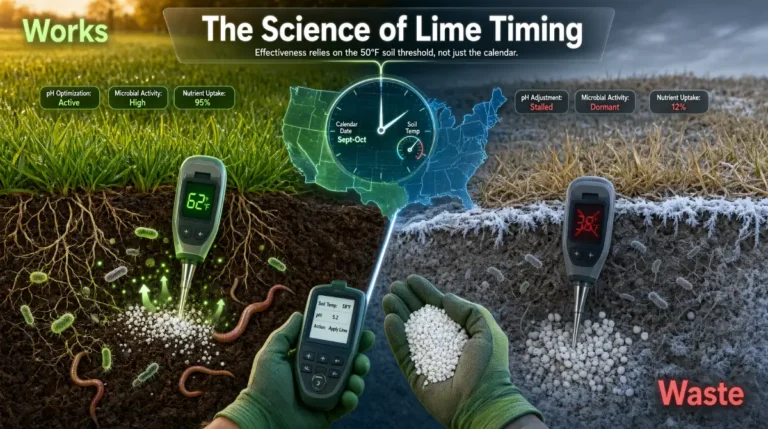
- Water it In: Both forms need moisture to break down. For a complete step-by-step guide on watering and timing, read our full guide on applying lime to lawns. Apply lime right before a good rainstorm, or water your lawn deeply (about 1/4 inch) immediately after application.
- Aerate First: If your soil is heavily compacted, core aerate your lawn before applying lime. This allows the calcium to reach the root zone much faster.
- Don’t Overdo It: Applying too much lime at once can lock out other essential nutrients like iron and manganese, causing your grass to turn yellow. If your soil test recommends more than 50 lbs per 1,000 sq ft, split the application into two doses, six months apart.
Final Thoughts
The choice between agricultural lime and pelletized lime isn’t just about what’s in the bag; it’s about what’s in your wallet, your shed, and your schedule. By using the True Cost Matrix, you can look past the deceptive sticker price of pulverized lime and make a data-driven decision. For the average homeowner with a standard-sized yard, the convenience, cleanliness, and hidden cost-savings of pelletized lime make it the undisputed champion. But if you are managing acres of land, the raw, unrefined power of bulk ag lime is the way to go. Ready to start? Calculate your exact lime needs now and get your soil ready for a massive growing season.