The Short Answer
Yes, you can apply fertilizer and lime at the same time, but with strict conditions. Applying lime and fertilizer at the same time is safe only if you use nitrate-based or potassium fertilizers. Never mix lime with urea or ammonium-based fertilizers, as the chemical reaction will cause your nitrogen to turn into gas and escape into the atmosphere, wasting your money. Always apply them in separate passes and water them in immediately.
Understanding the chemistry behind fertilizer-lime interactions isn’t just academic, it directly impacts your wallet and your lawn’s health. When incompatible materials meet, you can lose up to 40% of your nitrogen investment to ammonia volatilization.
Before we break down the chemistry, do you know exactly how much lime your lawn needs? Over-applying lime locks up nutrients, while under-applying wastes your time.
🧮 Calculate Your Exact Lime Requirements
Don’t guess. Use our free tool to calculate the exact amount of lime your soil needs based on your soil test results and lawn size.
The Chemistry Clash: What Really Happens in Your Soil
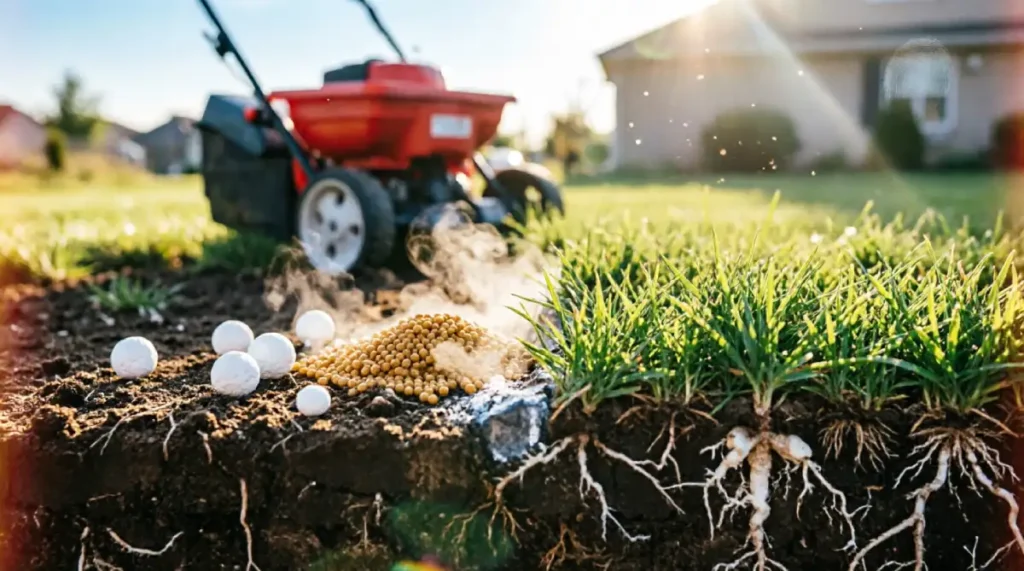
When lime (calcium carbonate) meets ammonium-based fertilizers, a chemical reaction occurs that increases soil pH at the microsite level. This sudden pH spike triggers a process called ammonia volatilization, where valuable nitrogen converts into ammonia gas and escapes into the air.
The Urea-Lime Disaster
Standard lawn fertilizers containing Urea present the highest risk when mixed with lime. Urea naturally reacts with the soil enzyme urease. When you add lime to the equation, the alkaline environment accelerates the conversion of ammonium to ammonia gas, dramatically increasing your nitrogen loss.
Safe to Mix vs. Keep Separate: Your Lawn Care Cheat Sheet
Not all fertilizers react poorly with lime. Here is exactly what you can and cannot mix based on your fertilizer’s N-P-K ratio.
| Fertilizer Type | Mix with Lime? | Risk Level | Why? |
|---|---|---|---|
| Urea (46-0-0) & Quick-Release Lawn Foods | ❌ NO | HIGH | Causes rapid ammonia gas loss, reducing nitrogen efficiency. |
| Ammonium Sulfate (21-0-0) | ⚠️ CAUTION | MOD | Alkaline conditions from lime can cause ammonium nitrogen to volatilize. |
| Calcium Nitrate | ✅ YES | LOW | Nitrate-based fertilizers have minimal volatilization risk. |
| Potassium Chloride (Muriate of Potash) | ✅ YES | LOW | Potassium fertilizers can generally be applied with lime safely. |
| Slow-Release Nitrogen (e.g., Milorganite, Poly-Coated) | ✅ YES | LOW | The coating prevents immediate chemical interaction with the lime. |
Timing Strategy: When to Lime and Fertilize at the Same Time
The Golden Rule: Lime First, Fertilizer Later
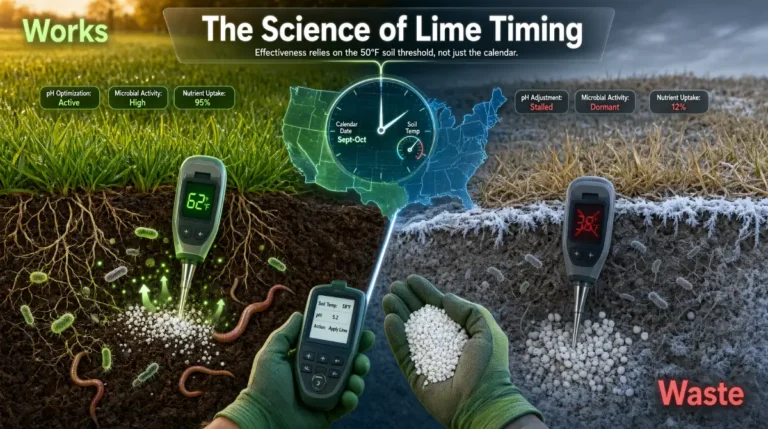
Since limestone can take 3 to 6 months to fully raise soil pH, the absolute best practice is to apply lime in the fall, and fertilize in the spring. This gives the lime time to neutralize soil acidity without interfering with your spring nitrogen applications.
What If I Must Apply Both on the Same Day?
If you are short on time and must fertilize and lime at same time, follow these strict rules to protect your investment:
- Never mix them in the spreader. Apply them in two completely separate passes.
- Check your fertilizer bag. Ensure it does not contain high levels of urea or ammonium sulfate.
- Water it in immediately. Apply at least 1/4 inch of irrigation right after spreading to push the lime and fertilizer into the soil profile, stopping the surface chemical reaction.
Environmental Factors That Increase Nitrogen Loss
Even if you follow the rules, certain weather conditions can amplify volatilization losses when applying lime and fertilizer together:
- Warm temperatures: Volatilization increases drastically when soil temperatures are above 70°F.
- High soil pH: If your soil is already above 7.0, adding more lime creates a highly alkaline surface that forces nitrogen into gas form.
- Dry, windy conditions: Wind pulls the ammonia gas away from the soil surface as it dries.
Real-World Lawn Care Scenarios
Scenario 1: The Standard Home Lawn
Situation: Your soil test shows pH 5.8 and recommends lime plus a spring nitrogen fertilizer.
The Fix: Apply pelletized lime now. Wait 2 to 4 weeks before applying your standard lawn fertilizer. If you absolutely must apply fertilizer and lime at same time today, use a slow-release, poly-coated fertilizer and water both products in immediately.
Scenario 2: Starting a New Garden Bed
Situation: You are tilling a new garden bed and need to amend the soil before planting vegetables.
The Fix: Till the lime into the soil first. Wait 2 weeks. Then apply your granular garden fertilizer and till it in lightly. Because both are incorporated into the soil (not sitting on the surface), the risk of nitrogen gas loss is near zero.
🌾 Note for Commercial Growers & Large Acreage
For large-scale agriculture, the stakes are higher. Research shows that for each 1 Mg ha⁻¹ of surface-applied lime, ammonia volatilization from urea increases by 1.7–2.2% in no-till systems. A typical 2-ton/acre lime application can increase nitrogen losses by 3-4%. Commercial operators should strictly separate UAN and Urea applications from surface liming by at least 3 weeks, or use NBPT urease inhibitors if simultaneous application is unavoidable.
📚 Continue Your Soil Health Journey
Mastering soil pH is just the beginning. Dive deeper into our related cluster guides:
Key Takeaways for a Healthy Lawn
- Never mix urea or ammonium-based fertilizers directly with lime.
- Apply lime 3-6 months before fertilizer when possible (Fall lime, Spring fertilizer).
- Minimum 2-4 week waiting period if applying in the same season.
- Always apply in separate passes, never mix them in the spreader.
- Water your lawn immediately after applying either product to push it into the soil.