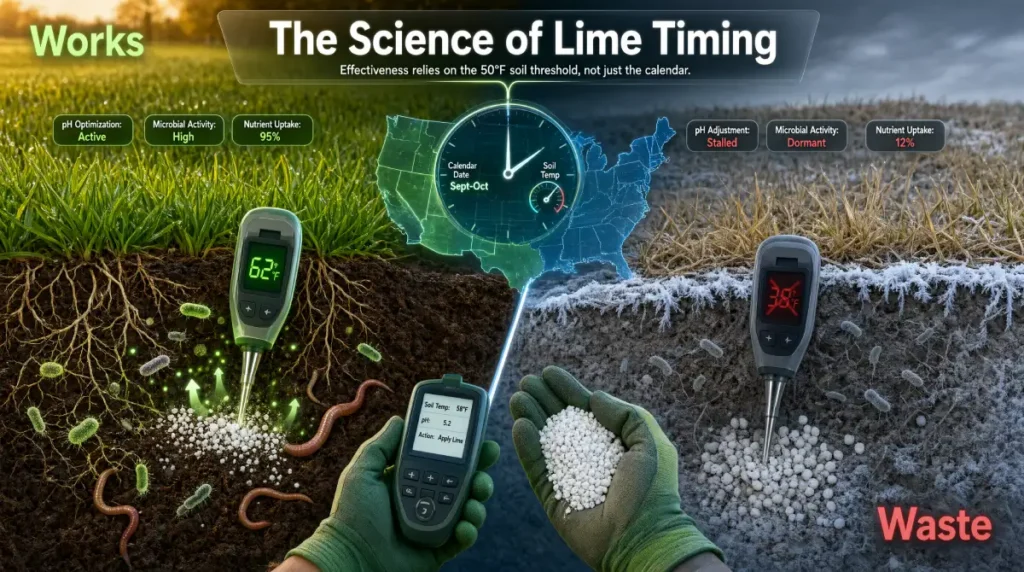
Most lawn care websites give you the same generic advice: “Apply lime in the fall.” But here’s the problem, that advice ignores the single most important factor that determines whether your lime application actually works: soil temperature. Lime works best when soil is above 50°F and beneficial soil microbes are actively breaking it down. Apply it when the soil is too cold, and you’re essentially wasting your time and money.
The best time for lime on lawn isn’t just about the season, it’s about matching your application to soil temperature patterns, grass type, and your specific USDA hardiness zone. This guide provides something you won’t find anywhere else: specific timing recommendations based on actual soil temperature data, not just vague seasonal suggestions.
Key Takeaways: Best Time for Lime on Lawn
- Soil temperature must be above 50°F for lime to activate properly
- Fall application (September-October) is ideal for Zones 2-6
- Spring application (March-May) works best for Zones 7-10
- Lime takes 3-4 months to fully react with soil
- Never apply lime to frozen ground or during summer heat stress
Why Soil Temperature Above 50°F Is Critical for Lime Effectiveness
Lime doesn’t work like fertilizer. It’s not immediately absorbed by your grass. Instead, lime needs soil microbes to break it down and neutralize acidity, and these microscopic workers have very specific temperature requirements.
The Microbial Activity Connection
Soil microorganisms are the engine that drives lime’s pH-adjusting power. For most microbes, activity doubles for every 10°F that the temperature rises, starting with soil temperatures around 60°F until about 85°F when activity peaks. Below 50°F, microbial activity slows dramatically, which means your lime sits in the soil largely inactive.
Research shows that soil microorganisms become critical biological indicators for evaluating soil health, and temperature directly drives microbial function, which in turn drives plant growth. When soil temperatures drop below 50°F, microbial growth and nitrogen mineralization rates plummet, severely limiting lime’s effectiveness.
The Four-Month Rule
Lime takes approximately four months to fully react with the soil. This is why timing matters so much. If you apply lime when soil temperatures are already dropping below 50°F, you’re giving it minimal time to work before winter dormancy sets in. The ideal scenario is applying lime when soil temperatures are consistently above 50°F and will remain so for at least 3-4 months.
When to Use Lime in the Garden vs. Lawn: Key Differences
While the best time for lime on lawn applications follows specific seasonal patterns, knowing when to use lime in the garden requires slightly different timing considerations. Gardens and lawns have distinct needs:
Garden-Specific Timing Considerations
Vegetable Gardens: Apply lime 2-3 months before planting your spring crops. For fall gardens, apply in early summer. This gives lime adequate time to adjust pH before sensitive vegetables need to access nutrients.
Flower Beds: The best time is late fall after plants go dormant, or early spring before new growth emerges. This prevents root burn and allows pH adjustment during the plant’s rest period.
Fruit Trees and Berries: Apply lime in late winter or early spring, at least 6 weeks before bud break. Blueberries and acid-loving plants typically don’t need lime, only apply if soil tests confirm pH is too low.
New Garden Beds: When establishing new beds and applying lime to gardens, do it during initial soil preparation, ideally 3-6 months before planting. This gives maximum time for pH adjustment.
Lawn vs. Garden: Application Timing Comparison
| Factor | Lawn | Garden |
|---|---|---|
| Best Season | Fall (Zones 2-6), Spring (Zones 7-10) | Fall after harvest or early spring before planting |
| Soil Temperature | Above 50°F for 3-4 months | Above 45°F acceptable |
| Lead Time | 3-4 months before peak growing season | 2-3 months before planting |
| Frequency | Every 3-4 years | Every 2-3 years or per crop rotation |
USDA Zone-by-Zone Lime Application Calendar
Use this regional guide to identify your optimal lime application window. These recommendations are based on historical soil temperature patterns and the 50°F threshold for microbial activity.
Zones 2-3 (Northern Minnesota, North Dakota, Montana, Northern Maine)
Best Time for Lime on Lawn: Late May through mid-July
Secondary Window: Early September (risky, soil cools quickly)
When to Use Lime in the Garden: Late May after last frost, or early September for fall crops
In these northern zones, soil temperatures don’t consistently reach 50°F until late May. You have a narrow window from late spring through mid-summer. Avoid fall applications after mid-September because soil temperatures drop rapidly, often falling below 50°F by October. If you miss the spring window, wait until the following year, applying lime in cold soil is ineffective.
Zones 4-5 (Wisconsin, Michigan, Southern Minnesota, Iowa, Northern Illinois)
Best Time for Lime on Lawn: Mid-April through June
Secondary Window: Early September through early October
When to Use Lime in the Garden: April for spring crops, September for fall crops
These upper Midwest zones offer two viable windows. Spring applications should begin once soil temperatures stabilize above 50°F, typically mid-to-late April. Fall applications must be completed by early October to ensure four months of microbial activity before the ground freezes.
Zone 6 (Pennsylvania, Ohio, Indiana, Southern Illinois, Missouri, Virginia)
Best Time for Lime on Lawn: Early April through May
Secondary Window: Mid-September through mid-October
When to Use Lime in the Garden: March-April or September-October
Zone 6 provides excellent flexibility. Spring soil temperatures typically cross the 50°F threshold in early April. Fall applications have a comfortable window from mid-September through mid-October, giving lime adequate time to react before winter.
Zone 7 (Maryland, Delaware, Southern Virginia, North Carolina, Tennessee, Northern Arkansas)
Best Time for Lime on Lawn: Mid-March through May
Secondary Window: Late September through early November
When to Use Lime in the Garden: March or October-November
In Zone 7, you can apply lime earlier in spring (mid-March) and later in fall (early November) because soil temperatures remain above 50°F longer. This extended window makes Zone 7 ideal for lime applications.
Zone 8 (Coastal Virginia, South Carolina, Georgia, Alabama, Northern Florida)
Best Time for Lime on Lawn: Early March through May
Secondary Window: October through mid-November
When to Use Lime in the Garden: February-March or October-November
Zone 8’s mild winters mean soil temperatures stay above 50°F for extended periods. You can apply lime in early spring (March) or take advantage of the long fall window extending into mid-November.
Zones 9-10 (Southern Florida, Coastal Texas, Southern California)
Best Time for Lime on Lawn: February through April
Secondary Window: October through December
When to Use Lime in the Garden: Year-round except peak summer
These warm zones have the most flexible timing. Soil temperatures rarely drop below 50°F, so lime can be applied almost year-round. However, avoid summer applications during peak heat stress when lawns are dormant or stressed.
Zones 11+ (Tropical Florida, Hawaii)
Best Time for Lime on Lawn: Any time except peak summer heat
When to Use Lime in the Garden: Any time, avoid drought periods
Tropical zones maintain soil temperatures well above 50°F year-round. Apply lime whenever convenient, but avoid periods of drought or extreme heat stress.
Grass Type Matters: Cool-Season vs. Warm-Season Timing
The best time for lime on lawn also depends on your grass type. Different grasses have different growing seasons and pH preferences:
Cool-Season Grasses (Kentucky Bluegrass, Fescue, Ryegrass)
Optimal Timing: Early fall (September-October) or early spring (April-May)
Why: These grasses grow most actively in cool weather. Applying lime during their peak growing season ensures roots can access nutrients as pH adjusts.
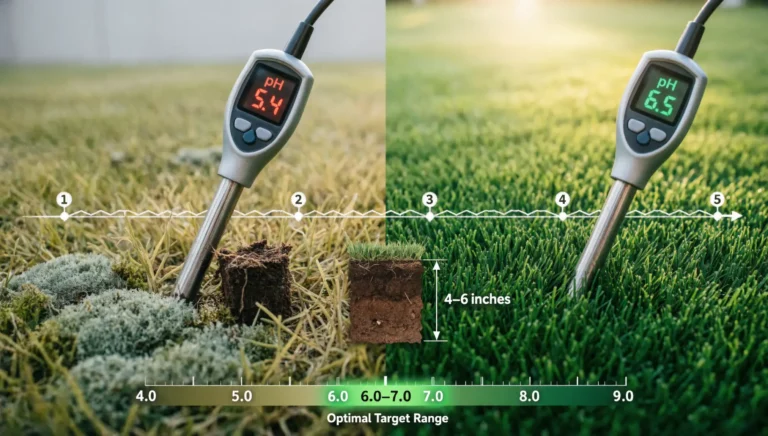
pH Target: 6.0-7.0
Warm-Season Grasses (Bermuda, Zoysia, St. Augustine, Centipede)
Optimal Timing: Late spring (May-June) when grass breaks dormancy
Why: Apply lime as warm-season grasses enter their active growth phase. Avoid fall applications in southern zones, as these grasses are going dormant and won’t benefit from pH adjustment.
pH Target: 5.8-6.5 (varies by species)
Transition Zone Grasses
If you’re in the transition zone (Zones 6-7) where both grass types grow, time your lime application based on your specific grass. For mixed lawns, early fall works best for both types.
Spring Application Risks: The Pre-Emergent Weed Preventer Conflict
Here’s where timing gets complicated. Many homeowners make a critical mistake in spring: applying lime at the same time as pre-emergent weed preventers (especially crabgrass preventers). This creates several problems.
The Timing Collision
Pre-emergent herbicides for crabgrass should be applied when soil temperatures consistently reach 53-55°F for a few days. This is the exact same temperature window when lime becomes effective (above 50°F). The problem? These products don’t play well together.
Why You Shouldn’t Apply Lime and Pre-Emergent Together
While some sources suggest lime and fertilizer can be applied the same day, there is conflict when adding multiple products at once, and you should keep lime and fertilizer at least 2 weeks apart. This is even more critical with pre-emergent herbicides.
Three key reasons to separate these applications:
- Chemical Interaction Risk: Lime can alter soil pH rapidly, potentially affecting the chemical stability and effectiveness of pre-emergent herbicides. The altered pH may cause the pre-emergent to break down faster or bind to soil particles, reducing its weed-control effectiveness.
- Watering Requirements Conflict: Both products need watering to activate, but timing matters. Pre-emergents need consistent moisture to form their chemical barrier in the top 1-2 inches of soil. Lime needs deeper incorporation. Applying both simultaneously can lead to uneven distribution or one product washing away before it’s effective.
- Application Priority: Pre-emergent timing is critical, apply too early and it breaks down before weeds germinate; apply too late and weeds have already sprouted. Lime timing is more flexible. Always prioritize the pre-emergent application window, then apply lime 2-3 weeks later.
The Safe Spring Application Strategy
If you need to apply both lime and pre-emergent in spring, follow this sequence:
Week 1: Apply pre-emergent herbicide when soil temperatures reach 53-55°F (typically when forsythia blooms drop in your area). Water it in according to label directions.
Week 3-4: Apply lime, waiting at least 2-3 weeks after the pre-emergent. This gives the pre-emergent time to establish its chemical barrier without interference from pH changes.
Important: Most traditional pre-emergents require a 12-16 week wait before overseeding, so a spring application usually pushes seeding to fall. Plan accordingly if you’re also planning to seed.
Alternative: Fall Application Avoids the Conflict
The easiest solution? Apply lime in fall and pre-emergent in spring. This eliminates any timing conflict and gives lime the full winter and early spring to react with the soil. Fall is the best time for lime application because it provides maximum time for the material to dissolve and neutralize acidity before the growing season.
Fall vs. Spring: Which Is Better for Your Situation?
Both seasons have advantages. Here’s how to decide the best time for lime on lawn for your specific needs:
Choose Fall Application When:
- Your soil test shows pH is significantly below 6.0 (you need substantial pH adjustment)
- You’re planning to seed or overseed in spring (lime needs 3-6 months before planting)
- You use pre-emergent herbicides in spring (avoids the timing conflict)
- You have cool-season grass (fall is peak growing season, lime works with active roots)
- You live in Zones 2-6 (fall provides consistent moisture and moderate temperatures)
- You want to avoid spring application rush and lawn care conflicts
Fall applications benefit from reliable moisture, moderate soil temperatures, and the absence of competition from other lawn treatments. With a fall application, pH should be ideal by the spring growing season.
Choose Spring Application When:
- You missed the fall window and soil pH is critically low (below 5.5)
- You’re establishing a new lawn or garden bed (apply 2-3 months before planting)
- You live in Zones 7-10 where spring soils warm early and stay warm
- Your soil test was done in fall and showed moderate acidity (pH 5.8-6.2)
- You don’t use pre-emergent herbicides (or you’re willing to wait 2-3 weeks between applications)
- You’re dealing with winter damage and need quick pH correction
Spring applications work well when soil begins to warm, giving lime time to react before summer stress. However, avoid applying to stressed or dormant lawns, which typically occurs in summer.
Type of Lime Matters: Timing Differences
Not all lime is created equal. The type you choose affects both timing and effectiveness:
Calcitic Lime (Calcium Carbonate)
Reaction Speed: Fast, dissolves quickly and adjusts pH within one week
Duration: Shorter-lasting (a few months)
Best Timing: Spring when you need quick pH adjustment
Best For: Lawns needing immediate correction, sandy soils
Dolomitic Lime (Calcium Magnesium Carbonate)
Reaction Speed: Slow, takes several months to fully react
Duration: Long-lasting (2-3 years)
Best Timing: Fall application gives it time to work slowly through winter
Best For: Soils deficient in magnesium, clay soils, long-term pH maintenance
Dolomitic lime reacts more slowly with acid soils than calcitic lime, but both are effective when applied at proper rates. Choose dolomitic lime if your soil test shows magnesium deficiency; otherwise, calcitic lime works well.
Pelletized Lime vs. Pulverized Lime
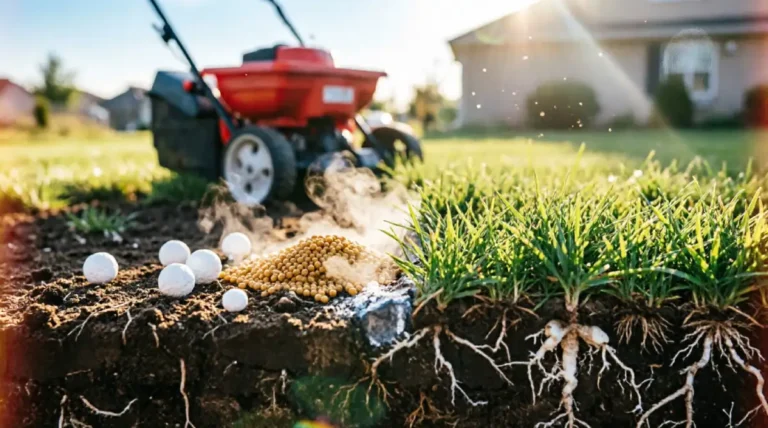
Pelletized Lime: Easier to apply, less dusty, reacts moderately fast. Best for homeowners with broadcast spreaders.
Pulverized (Powdered) Lime: Faster reaction time but harder to apply evenly, creates dust. Best for professional applications.
Hydrated Lime (Calcium Hydroxide)
Reaction Speed: Very fast, provides immediate results
Duration: Short-term
Best Timing: Emergency pH correction only
Warning: High burn risk; not recommended for lawns
Hydrated lime provides rapid results for immediate needs but is rarely recommended for lawns due to burn risk and rapid pH swings. Use only in extreme situations and with extreme caution.
How Often to Reapply Lime Based on Soil Tests
Applying lime isn’t a “set it and forget it” task. Because soil naturally re-acidifies over time due to rainfall, decomposing organic matter, and nitrogen fertilizers, you must monitor your pH levels.
The 3-to-4 Year Rule for Lawns
For most established lawns, you should only reapply lime every 3 to 4 years. However, this is entirely dependent on your soil test results. If your soil pH remains between 6.0 and 7.0, skip the lime application that year. Over-liming can lock up essential micronutrients like iron and manganese, causing your grass to yellow.
Reapplication Frequency for Gardens
Gardens often require more frequent liming, typically every 2 to 3 years, or aligned with your crop rotation schedule. Heavy feeders and frequent harvesting deplete soil buffers faster than a permanent lawn.
Signs You Need to Reapply Sooner
- Heavy Rainfall Regions: Areas with over 40 inches of annual rain leach calcium and magnesium rapidly, requiring more frequent applications.
- Sandy Soils: Sandy soils have low “buffering capacity” and lose their pH balance much faster than heavy clay soils.
- Heavy Fertilizer Use: Synthetic nitrogen fertilizers accelerate soil acidification. If you fertilize heavily, test your soil every 2 years.
Application Rates and Split Applications
If your soil test recommends heavy lime applications, don’t apply it all at once. Follow these guidelines:
Split Application Strategy
Under 50 pounds per 1,000 sq ft: Apply all at once in your chosen window
50-100 pounds per 1,000 sq ft: Apply half in spring, half in fall, then retest the following spring
Over 100 pounds per 1,000 sq ft: Apply 50 pounds in spring, 50 pounds in fall, then retest the following spring and add more if needed
Split applications prevent pH shock to your lawn and ensure more even distribution. Remember, lime can take several months after application to break down, so patience is key.
Regional Considerations and Special Cases
Cool-Season Grasses (Kentucky Bluegrass, Fescue, Ryegrass)
For cool-season grasses, apply lime when soil is around 50°F to 65°F. This typically means early fall (September-October) or early spring (April-May) in most zones.
Warm-Season Grasses (Bermuda, Zoysia, St. Augustine)
Apply lime in late spring or early summer when warm-season grasses are actively growing. Avoid fall applications in southern zones, as warm-season grasses are going dormant and won’t benefit from pH adjustment.
New Lawn Establishment
If you’re establishing a new lawn, apply lime 2-3 months before seeding or sodding. This gives it time to react and adjust pH before grass roots need to access nutrients.
Garden Beds vs. Lawns
Garden beds can be limed in fall or winter just prior to digging, as the lime can take effect over the winter months. For vegetable gardens, apply lime 2-3 months ahead of planting owing to its relatively slow reaction.
Acid-Loving Plants
If you have blueberries, azaleas, rhododendrons, or camellias, do not apply lime near these plants. They thrive in acidic soil (pH 4.5-5.5). Apply lime only to areas with grass or plants that prefer neutral to slightly alkaline soil.
Common Timing Mistakes to Avoid
- Applying to Frozen or Frost-Covered Ground: Lime should not be applied to turf that is wilted or frost-covered. Wait for thaw and active growth.
- Summer Applications During Stress: Never apply lime during summer when lawns are stressed or dormant, as this is typically the most stressful time for your lawn.
- Winter Applications in Cold Zones: Applying lime when soil is below 50°F in Zones 2-6 is wasteful. The lime sits inactive until spring, providing no benefit.
- Same-Day Application with Pre-Emergents: While not dangerous, applying lime and pre-emergent the same day risks reducing the effectiveness of both products. Wait at least 2 weeks.
- Ignoring Soil Test Results: Never apply lime based on guesswork. Always test first, as over-liming can be as problematic as under-liming.
- Applying Before Heavy Rain: While lime needs water to activate, applying immediately before a torrential downpour can wash away surface lime before it incorporates into soil.
- Forgetting About Existing Plants: When liming garden beds, avoid getting lime on the foliage of existing plants, as it can cause leaf burn.
Your Action Plan: Step-by-Step Timing Guide
Step 1: Test Your Soil (Fall or Early Spring)
Collect soil samples when soil is workable and hasn’t been recently amended. Send to a reputable lab and wait for pH recommendations. Test every 3-4 years for lawns, every 2-3 years for gardens.
Step 2: Calculate Your Application Rate
Follow soil test recommendations precisely. If rates exceed 50 pounds per 1,000 sq ft, plan split applications.
Step 3: Choose Your Window Based on Zone
Reference the zone-specific timing guide above. Prioritize fall applications when possible, especially if you use pre-emergent herbicides.
Step 4: Check Soil Temperature
Before applying, verify that soil temperatures are consistently above 50°F. Use a soil thermometer or check local extension service data.
Step 5: Prepare Your Lawn or Garden
Mow your lawn short (but not scalped) before applying lime. For gardens, remove debris and loosen topsoil slightly. Water dry soil 24 hours before application if needed.
Step 6: Apply and Water In
Apply lime evenly using a broadcast or drop spreader. Calibrate your spreader according to the product label. Water immediately after application to begin the reaction process. Avoid heavy rain for 24 hours if possible.
Step 7: Wait and Retest
Allow 3-4 months for lime to fully react, then retest soil pH. Adjust your strategy based on results. Keep records of application dates and rates for future reference.
The Bottom Line: Timing Is Everything
The best time for lime on lawn isn’t a specific month, it’s when soil temperatures are above 50°F and will remain so for at least 3-4 months. For most homeowners, this means:
Zones 2-6: Fall is king. Apply between September and early October for maximum effectiveness before winter dormancy.
Zones 7-8: You have flexibility. Fall (October-November) or spring (March-May) both work well.
Zones 9-11: Apply whenever convenient except during peak summer heat stress. Soil temperature isn’t your limiting factor.
For gardens: When to use lime in the garden depends on your planting schedule. Apply 2-3 months before planting for best results, typically in late fall after harvest or early spring before new growth.
Remember: lime is a long-term soil amendment, not a quick fix. Proper timing ensures you get the maximum benefit from every pound applied. Test your soil, know your zone, watch your soil temperature, and apply when conditions are right, not just because a calendar says it’s “fall.”
By following this zone-specific, temperature-based approach, you’ll avoid the common mistake of applying lime when it can’t work effectively, saving both time and money while achieving healthier soil and a more vibrant lawn or garden.
Need Help Calculating Your Lime Application Rate?
Use our free Lime Rate Calculator to determine exactly how much lime your lawn or garden needs based on your soil test results, soil type, and target pH.