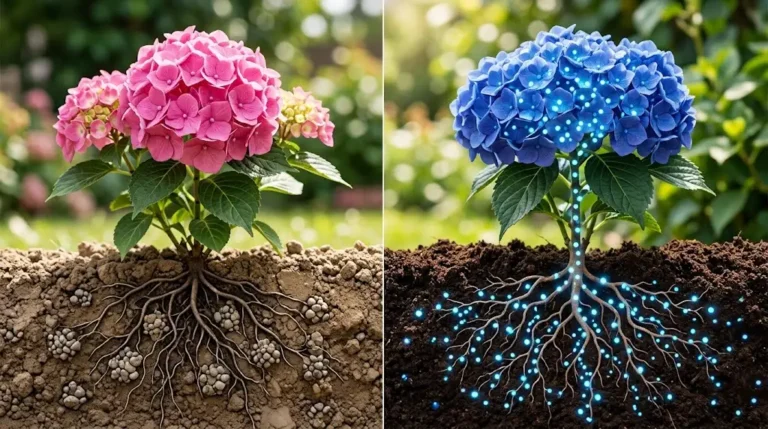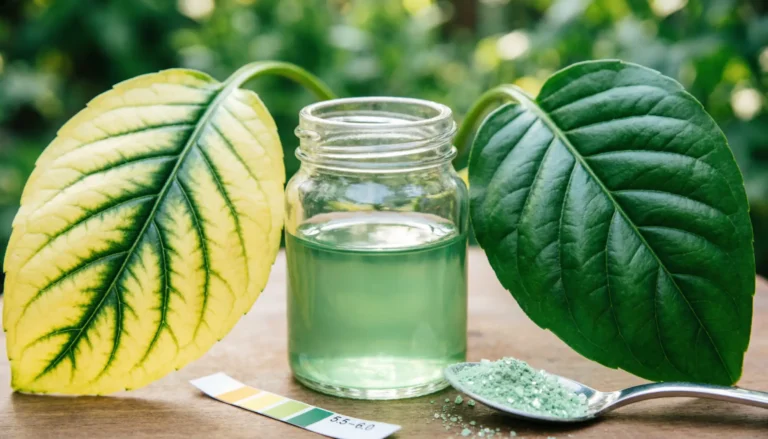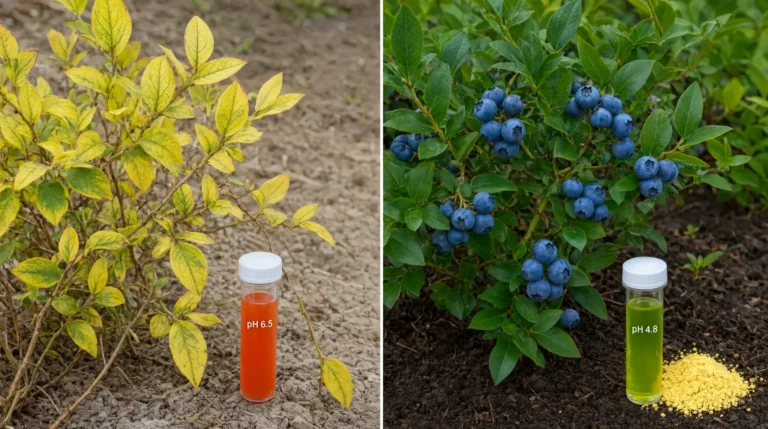
If you are comparing a fertilizer with sulphur for plant nutrition and soil pH correction, the most important distinction is the chemical form of the sulphur. Elemental sulphur fertilizer is the slow-release product that actively lowers soil pH over time. Sulphate sulphur is the instantly available nutrient form, but it does not directly lower pH in the way most growers expect.
Quick answer: Use elemental sulphur fertilizer if your primary goal is to reduce alkaline soil pH. Use sulphate sulphur if your goal is to feed plants quickly and correct a sulphur deficiency during the active growing season.
The Core Difference: Instant Nutrition vs. Slow-Release pH Correction
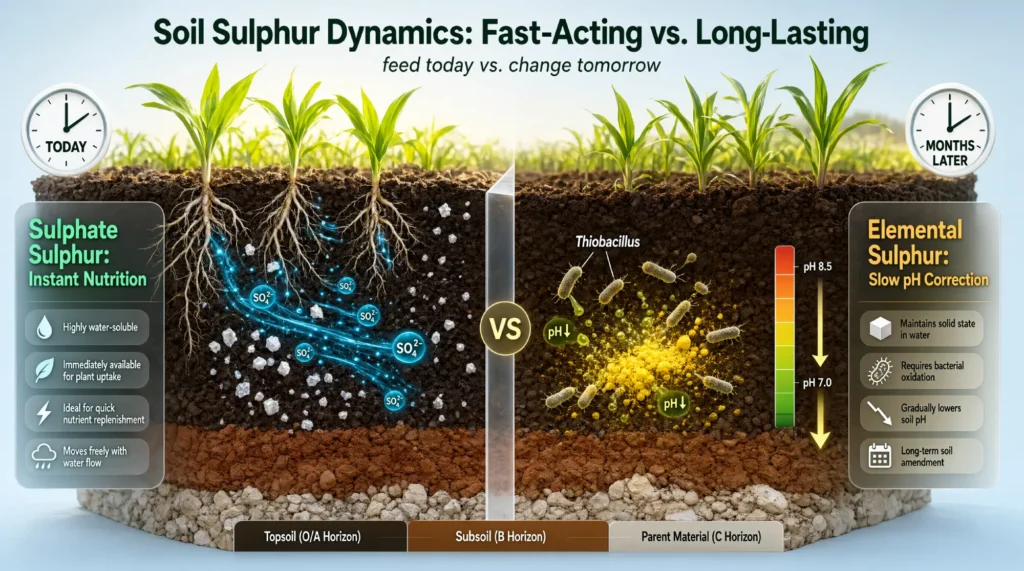
The confusion happens because both products contain sulphur, but they behave entirely differently in the soil profile. One feeds plants immediately; the other changes soil chemistry slowly through microbial activity. Understanding this biological and chemical difference prevents wasted money, incorrect application timing, and disappointing harvest results.
Sulphate Sulphur: Instantly Available, But Not a Direct pH Reducer
Sulphate sulphur is sulphur that is already present in the oxidized form as sulfate (SO₄²⁻). Plant roots absorb sulphur mainly as sulfate, so this form is immediately usable once it dissolves into the soil solution. In moist soil, sulphate sulphur can become available to plant roots within a matter of days. This makes sulfate fertilizers highly useful for fast crop response, especially in high-demand crops such as canola, broccoli, cabbage, onions, corn, wheat, and pasture grasses.
However, sulphate sulphur is primarily a nutrient source. It does not create strong acidity simply by being applied to the soil. Some sulfate fertilizers, especially ammonium sulfate, can gradually acidify soil over time because the ammonium is converted to nitrate by soil microbes. This acidifying effect is much slower and less predictable than the direct pH-lowering effect of elemental sulphur. For this reason, sulphate sulphur should not be chosen as the main product when the primary goal is lowering soil pH.
Elemental Sulphur Fertilizer: Slow-Release pH Correction
Elemental sulphur fertilizer contains sulphur in its pure, unoxidized elemental form (S⁰). Plant roots cannot absorb elemental sulphur directly. Instead, soil bacteria must oxidize it into sulfate. During this biological oxidation process, acidity is produced, which gradually and effectively lowers soil pH. In simple terms: elemental sulphur + oxygen + water + soil bacteria = sulfate + acidity.
Because elemental sulphur fertilizer depends entirely on microbial oxidation, it is not instant. It can take a few weeks in warm, biologically active soil, and several months in cool, dry, or compacted soil. This slow-release behavior is exactly why elemental sulphur fertilizer is valued for long-term pH management and gradual soil conditioning without risking sudden salt burn to plant roots.
Side-by-Side Comparison
| Feature | Elemental Sulphur Fertilizer | Sulphate Sulphur |
|---|---|---|
| Chemical Form | Pure Sulphur (S⁰) | Sulfate (SO₄²⁻) |
| Primary Purpose | Lowering soil pH over time | Immediate plant nutrition |
| Availability to Plants | Slow (Weeks to Months) | Instant (Days) |
| Requires Soil Microbes? | Yes (Bacterial oxidation) | No |
| Effect on Soil pH | Significantly lowers pH | Neutral to slight acidification |
| Common Physical Forms | Powder, Pellets, Bulk Prills | Crystals, Granules, Liquid |
| Spreader-Friendly? | Yes (if pelletized); No (if powder) | Yes (standard granules) |
| Relative Cost per lb of S | Lowest (especially in bulk) | Highest |
Why Elemental Sulphur Fertilizer Takes Months to Work
Elemental sulphur fertilizer is a biological slow-release amendment. Its speed depends on several critical environmental factors. Soil temperature plays a massive role, with faster oxidation occurring in warm soils above 60°F (15°C). Soil moisture is equally vital, because microbes need water to survive but also require oxygen to breathe. Particle size dictates the surface area; finer or micronized sulphur oxidizes much faster than coarse granules. Soil biology must be present, meaning sulfur-oxidizing bacteria (like Thiobacillus) must be active in your soil. Finally, soil buffering capacity matters, because heavy clay, high organic matter, and residual lime naturally resist pH changes.
This means elemental sulphur fertilizer is best applied well before planting or during the off-season. If you apply it in cold soil, results may not appear until conditions warm up and microbial activity increases in the spring.
How to Speed Up Elemental Sulphur
If you need to lower pH quickly using elemental sulphur fertilizer, you can accelerate the microbial process. First, choose micronized or bentonite-coated elemental sulphur, which breaks apart in moisture and exposes more surface area to bacteria. Second, incorporate the sulphur into the top 6 inches of soil rather than leaving it on the surface. Third, ensure the soil is kept consistently moist (but not waterlogged) to encourage bacterial multiplication. Adding a high-quality compost or microbial inoculant can also introduce the necessary Thiobacillus bacteria to the root zone.
Physical Forms: Elemental Sulfur Powder vs. Pelletized vs. Bulk
Elemental sulfur powder (micronized/wettable)
Fastest oxidation due to high surface area. Best incorporated directly into garden beds or agricultural soil. Not ideal for broadcast spreaders due to dust.
Pelletized sulfur for lawns (bentonite/dispersing)
Formed into dust-free prills that break apart upon contact with moisture. This is the standard choice for turf management because it works seamlessly with rotary spreaders.
Bulk elemental sulfur vs. bagged
Bulk sulfur (often purchased by the ton) is the most cost-effective option for large-acreage farming. Bagged sulfur (5-50 lbs) is priced for homeowners and small-scale growers.
Elemental Sulfur for Lawns & Turf
When treating alkaline turf or correcting iron chlorosis, elemental sulfur for lawn applications requires a specific approach. Always use pelletized sulfur for lawns to ensure even distribution via a broadcast spreader.
- Application Rate: Apply 1 to 2 lbs per 1,000 sq ft to lower pH by roughly 0.5 to 1.0 points (always verify with a soil test).
- Method: Apply to dry grass, then water immediately to activate the bentonite clay and push the sulfur into the thatch/soil layer. Do not apply more than 5 lbs per 1,000 sq ft in a single year to avoid salt burn.
Which One Do I Need? A Simple Decision Guide
Choosing the right fertilizer with sulphur comes down to your immediate goals. Follow this logical path to make the right choice:
- Step 1: Do you want to lower soil pH? If yes, choose elemental sulphur fertilizer. If no, move to Step 2.
- Step 2: Do plants need sulphur nutrition immediately? If yes, choose sulphate sulphur, such as ammonium sulfate, potassium sulfate, or magnesium sulfate. If no, move to Step 3.
- Step 3: How are you applying it and what is your soil type? If you are treating a lawn with a spreader, buy pelletized sulfur for lawns. If you are tilling a garden bed, buy elemental sulfur powder. If you are managing large acreage, source bulk elemental sulfur. If you have highly buffered clay soil, you will need higher application rates than sandy soil.
- Step 4: Is your soil already acidic? If soil pH is already at or below your target, avoid adding elemental sulphur. Use sulphate sulphur only if a soil test or plant tissue test confirms a sulphur deficiency.
- Step 5: Do you need calcium without changing pH? If yes, gypsum (calcium sulfate) is your answer. It supplies calcium and sulphate sulphur, but it does not significantly lower pH.
Common Sulphur Products and Their Specific Uses
What Is Elemental Sulfur Used For?
Beyond pH correction, what is elemental sulfur used for in agriculture? It is used as a slow-release elemental sulfur for plants (like brassicas and alliums), a compost activator to manage high-pH compost piles, and historically as a dusting fungicide for powdery mildew.
When shopping for a fertilizer with sulphur, you will encounter several specific formulations. Here is what they actually do:
- Elemental Sulphur: Best for lowering pH over time. It is slow-release and microbially converted.
- Pelletized (bentonite) sulfur: Disintegrates when wet, making it highly spreader-friendly for large turf areas, though it oxidizes slightly slower than pure powder.
- Elemental sulfur powder (micronized): Offers the maximum surface area for bacteria, resulting in the fastest oxidation, but it is dusty and must be tilled into the soil rather than top-dressed.
- Ammonium Sulfate: Supplies nitrogen and sulfate sulfur fertilizer quickly. It may slowly acidify over time, but it is not the primary choice for fast pH reduction.
- Potassium Sulfate (SOP): Supplies potassium and sulfate sulfur fertilizer without adding nitrogen. Excellent for chloride-sensitive crops and general sulphur nutrition.
- Magnesium Sulfate (Epsom Salt): Supplies magnesium and sulfate sulfur fertilizer. Highly useful when both magnesium and sulphur are deficient.
- Gypsum (Calcium Sulfate): Supplies calcium and sulfate sulfur fertilizer. It improves calcium availability and can help break up sodic soils, but it does not meaningfully lower pH.
Sulfur Application: Rates, Timing & Methods
The right sulfur application depends on your goal: lowering soil pH, correcting a sulfur deficiency, or feeding a high-demand crop. Use the rates below as planning numbers, then adjust based on your soil test, crop needs, and product label.
| Target | Recommended Form | Planning Rate | Application Method |
|---|---|---|---|
| Lawns and turf | Pelletized sulfur for lawns | 1–2 lb per 1,000 sq ft for gradual pH correction | Apply with a rotary or drop spreader, then water in |
| Garden beds and raised beds | Elemental sulfur powder | Use label rate for bed size; incorporate before planting | Till or mix into the top 6 inches of soil |
| Field crops and acreage | Bulk elemental sulfur | 10–20 lb actual S per acre as a planning range; pH correction may require more | Broadcast and incorporate where possible |
| Quick plant nutrition | Sulfate sulfur fertilizer | Use crop-specific split rates based on soil test | Broadcast, side-dress, or apply through fertigation |
Timing Rules
- For pH correction: Apply elemental sulphur fertilizer weeks or months before planting because soil microbes need time to convert it into sulfate.
- For lawns: Use pelletized sulfur for lawns during active growth, apply to dry grass, and water immediately.
- For sandy or high-rainfall soils: Split sulfate applications because sulfate is mobile and can leach.
- For high-demand crops: Use a sulfate sulfur fertilizer when the crop needs sulfur immediately.
- For large-scale use: Compare cost using the guaranteed analysis before buying bulk elemental sulfur.
Match the Form to Your Soil Type
Soil type changes how fast sulfur works and how much you may need. Heavy clay soils resist pH change, sandy soils lose sulfate more easily, and lawns need a physical form that spreads cleanly.
| Soil Type | Recommended Form | Why |
|---|---|---|
| Sandy soil | Sulfate sulfur in split applications, or finely ground elemental sulfur | Sulfate can leach, so smaller split applications improve efficiency. |
| Heavy clay or high-buffering soil | Elemental sulfur powder or finely ground elemental sulfur | Clay and high organic matter resist pH change, so slow-release elemental sulfur is usually more effective. |
| Lawn or turf | Pelletized sulfur for lawns | Pellets spread evenly and are less likely to blow away or create dust. |
| Tilled garden beds | Elemental sulfur powder | Powder can be mixed into the root zone for better microbial contact. |
5 Critical Mistakes to Avoid When Applying Sulphur
- Buying sulphate sulphur expecting a rapid pH drop.
Sulphate sulphur feeds plants; it does not directly acidify soil like elemental sulphur fertilizer. - Expecting instant results from elemental sulphur.
Elemental sulphur fertilizer needs microbial oxidation, which takes time. Do not reapply just because you do not see changes in a week. - Using gypsum to lower pH. Gypsum supplies calcium and sulphate sulphur, but it is chemically neutral and is not an acidifying amendment.
- Applying elemental sulphur to already acidic soil. This can push pH dangerously low, locking out essential macronutrients and harming plant health.
- Ignoring soil temperature and moisture.
Elemental sulphur fertilizer works best when soil biology is highly active. Applying it in frozen or drought-stricken soil is a waste of money.
Reading the Bag: Elemental Sulfur Analysis Explained
Before comparing products, check the guaranteed elemental sulfur analysis. This tells you how much actual sulfur is in the bag.
For example, a 50 lb bag labeled as 90% elemental sulfur contains 45 lb of actual sulfur. The remaining material may include binders, coating, moisture, or inert ingredients.
Formula: Bag weight × % sulfur = actual sulfur.
Example: 50 lb × 0.90 = 45 lb of actual sulfur.
Why This Matters
- It helps you compare the true cost of bulk elemental sulfur versus bagged sulfur.
- It prevents confusion between elemental sulfur for plants and sulfate sulfur products.
- It helps you calculate application rates more accurately.
- It makes it easier to understand whether the product is designed for pH correction or immediate nutrition.
Do not assume that all sulfur products are the same. A product labeled “sulfur” may contain elemental sulfur, sulfate sulfur, or a combination of both. Always read the analysis before applying it to lawns, garden beds, or field crops.
Bottom Line: Instant Nutrition vs. Slow-Release pH Control
If you need sulphur nutrition right now, choose sulphate sulphur. It is the instant, plant-available form found in a high-quality fertilizer with sulphur. If you need to lower soil pH for acid-loving plants or to correct alkaline conditions, choose elemental sulphur fertilizer and give it the time and moisture it needs to work. The easiest way to remember the difference is this: sulphate sulphur feeds the plant today; elemental sulphur fertilizer changes the soil tomorrow.