Aluminum sulfate for soil pH control is the fastest acidifier on the garden shelf, and the easiest one to misuse. Your hydrangeas stay stubbornly pink, your blueberries refuse to fruit, and your soil test reads 7.8 while every acid-loving plant slowly starves. You need the pH down fast, and someone at the garden center just handed you a bag with a vague “sprinkle it around.”
Here’s the problem: most product labels skip the part where over-application burns roots, locks out phosphorus, and bleaches turfgrass white. University fact sheets often dismiss the product entirely, while forums scream toxicity warnings without offering a single solution.
This guide closes that gap. You’ll learn the chemistry behind results that arrive in days rather than months, use a decision matrix that tells you exactly when to reach for the bag, and follow a step-by-step anti-toxicity protocol that keeps every plant alive. No guesswork, no horror stories.
First, we confirm whether your soil actually needs acidifying. Then we choose the right tool for the job.
Why Lower Soil pH? Acid-Loving Plants That Need It
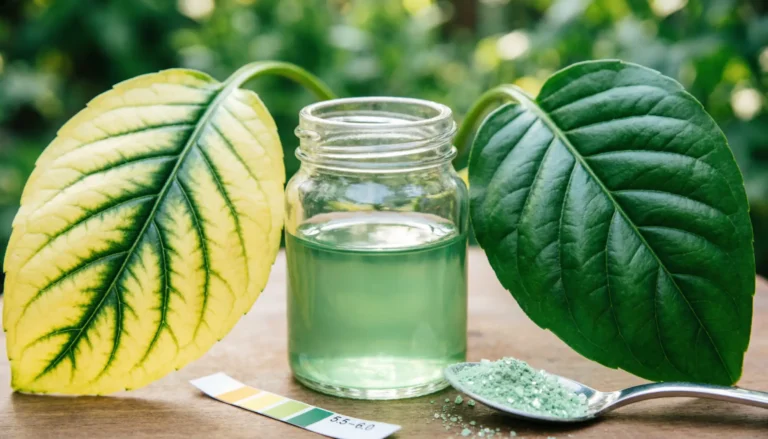
Most U.S. garden soils fall between 6.0 and 7.5 on the pH scale. However, a specific group of species, acid-loving plants, thrives only below 6.0, with many performing best between 4.5 and 5.5. When alkaline soil climbs above 7.0, these species cannot absorb iron, manganese, or phosphorus efficiently, no matter how much fertilizer you add.
You likely need to lower your pH if you grow any of the following:
- Azaleas and rhododendrons (prefer 4.5–5.5)
- Blueberries (require 4.0–5.0)
- Hydrangea macrophylla (blue blooms need 5.0–5.5)
- Camellias and gardenias (thrive at 5.0–6.0)
- Conifers and ericaceous ornamentals
In practice, if your soil test reads above 6.5 and you grow any of these, correction isn’t optional, it’s the difference between a thriving garden and a slow, chlorotic decline. Before you amend anything, our guide on how to choose the right soil testing tool covers kits, probes, and lab sampling so your starting numbers are trustworthy.
Aluminum Sulfate vs. Elemental Sulfur: The Speed vs. Safety Matrix
This is the decision framework most resources skip. University extensions recommend elemental sulfur almost exclusively because it’s slower and gentler, while e-commerce listings push aluminum sulfate because it works fast. Neither tells you when speed actually justifies the added risk.
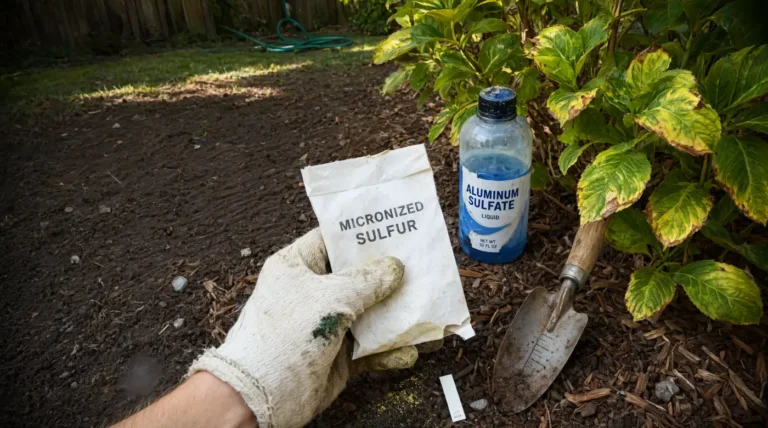
The core difference is chemical. Aluminum sulfate (Al₂(SO₄)₃) is a fast-acting chemical soil acidifier. It dissolves in soil moisture and releases hydrogen ions immediately, dropping pH through a direct acid-base reaction the moment it contacts water. This is the exact opposite of how amendments raise pH, as explained in our breakdown of the chemistry of calcium carbonate and how lime works in soil.
Elemental sulfur, by contrast, is a slow-release biological acidifier. Our definitive guide on how to use sulfur to lower soil pH explains that Thiobacillus bacteria must oxidize it first, a microbial process driven by soil temperature and moisture that typically takes 6 to 12 weeks. Mosaic Crop Nutrition notes that oxidation speed depends heavily on soil conditions.
In practice, the right choice comes down to area size, timeline, and plant sensitivity. Use the matrix below to match your exact situation to the correct soil acidifier:
| Use Case | Recommended Agent | Speed of Action | Toxicity Risk |
|---|---|---|---|
| Blue hydrangea color shift (containers) | Aluminum sulfate | 1–3 days | Low (small volume) |
| Quick pH fix in potted plants | Aluminum sulfate | 2–5 days | Low–Moderate |
| Established lawn (broad application) | Elemental sulfur or iron sulfate | 6–12 weeks | Very Low |
| Long-term garden bed preparation | Elemental sulfur | 1–3 months | Very Low |
| Emergency correction before planting acid-loving shrubs | Aluminum sulfate (single dose) | 3–7 days | Moderate |
| Large-acreage or turfgrass renovation | Elemental sulfur | 2–4 months | Very Low |
The rule is simple: if you need results in days and the application area is small or targeted, aluminum sulfate earns its place. If you’re treating an entire lawn or preparing beds months ahead, choose elemental sulfur or ferrous sulfate and skip the risk entirely.
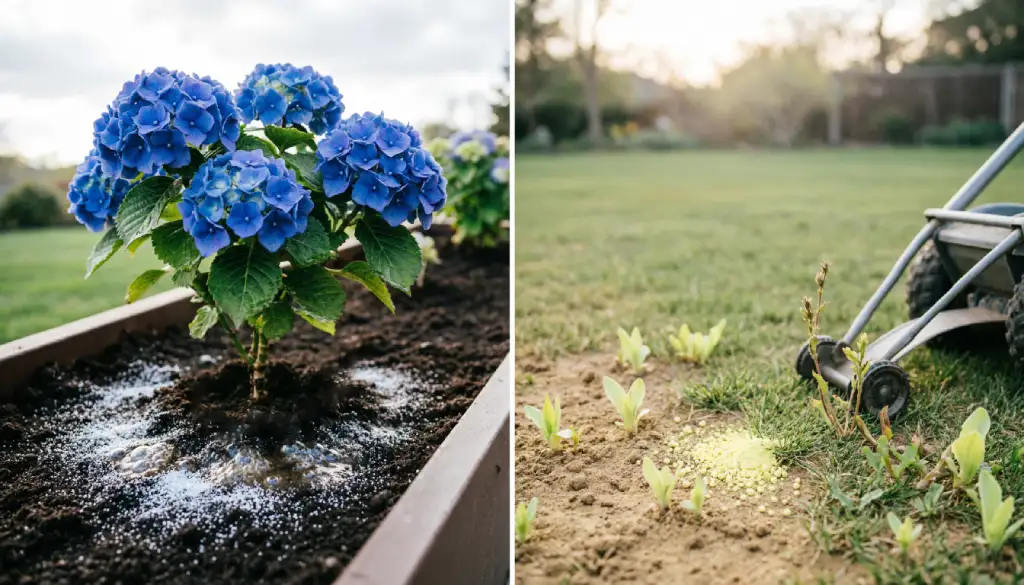
The Hydrangea Exception: Turning Hydrangea macrophylla Blue
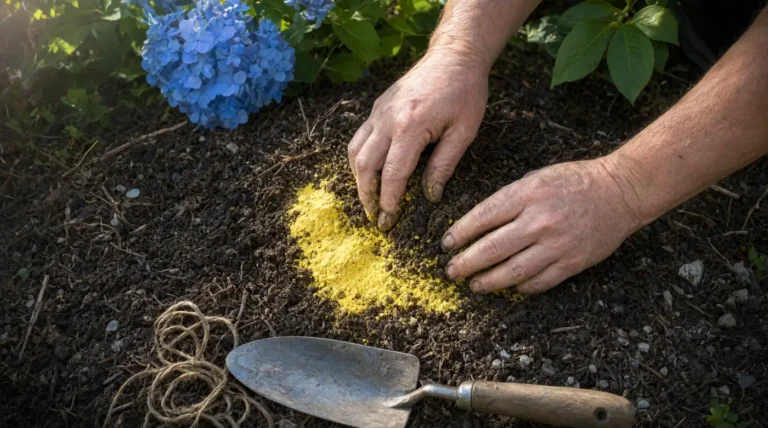
Here’s where the product shifts from risky acidifier to essential tool. Hydrangea macrophylla produces blue sepals only when aluminum ions are present in the soil solution at a pH around 5.0 to 5.5, per North Carolina State University Extension guidance. Without available aluminum, the flowers stay pink or purple regardless of pH.
Consequently, hydrangeas are the safest use case for the product. You apply small quantities to individual shrubs instead of broadcasting across a lawn, so total aluminum volume per plant stays minimal while the target pH keeps aluminum soluble but not excessive.
Quick 3-Step Hydrangea Drench Recipe
- Dissolve 1 tablespoon of aluminum sulfate per gallon of water.
- Pour evenly around the drip line in early spring, before bud break.
- Repeat every 3–4 weeks through the blooming season for sustained blue color.
Before any drench, confirm your starting pH with a calibrated soil test kit, it’s the cheapest insurance in gardening. For broader acidification strategies, our guide on how to lower soil pH fast without killing your plants covers additional emergency corrections.
How to Apply Aluminum Sulfate for Soil pH: A Step-by-Step Safety Protocol
Aluminum sulfate for soil pH correction acts almost immediately upon contact with soil moisture, releasing hydrogen ions through a rapid chemical reaction. While elemental sulfur takes months, this acidifier works within days, making it ideal for quick adjustments but demanding strict dosage control to avoid plant toxicity.
That speed is exactly why the protocol below is non-negotiable. Treat it like a safety manual.
Step 1: Test Your Soil’s pH and Buffer Capacity
Never apply any soil acidifier blind. Purchase a reliable test kit or send a sample to your local cooperative extension lab, then record two numbers: current pH (how far you must drop) and buffer capacity (clay soils resist pH change far more than sandy soils, so they require higher rates). You’ll use both in Step 2.
Step 2: Calculate the Exact Dosage
Dosage depends on soil type, current pH, and target pH. Extension publications, including Oklahoma State’s acidifying fact sheet and the Clemson University Soil Acidification Calculator, publish texture-based rates like these:
| Soil Type | Rate to Drop pH by 1.0 (per 100 sq ft) |
|---|---|
| Sandy soil | 1.0 – 1.5 lbs |
| Loam | 2.0 – 2.5 lbs |
| Clay soil | 3.0 – 4.0 lbs |
For a liquid drench, the standard ratio is approximately 1 lb of aluminum sulfate per 5 gallons of water, applied to 100 sq ft. Adjust downward for sandy soil and shallow-rooted plants.
Step 3: Apply and Water Deeply (The Anti-Toxicity Protocol)
This is where most damage occurs, and where you prevent it. Follow the sequence exactly:
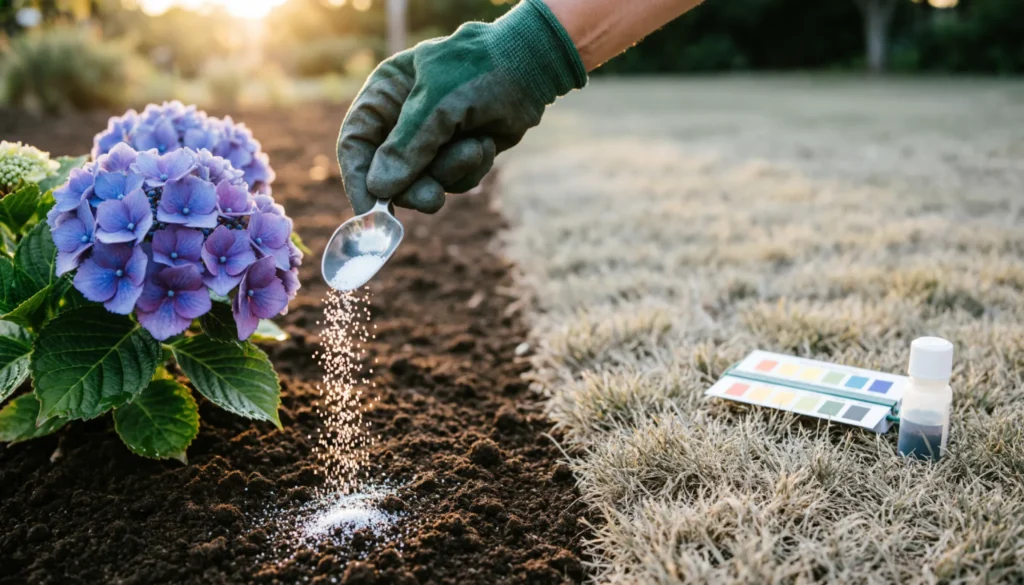
- Apply dry granules evenly with a broadcast spreader or by hand (wear gloves and eye protection). For liquid drenches, use a watering can or hose-end sprayer at the correct dilution.
- Keep granules off foliage. Sweep or rinse any product off leaves and grass blades immediately.
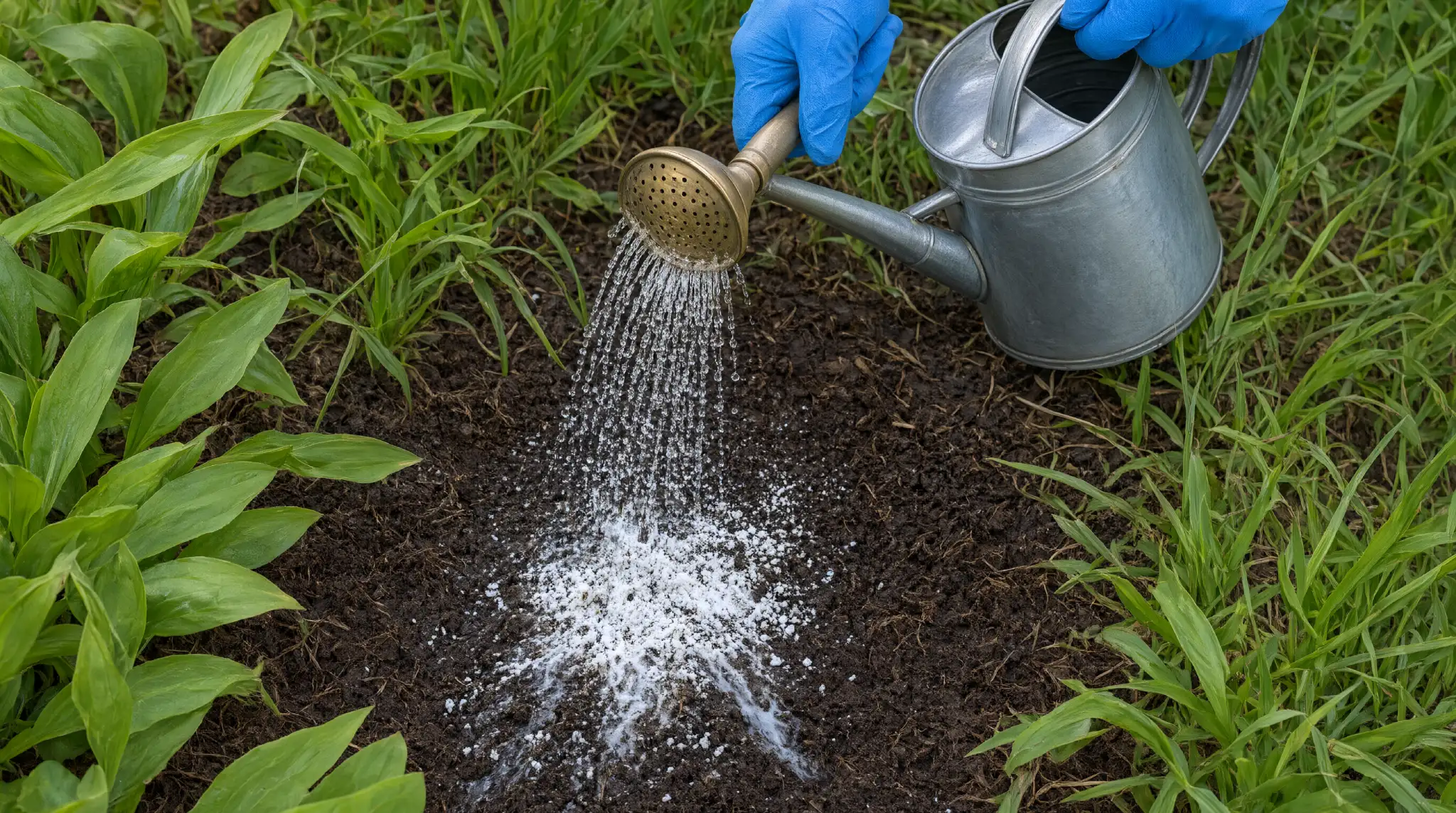
- Water deeply within 10–15 minutes. Apply at least 1 inch of water (roughly 0.6 gallons per sq ft) to flush the product past the top 2 inches and into the root zone, preventing surface aluminum accumulation and root burn.
- Wait at least 4 weeks before reapplying, and re-test pH first.
- Keep children and pets off treated areas until the surface is fully dry.
This “water-in” technique is the single most important step in the entire protocol. Skipping it causes nearly every horror story you’ll read online.
You now have the full protocol, the only missing inputs are your starting pH and a quality product. Grab a calibrated soil test kit and a reputable aluminum sulfate before your next application window.
Safer Soil Acidifier Alternatives for Lawns and Large Gardens
If the toxicity warnings above made you set the bag down, you have good instincts. For broad applications, especially turfgrass, lower-risk options exist:
- Iron sulfate (ferrous sulfate): Acidifies moderately fast (1–3 weeks) and adds visible greening to grass. Lower toxicity risk than aluminum sulfate; ideal for lawns needing a pH nudge plus color.
- Elemental sulfur: Slowest option (6–12 weeks) but safest for large areas. Requires warm, moist soil for microbial oxidation, so apply in early spring or early fall.
- Organic amendments: Sphagnum peat moss, composted pine bark, and aged pine needles lower pH gradually over seasons. Excellent for building long-term soil buffer capacity in beds; too slow for emergency corrections.
Instead, for most established lawns, we recommend elemental sulfur or iron sulfate over aluminum sulfate every time. Reserve the fast product for targeted, small-area jobs where speed genuinely matters. Our breakdown of elemental sulphur fertilizer vs. sulphate forms explains application rates and uses side by side.
One legal note: as of 2026, no U.S. state bans residential aluminum sulfate, but municipalities with fertilizer-runoff ordinances may restrict application timing or rates near waterways. When in doubt, ask your county extension office.
Key Takeaways: A Safer Path to Acid-Loving Plants
- Aluminum sulfate delivers results in days through a direct chemical reaction, while elemental sulfur requires weeks to months of microbial activity.
- Use the Speed vs. Safety Decision Matrix: aluminum sulfate for small, targeted, time-sensitive jobs; elemental sulfur or iron sulfate for lawns and large beds.
- The anti-toxicity protocol is non-negotiable, water in within 15 minutes, never exceed 5 lbs per 100 sq ft, and re-test before reapplying.
- Hydrangeas are the safest and most rewarding use case, needing only 1 tablespoon per gallon for vivid blue blooms.
- When in doubt, choose the slower, safer option. Your soil’s biology will thank you next season.
Once your pH is dialed in, keep your garden thriving by understanding the fundamentals in our ultimate guide to soil reaction and pH.
Aluminum sulfate for soil pH is a precision tool, not a broadcast solution. Respect the chemistry, follow the protocol, and your acid-loving plants will reward you within the week.