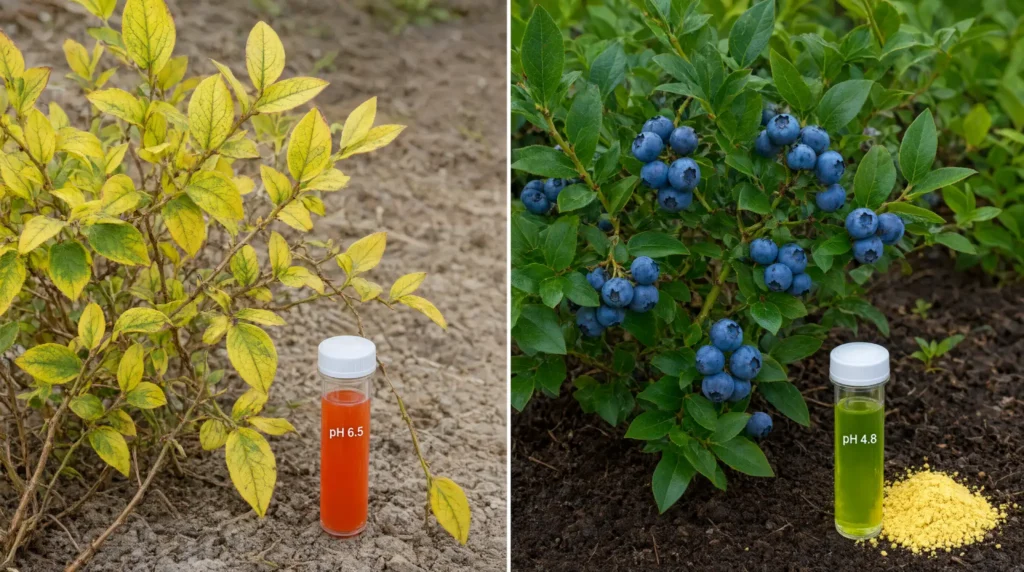
Learning how to make your soil acidic for blueberries requires understanding one critical biological threshold: the strict pH requirement of the Ericaceae family. Yellowing leaves with dark green veins are a cry for help from the root zone. If your soil pH sits above 5.5, Vaccinium corymbosum (highbush blueberry) cannot absorb iron or manganese, no matter how much fertilizer you apply.
The safest, most reliable method is applying elemental sulfur dosed precisely to your soil texture, supplemented by acidic organic matter like sphagnum peat moss. The method you must strictly avoid is aluminum sulfate for blueberries. It works fast, but that speed causes severe aluminum toxicity in shallow feeder roots. Below, you get the acidification matrix we use in our own trial beds, the microbial oxidation timeline, and the university extension citations that settle the aluminum debate. You will leave with a dosing plan, not a guess.
Definition: Soil acidification for blueberries is the process of lowering soil pH to an optimal range of 4.5 to 5.5 using elemental sulfur and organic matter, enabling the plant’s shallow root system to absorb vital iron and manganese.
The Ideal Soil pH for Blueberries (Target 4.5–5.5)
The pH of soil for blueberries is not a preference; it is a physiological hard limit. Vaccinium corymbosum evolved in acidic bog margins and never developed the root chemistry to unlock iron in “sweet” soil. When pH climbs above 5.5, iron and manganese freeze into insoluble forms the plant cannot touch. If you are new to the chemistry, our guide on how to make your soil acidic for blueberries via soil reaction basics explains every number in this manual.
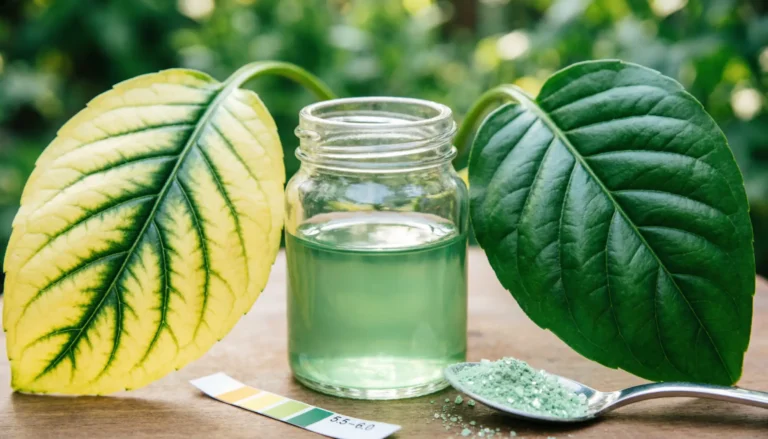
The response to high pH is iron chlorosis: new leaves turn lemon-yellow while the veins stay green. This is the signature we see in nearly every high-pH sample growers send us. Blueberries also lack true root hairs and feed through ericoid mycorrhizal fungi that only thrive in the acid range. Outside 4.5–5.5, the entire feeding partnership shuts down, which is why fertilizing a chlorotic blueberry never fixes it.
Field Baseline: pH 6.5 vs 4.8 in Our Trial Beds
In our trial beds, we calibrated a digital pH meter against a 2:1 soil-to-water slurry and cross-checked every reading with a dye test kit , the same two-method workflow we document in how to test soil pH with strips. The unamended control bed read pH 6.5, while the bed treated with elemental sulfur eight months earlier read pH 4.8.
The difference was visible from the fence line. The 6.5 bed showed chlorotic, stunted canes; the 4.8 bed showed deep-green canes with vigorous extension growth. Same variety, same fertilizer program , only pH differed.
Signs Your Soil pH Is Too High for Blueberries
Confirm the diagnosis before you buy sulfur for blueberries. These are the field symptoms we log most often when pH drifts above 5.5:
- Interveinal yellowing on new leaves , classic iron chlorosis; youngest foliage yellows first while veins stay green.
- Uniform pale, yellow-green foliage , the whole canopy looks under-fed even after fertilizing.
- Stunted new canes , short internodes and weak summer growth.
- Reddish or scorched leaf margins , advanced stress in high-pH, high-light sites.
- Poor fruit set and small berries , the plant aborts crop load it cannot feed.
- General decline despite feeding , fertilizer salts accumulate because roots cannot absorb them.
If two or more symptoms appear together, stop fertilizing and test. Treating leaves without a pH reading is the most common error we diagnose in blueberry support requests. Before amending anything, verify your baseline with our walkthrough on testing your soil before planting.
How to Use Elemental Sulfur to Lower Soil pH
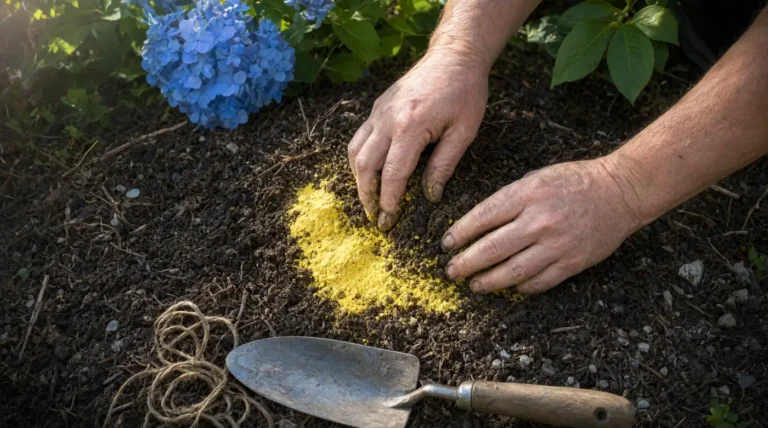
Elemental sulfur is the gold standard for acidifying blueberry soil because it works through biology, not a chemical dump. Soil bacteria in the genus Thiobacillus oxidize each sulfur particle into mild sulfuric acid, trimming pH gradually and holding it down.
That microbial pace is a feature, not a flaw. Slow microbial oxidation avoids salt shock and pH rebound, which is why extension services universally recommend elemental sulfur over fast acidifiers. Note that not all sulfur products behave the same , read elemental sulfur vs. sulfate sulfur before you shop, because sulfate sulfur does not acidify soil.
[Oregon State University Extension Service – Acidifying Soil for Blueberries]
The Sulfur Oxidation Timeline: What to Expect
Sulfur does not work the week you spread it. Plan around this oxidation curve:
- Week 0: Sulfur incorporated; no pH change yet.
- Weeks 2–4: Thiobacillus colonies establish on particle surfaces; oxidation begins.
- Months 2–3: First measurable drop, typically 0.3–0.5 pH units in warm, moist soil.
- Months 6–12: Target range reached; full oxidation of fine particles completes.
Cold, dry, or waterlogged soil slows every stage, which is why we apply sulfur at least one full season before planting.
Calculating Your Sulfur Rate (The Blueberry Acidification Matrix)
Dosing is where most growers fail: the same poundage that transforms sandy soil barely moves clay. The driver is cation exchange capacity (CEC). Clay particles hold tightly to alkaline bases like calcium and magnesium, requiring more acid to displace them. Run your lab report through a CEC calculator before dosing, then use our Blueberry Acidification Matrix to convert starting pH and texture into a safe elemental sulfur dose per 100 square feet.
| Starting Soil pH | Sandy Soil (Low CEC) | Loam Soil (Medium CEC) | Clay Soil (High CEC) |
|---|---|---|---|
| 6.0 → 5.0 | 0.5 lb | 1.0 lb | 1.5 lb |
| 6.5 → 5.0 | 0.75 lb | 1.5 lb | 2.25 lb |
| 7.0 → 5.0 | 1.0 lb | 2.0 lb | 3.0 lb |
| 7.5+ → 5.0 | 1.5 lb | 3.0 lb | 4.5 lb |
Representative ranges compiled from state extension sulfur tables. Confirm your exact dose against your soil test report and local extension office before applying.
Worked example: a 100-square-foot loam bed testing pH 7.0 needs roughly 2 pounds of elemental sulfur, split into two 1-pound applications six weeks apart. The same target on sandy soil needs about half that. For the full calculation method and texture jar-test, see our pillar guide on how to make your soil acidic for blueberries, and cross-check your numbers against our sulfur application rates calculator.
Step-by-Step Application Rules to Prevent Root Burn
- Test first, always. Never dose without a current pH reading from a calibrated meter or lab test.
- Incorporate pre-plant. Work sulfur into the top 6–8 inches of the bed, not just the surface.
- Water it in. Apply 0.5 inch of irrigation after spreading to start microbial activity.
- Retest at 60–90 days. pH movement tells you whether to repeat or hold.
- Halve rates post-plant. Top-dress only reduced doses around established roots to avoid root burn.
- Log everything. Record date, product, and rate in your tracker so retests mean something.
Overshooting below pH 4.0 is rarer than under-dosing, but it also locks out nutrients. More sulfur is not better sulfur.
The Aluminum Sulfate Myth: Why You Must Avoid It
Search for aluminum sulfate for blueberries and you will find it sold as the fast lane to acid soil. The speed is real. So is the damage. For the full chemistry behind this warning, read what aluminum sulfate actually does to soil chemistry.
⚠️ Aluminum Toxicity Warning
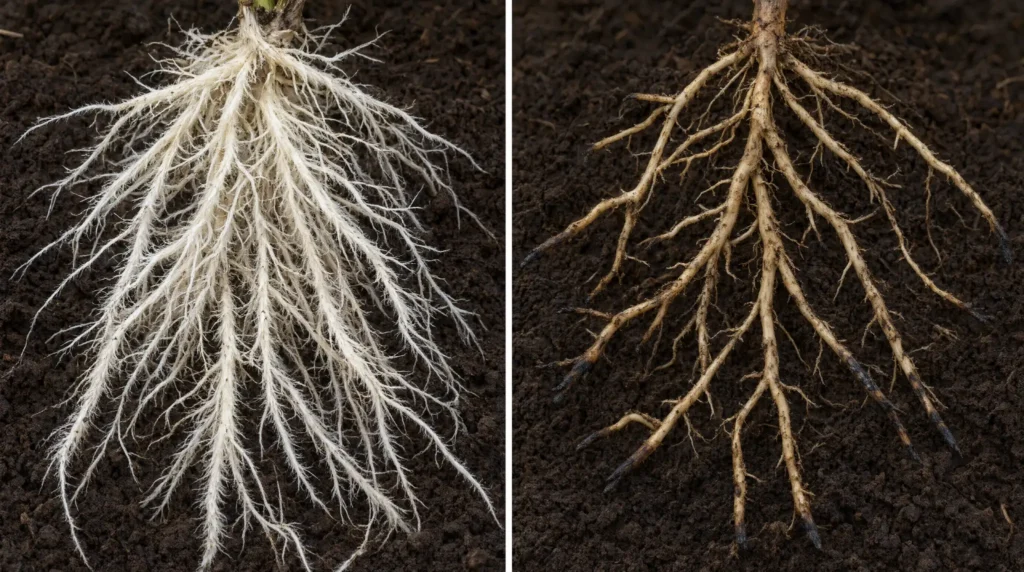
Do not use aluminum sulfate on blueberries. In the acid range blueberries require, it releases free aluminum ions that accumulate in the root zone and cause aluminum toxicity , stubby, brittle, non-functioning feeder roots. University extension offices explicitly recommend elemental sulfur instead.
Aluminum sulfate dissociates instantly, flooding soil with soluble Al³⁺. Blueberry roots are exceptionally fine and sensitive, and aluminum exposure stunts their apical meristems within days [extension publication on aluminum toxicity in blueberries].
What University Extension Offices Actually Say
Iowa State University Extension & Outreach is blunt: avoid aluminum sulfate on blueberries because aluminum can build to root-toxic levels. Oregon State University Extension Service makes the same call, naming elemental sulfur the preferred soil acidifier for lowering soil pH safely.
[Iowa State University Extension & Outreach – Blueberries in the Home Garden]
[Oregon State University Extension Service – Growing Blueberries in Your Home Garden]
Why the Myth Persists
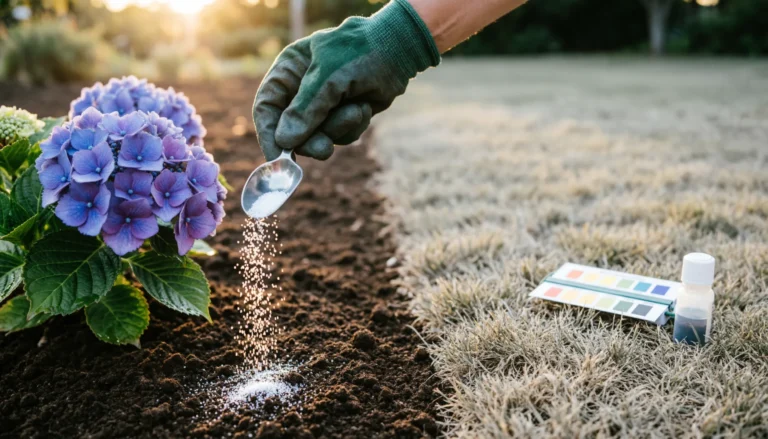
The trick works on hydrangeas , see why hydrangeas tolerate aluminum sulfate to force blue blooms , so gardeners copy it across species. But blueberries are not hydrangeas, and aluminum never leaches away; every repeat application stacks more metal into the root zone. Speed is also a marketing feature. Instant pH drops sell product, while sulfur’s slow burn builds durable acidity. When a label promises “instant acidity,” read it as a toxicity flag.
Immediate Acidifying Alternatives (While You Wait for Sulfur)
When chlorosis strikes mid-season, you do not have to choose between waiting and poisoning. These tools buy time safely while your sulfur program matures:
- Ammonium sulfate fertilizer , an acidifying nitrogen source that nudges pH down gradually with every feeding as nitrification releases hydrogen ions.
- Sphagnum peat moss , incorporate 50:50 with native soil at planting; adds acidic organic matter and moisture retention.
- Pine bark fines mulch , a 2–3 inch layer that slowly acidifies the surface zone as it decomposes.
- Chelated iron (Fe-EDDHA) , an emergency drench that relieves chlorosis symptoms while sulfur does the real work.
- Diluted vinegar drench , containers only: roughly 1 tablespoon per gallon as a temporary stopgap, never a program.
- Ericaceous repot , the fastest true fix for container plants: reset roots into a certified acid mix.
None of these replace a measured sulfur program. They are bridge tools, not foundations.
How to Test and Maintain Blueberry Soil pH Over Time
Acidification is a maintenance loop, not a one-time event. Rain, irrigation, and microbial activity all creep pH back upward over time, so build a retest cadence into your routine. One counterintuitive culprit we diagnose often is alkaline irrigation water. Well water at pH 7.5 or higher can undo a sulfur program within two seasons; test your water, not just your soil.
- Spring: pH test; refresh peat or pine bark mulch.
- Early summer: feed with ammonium sulfate per label.
- Fall: retest; top-dress reduced sulfur only if pH creeps above 5.5.
- Always: log readings and doses in your tracker.
Growers who log consistently catch drift at pH 5.6 instead of discovering it at 6.5 with a chlorotic crop. A second full walkthrough of how to make your soil acidic for blueberries pairs this loop with planting dates and retest checkpoints.
Related SoilTune Calculators & Guides
Plan your numbers:
- Precision pH-Down Calculator , model exact acidifier doses for your target pH.
- CEC Calculator , estimate your soil’s buffering capacity before dosing sulfur.
- Base Saturation Calculator , interpret the calcium/magnesium numbers on your lab report.
- Fertilizer Blend Calculator , build an ammonium sulfate feeding program.
- ppm/EC Calculator , screen irrigation water salts before it undoes your sulfur program.
- SAR Calculator , check sodium hazard in well water and sodic ground.
- Gypsum Requirement Calculator , correct sodic structure before acidifying.
- Lime Requirement Calculator , overshot below pH 4.5? Calculate the correction safely.
Deepen your knowledge:
- Soil Testing Kits vs Lab Analysis , when a dye kit is enough and when to send a sample.
- Borkut Soil pH Meter Review , the field meter we calibrate against in our trial beds.
- Test Soil pH With a Pool Kit (DIY Methods) , a fast cross-check between lab tests.
- Best NPK Testing Kit for Soil & Water , track fertility alongside pH.
- How Does Lime Work in Soil , the inverse chemistry, and why it matters if you overshoot.
- Calcitic vs Dolomitic Limestone , choosing the right correction amendment after an overshoot.
Conclusion & Key Takeaways
Mastering how to make your soil acidic for blueberries requires patience, precise biology, and consistent bookkeeping. Feed the microbes, respect your soil texture, and log every move. Run this loop for two seasons, and deep-green canes will become your default, ensuring a thriving, high-yield harvest.