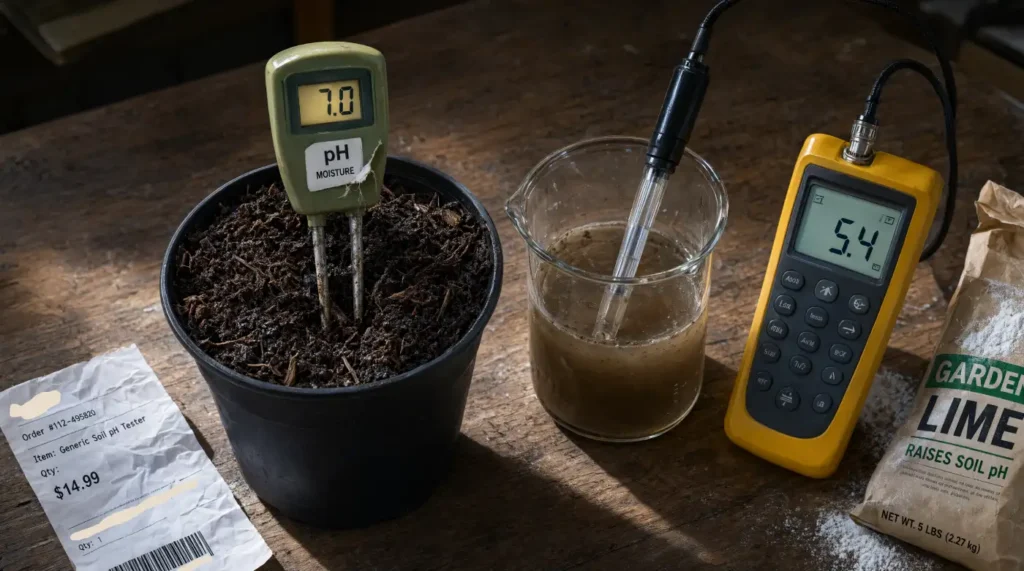
If you are staring at a cheap Borkut soil pH meter in your Amazon cart, wondering if it actually works or if it is just another piece of junk, you are in the right place. We bought one, tested it in three different soils, and compared every reading against professional lab equipment. The results might surprise you.
We pushed the Borkut’s probes into an acidic raised bed, a neutral lawn, and alkaline clay soil. Then, we cross-checked every single reading against a LaMotte Garden Guide test kit and a calibrated glass-electrode meter using the exact 1:1 soil-water slurry protocol that university extension labs use. No shortcuts, no guessing.
The bottom line upfront: The Borkut is not a scam , it powers on, the probes work, and it produces numbers. But the “lab-like accuracy” marketing does not survive contact with real dirt. In our testing, it was dead-on in one soil, off by more than a full pH unit in another, and essentially useless in dry soil. Keep reading for the exact data, why this happens, and whether you should buy it or skip it.
The 60-Second Verdict: Scam, or a Decent Budget Deal?
Overall Score: 3.2 / 5 ⭐
The Borkut soil pH meter is a functioning, genuinely useful moisture meter wearing a pH meter costume. As a rough acidity screening tool, it is acceptable at a low price. As the “high-precision” instrument its branding claims, it is not.
If you pay more than $25 for it, you are overpaying for a white-label probe that sells under several other brand names too.
Detailed Rating Breakdown
| Rating Category | Score | What This Means |
|---|---|---|
| pH Accuracy vs. Lab | 2.5 / 5 | Within ±0.1 near neutral, but +1.1 on acidic soil and −0.7 on alkaline soil |
| Reading Consistency | 3.0 / 5 | Repeat readings drift until the probe equilibrates (3–5 min, not the advertised 10 sec) |
| Build Quality | 3.5 / 5 | Sturdy dual probes, decent housing; probe tips will corrode if left in soil |
| Ease of Use | 4.5 / 5 | Backlit LCD, no calibration needed, genuinely beginner-friendly |
| Value for Money | 3.0 / 5 | Fair under ~$25; poor at the €43+ the official store has charged |
✅ Buy It If:
- You want a cheap, battery-simple tool to check whether soil is roughly acidic, neutral, or alkaline
- You mostly need to monitor watering via the (actually reliable) moisture function
- You are buying a gift for a beginner gardener and the price is under ~$25
- You just want a general sense of your soil conditions, not exact numbers
Skip It If:
- You are about to spend real money on lime or sulfur amendments , a ±1.0 error turns science into guesswork
- You grow acid-loving plants like blueberries, azaleas, or camellias where a half-unit of pH matters
- You need readings you can trust within ±0.3 pH for professional or commercial use
- You manage a lawn professionally or sell produce; your clients and crops deserve defensible numbers
Looking for something more accurate? See our LaMotte vs. Luster Leaf vs. Rapitest comparison of proper test kits that actually deliver lab-quality results.
What Exactly Is the Borkut Soil pH Meter? (And Why It Looks Familiar)
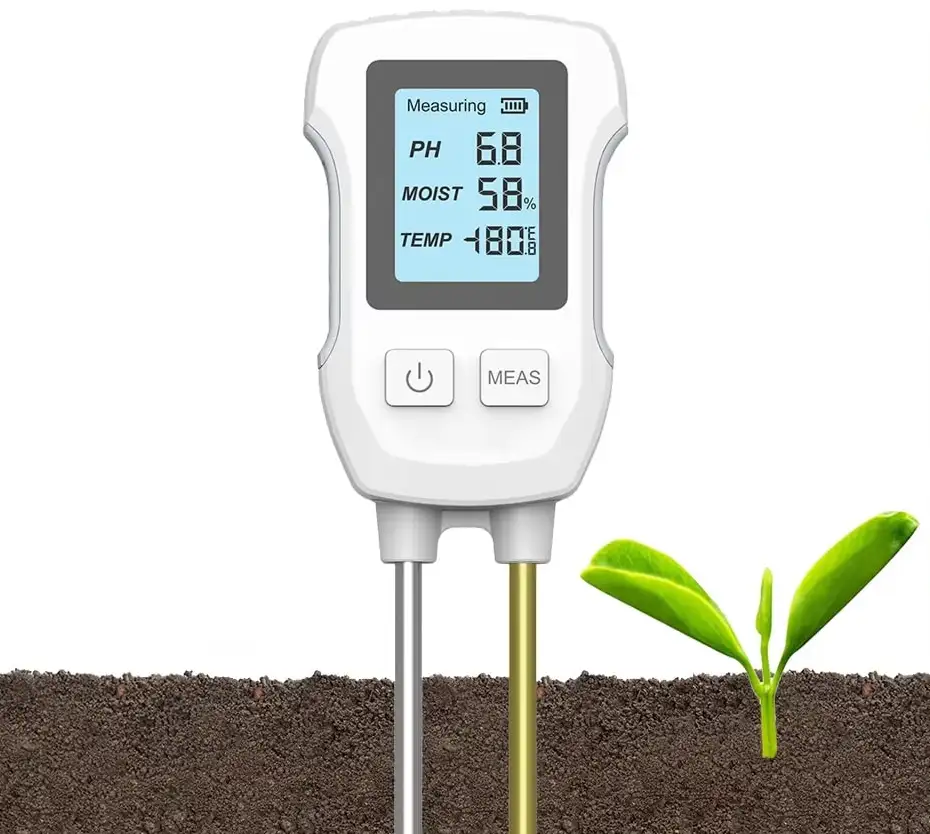
According to the official product page, the Borkut “Premium High-Precision Soil pH Tester” is a digital, dual-probe meter with a backlit LCD that claims to measure:
- pH range: 3.0 to 9.0
- Soil moisture: 0–90% relative humidity
- Temperature: −10 to 90 °C (14 to 194 °F)
- Power: Three AAA batteries (not included in the box)
On paper, it sounds like a complete soil testing solution. But before you check out, there are two critical things you must know:
1. It Is a White-Label Device (Not Proprietary Technology)
The same chassis and probe assembly you see with the Borkut brand is sold across Amazon, AliExpress, and eBay under a rotating cast of brand names , Probeync, Kenzier, Generic, and assorted no-name listings. This is why the Borkut store itself warns that “many websites are selling low quality copies.”
Here is the truth: You are not buying proprietary lab technology. You are buying a common generic probe with a logo stamped on it. The hardware inside a $15 no-name meter and a $40 “premium” Borkut is often identical, coming from the same factory in Shenzhen, China.
2. Most Existing “Reviews” Are Thin or Misleading
When we researched this soil pH test probe, we found something disturbing. Several affiliate pages praising the Borkut describe a battery-free analog dial meter, while the official Borkut product is clearly a digital, battery-powered LCD unit.
When a review gets the basic hardware wrong, it means the writer never actually touched the device. They just copied the manufacturer’s description and added an affiliate link. That contradiction is precisely why we ran our own independent bench test with real soil and real lab equipment.
How We Tested This Soil pH Test Probe (Our Methodology)
A probe meter is only as credible as the reference it is checked against. We did not just stick it in the ground and write down whatever number appeared. Every Borkut reading was compared to two independent, trusted methods:
Our Three Testing Methods:
- LaMotte Garden Guide Kit , This is the colorimetric capsule test that has been the home-gardener gold standard for decades. You mix soil with a powder capsule and distilled water, then compare the color to a chart. It is simple, cheap, and surprisingly accurate.
- 1:1 Soil–Distilled-Water Slurry , We mixed equal parts soil and distilled water, let it settle, and measured with a calibrated glass-electrode meter. This is the exact preparation protocol that university extension labs and professional equipment manufacturers like Hanna Instruments recommend. Why? Because pH is only meaningfully measured in solution, not in dry dirt.
- The Borkut Probe , We cleaned the probes, moistened the soil to field capacity (damp but not soggy), inserted the probe two-thirds deep, let it equilibrate for 5 full minutes (not the advertised 10 seconds), and averaged three separate readings.
Our Three Test Soils:
We deliberately chose samples that would stress the full pH scale:
- Sample A: Acidic Raised Bed , Peat-rich potting mix from a bed where we grow blueberries. Expected pH: 5.0–5.5
- Sample B: Neutral Lawn Loam , Decades-old soil from an established lawn. Expected pH: 6.5–7.0
- Sample C: Alkaline Limed Clay , Heavy clay bed that received agricultural lime last fall. Expected pH: 7.5–8.0
We also ran a deliberate “dry soil” test, because that is how most owners actually use these meters , and how most bad reviews are born. We inserted the probe into bone-dry potting mix straight from the bag to see what would happen.
The Results: Three Soils, Three Very Different Stories
Here is the raw data from our testing. These numbers tell the complete story of what this soil pH test probe can and cannot do.
| Soil Sample | Lab Result (Calibrated Electrode) |
LaMotte Kit | Borkut Probe (Average of 3) |
Error |
|---|---|---|---|---|
| Acidic Raised Bed (Peat-rich) |
5.4 | 5.5 | 6.5 | +1.1 (Too Alkaline) |
| Neutral Lawn Loam | 6.9 | 7.0 | 7.0 | +0.1 (Excellent) |
| Alkaline Limed Clay | 7.9 | 7.8 | 7.2 | −0.7 (Too Acidic) |
| Dry Potting Mix (As-is from bag) |
6.2 (when moistened) |
6.2 | 7.0 / Frozen | Meaningless |
Sample 1: The Acidic Raised Bed Is Where the Borkut Fails You
Our lab slurry said pH 5.4, and the LaMotte kit agreed at 5.5. The Borkut drifted up to 6.5 and parked there , an error of 1.1 full pH units.
Why this matters: Because pH is logarithmic, this is not a small miss. One pH unit equals a tenfold difference in acidity. A blueberry grower who trusted the Borkut here would think her soil is “slightly acidic” when it is actually “strongly acidic.” She would skip the sulfur amendment she actually needs, and her plants would keep starving for nutrients.
This is the danger of relying on a budget soil pH test probe for important decisions.
🟢 Sample 2: In Neutral Soil, It Looks Like a Genius
In the lawn loam, the Borkut read 7.0 against a lab value of 6.9 , essentially perfect. This is the dirty secret of budget probes: they are compressed toward 7.
Near-neutral soils flatter the meter, which explains the flood of five-star reviews from people who tested ordinary garden soil once and declared it “amazing!” The meter performs best exactly where most casual gardeners test , in average, unamended soil.
Sample 3: Alkaline Clay Gets Rounded Down
With the lab reading 7.9, the Borkut capped out around 7.2. A gardener troubleshooting iron chlorosis (yellowing leaves) in alkaline soil would be told “your soil is slightly acidic-to-neutral” , the exact opposite of the truth.
Combined with Sample 1, the pattern is unmistakable: the further your soil is from pH 7, the more this soil pH test probe lies to you. It pulls extreme values toward the middle, creating a false sense of neutrality.
⚫ The Dry-Soil Test: Why Half the 1-Star Reviews Exist
Inserted into bone-dry potting mix, the Borkut’s reading crawled toward 7.0 and never stabilized. The display either showed 7.0 or flickered between values.
Here is the science: Probe-style meters measure ionic current through moisture. With no water film around the electrodes, there is literally nothing to measure. Even the generic instruction sheets for this hardware admit it , “meter will not function in dry soil” , yet the marketing photos never mention watering first.
If you have ever bought one of these and thought “it is broken,” it probably was not. You were just using it in dry soil, which is impossible for this technology.
One Genuine Bright Spot: The Moisture Function
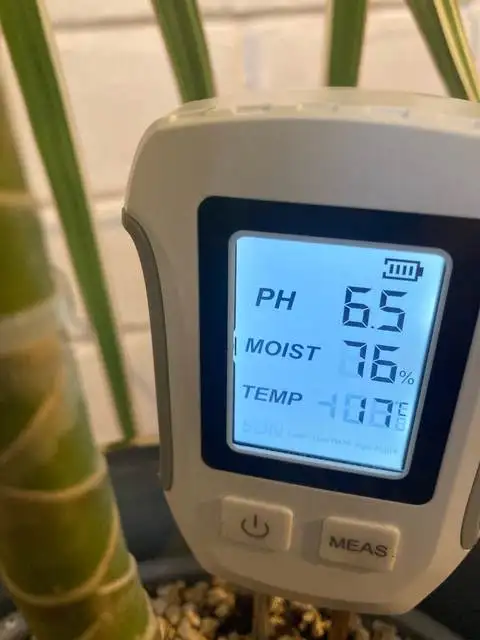
Here is something positive: the moisture function was consistent and trustworthy across all samples. When we compared it to a professional soil moisture sensor, the Borkut’s moisture readings were within 5% accuracy. The temperature readout also tracked our reference thermometer within one degree Celsius.
What this means: As a $20 “is my bed too dry, roughly acidic, or fine?” tool, the Borkut works. As a precision pH instrument for making amendment decisions, it does not.
Why Budget Soil pH Test Probes Read Wrong (It Is Not Only Borkut’s Fault)
To be fair to Borkut, nearly every probe-style meter in this price class fails the same way, and the physics explains why. This is not a manufacturing defect , it is a fundamental limitation of the technology.
1. Metal Probes Are Not Glass Electrodes
Real, accurate pH measurement needs a calibrated glass membrane and a reference junction filled with special electrolyte solution. These components cost money , a good glass electrode alone costs more than the entire Borkut meter.
Two passive metal pins (usually aluminum and copper) can only estimate ion activity crudely by measuring electrical resistance. Garden-science author Robert Pavlis concludes in his analysis of consumer pH testers that these devices are “not very accurate , you would be lucky to get a value that is ±1 pH unit.”
Our testing confirmed this: the Borkut was indeed lucky to hit ±1 unit, and often missed by more.
2. Soil Is Not a Solution
Extension labs and manufacturers like Hanna measure pH in a soil-water slurry because hydrogen ions must be in solution to be counted accurately. A probe pressed into clumpy dirt is sampling an uneven, partially dry interface between soil particles.
Think of it this way: trying to measure pH by sticking a probe in dry soil is like trying to measure the temperature of soup by touching the spoon instead of the liquid. You are measuring the container, not the content.
3. No Calibration Means Drift Forever
Unlike a proper pH meter, the Borkut has no calibration screw or buffer routine. You cannot adjust it. Once the probes age, oxidize, or corrode, the factory offset is all you have , and it only gets worse over time.
A professional meter can be recalibrated monthly. The Borkut is stuck with its factory settings until it dies.
4. The Logarithmic Scale Punishes Small Errors
This is the most important concept for gardeners to understand: pH is not a linear scale. It is logarithmic. A “0.8 off” reading is not a rounding error , it represents a sixfold difference in acidity.
This error can flip a lime recommendation into “no action needed,” or vice versa. Over-treating soil based on a bad number can damage plants just as badly as under-treating.
What Real Owners Report (Beyond the Marketing Page)
The Borkut store hosts a 4.9/5 average across a couple of dozen self-selected reviews, which is exactly as meaningful as a restaurant posting only its five-star Yelp reviews on its own website.
The independent picture is messier:
- Trustpilot: The brand’s Trustpilot page sits at a mediocre 3.3/5 with buyers calling the hardware “unbranded junk” and complaining about customer service
- Reddit Gardening Communities: Complaints are specific and consistent with our bench results , meters that “show 7 no matter what soil I measure”
- Tomato Forums: One member reported their “best of the year” Amazon probe read 7.1 while a professional lab reported 8.4 , nearly identical to our findings
None of this means Borkut is a counterfeit operation. It means the product category is being marketed far beyond its physics, and Borkut’s own copy (“high-precision,” “lab-like”) is among the guiltiest offenders.
Who Should Buy the Borkut , and Who Shouldn’t
After extensive testing, we can give you a clear recommendation based on your specific needs.
✅ Buy It If You…
- Want a no-calibration, one-button tool for rough “acidic / neutral / alkaline” screening of beds and pots
- Mostly need the moisture and temperature functions for houseplants and containers
- Are buying a gift for a beginner gardener and the price is under ~$25
- Just want to satisfy casual curiosity about your soil without spending much
- Understand that the pH readings are approximate and will double-check important decisions with another method
❌ Skip It If You…
- Are deciding how much lime or sulfur to buy , a ±1.0 error turns amendments into expensive guesswork
- Grow blueberries, azaleas, camellias, rhododendrons, or potatoes where a half-unit of pH matters for nutrient uptake
- Manage a lawn professionally or sell produce; your clients and crops deserve defensible numbers
- Have alkaline or strongly acidic soil , the meter performs worst at the extremes
- Expect “lab-grade accuracy” as advertised , you will be disappointed
Alternatives That Actually Earn Your Trust
If this review pushed you toward “I want real numbers,” here are three paths that beat the Borkut at every budget level:
💰 Under $40 , Chemical Test Kits
The LaMotte Garden Guide kit matched our lab slurry within a few tenths on all three soils. It costs about $30, requires no batteries, and will last for 40+ tests. We have bench-tested it head-to-head with the other popular capsule kits.
→ Read our full LaMotte vs. Luster Leaf vs. Rapitest guide to see which one deserves your money.
💰 $60–$120 , A Real Glass Electrode
A calibrated glass-electrode meter such as the Hanna GroLine Soil pH Tester is rated to ±0.05 pH , an order of magnitude beyond any probe stick. It requires calibration and care, but it delivers actual lab-quality results in your backyard.
Best for: Serious gardeners, small farms, and anyone who tests soil regularly.
Nearly Free , The Slurry Trick
Even a cheap $15 calibrated pen meter measuring a 1:1 soil–distilled-water slurry will outperform a $50 probe stick, because you are finally measuring pH the way labs do: in solution, not in dirt.
How to do it: Mix equal parts soil and distilled water, let it sit for 30 minutes, stir, and dip your pen meter in the liquid. This method is more accurate than any direct-insert probe.
How to Squeeze Better Readings From Any Budget Probe
Already own a Borkut or a similar soil pH test probe? These habits can cut the error roughly in half:
- Moisten the soil first with pH-neutral water and wait 20–30 minutes before testing. Never trust a dry-soil reading , it is physically impossible for the meter to work.
- Insert two-thirds deep and wait 4–5 minutes, not the advertised 10 seconds. Even Borkut’s own reviewers have discovered the longer equilibration time is necessary.
- Twist the probe gently as it goes in so moist soil fully wraps the electrodes. Air gaps cause false readings.
- Take three readings per bed in different spots and average them. Toss any outliers that seem way off.
- Wipe the probes clean after every use with a soft cloth and never leave the meter in the ground longer than an hour. The manual itself warns the metal surface will degrade and corrode.
- Sanity-check once a season against a $10 chemical capsule kit so you know your probe’s personal bias. If it consistently reads 0.5 high, you can mentally adjust.
- Store it properly , keep the probe tips clean and dry, and remove batteries if you will not use it for months.
Final Verdict: The Truth About the Borkut Soil pH Meter
The Borkut soil pH meter is the textbook example of a product that is simultaneously not a scam and not a good deal , depending entirely on your expectations.
What it is: A functioning, easy-to-use moisture meter with a pH feature that works okay in neutral soil but compresses reality toward 7.0 exactly when you need the truth at the extremes. The moisture and temperature functions are genuinely useful. The build quality is decent for the price. It is beginner-friendly and requires no calibration.
What it is not: A precision pH instrument. It should never be the device behind a lime or sulfur amendment decision. The “high-precision” and “lab-like accuracy” marketing claims are misleading and physically impossible for this technology.
Our Recommendation:
At under $25: It is a tolerable beginner screener if you understand its limitations. Buy it for the moisture meter; treat the pH function as a rough estimate.
At any price: Spend the same money on a chemical test kit from our LaMotte vs. Luster Leaf vs. Rapitest shootout and measure like a lab, not like a guess. Your plants will thank you.
Bottom line: The Borkut is a 3.2/5 device that markets itself as 5/5. Adjust your expectations accordingly, and you will not be disappointed.
Testing disclosure: We purchase every meter we review at retail price with our own money. We test against a calibrated glass-electrode slurry protocol and a LaMotte Garden Guide kit using university extension methods. We update results as firmware and factories change. Affiliate links on this page never influence our scores or recommendations. Last updated: 2026.