No, lime will not lower pH in soil. In fact, it does the exact opposite. Lime (calcium carbonate) is an alkaline soil amendment used exclusively to raise the pH of acidic soil. If your soil is too alkaline and you need to lower the pH, lime will make the problem worse , if you actually need to lower your soil’s pH, you should use elemental sulfur instead of lime. This guide explains the exact chemistry of how calcium carbonate raises pH, the role of Cation Exchange Capacity (CEC), and what to use if you actually need to lower your soil’s pH.
Spread lime on acidic soil and you are not just dusting the ground , you are triggering a two-step ion exchange that pulls hydrogen ions out of the soil and ships them away as water and carbon dioxide gas. That single reaction is why calcium carbonate and lime have been agriculture’s standard acidity fix for centuries, and why the right product at the right rate can transform a tired, acidic bed into productive soil. This guide explains the chemistry in plain English, then turns it into practical decisions: which lime to buy, how much to use, and how fast to expect results.
Table of Contents
- Calcium carbonate vs. lime: what’s the difference?
- How does lime work in soil? The Soil Buffering Battery
- What is the pH of Calcium Carbonate Lime? (Calcitic vs. Dolomitic)
- Three bonus benefits: structure, nutrients, microbes
- How fast does lime work?
- How much lime your soil needs (5-step method)
- Six lime myths that waste money
- FAQ: lime and soil pH
Calcium Carbonate vs. Lime: What’s the Difference?
“Lime” is a job description, not a single chemical: any material that neutralizes soil acidity earns the name. The workhorse behind most bags is calcium carbonate (CaCO₃), the main compound in ground limestone, sold as agricultural lime or garden lime. A few related materials also count as lime, and they behave very differently:
- Calcitic (agricultural/garden) lime: ground limestone, mostly CaCO₃ , slow, steady, and forgiving.
- Dolomitic lime: calcium magnesium carbonate, CaMg(CO₃)₂ , raises pH while adding magnesium.
- Hydrated lime: calcium hydroxide, Ca(OH)₂ , reacts in days, caustic, easy to over-apply.
- Quicklime: calcium oxide, CaO , the hottest and fastest form; mainly industrial, not for garden beds.
For most gardens and farms, ground calcium carbonate is the right choice precisely because it is slow. It buffers pH upward and then stalls near 8.3 instead of spiking the soil and shocking roots, earthworms, and fungi. When you shop for pH lime, the label’s calcium carbonate equivalent (CCE) and its calcitic or dolomitic status matter far more than the brand name.
How Does Lime Work in Soil? The Soil Buffering Battery
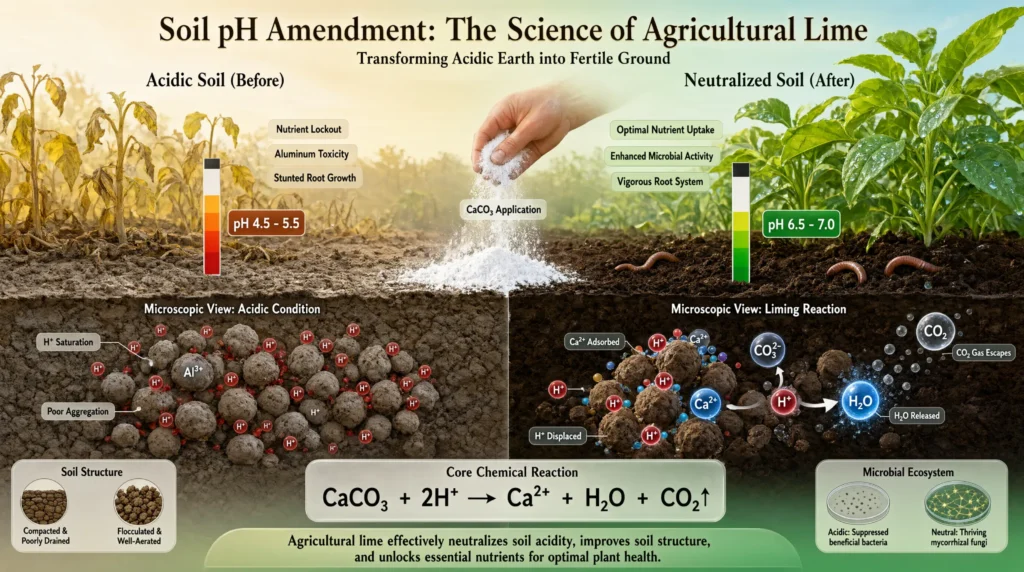
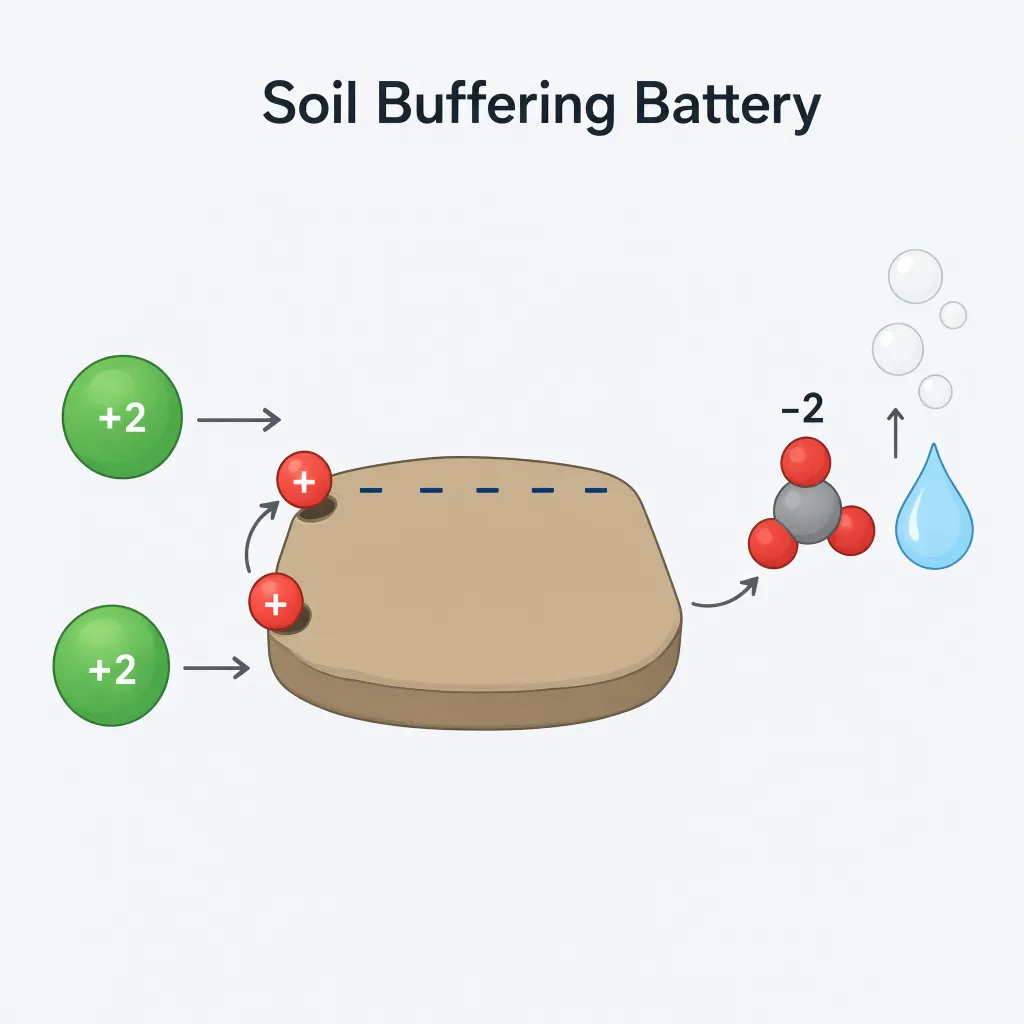
Lime raises soil pH by dissolving into calcium and carbonate ions. The calcium swaps places with acidic hydrogen ions clinging to soil particles, while the carbonate bonds with those displaced hydrogen ions to form water and carbon dioxide gas that leave the soil. With fewer free hydrogen ions, acidity falls and pH rises.
To see why that swap matters, picture your soil as a rechargeable battery , the Soil Buffering Battery. Its negative terminals are clay and humus particles, which carry a negative electrical charge and hold positively charged ions (cations) such as calcium (Ca²⁺), magnesium (Mg²⁺), and potassium (K⁺). The total number of those parking spots is the cation exchange capacity (CEC).
“Think of soil acidity as a parking problem: hydrogen ions park in the spots where calcium belongs, and lime is the tow truck that removes them for good.”
In acidic soil, hydrogen (H⁺) and aluminum (Al³⁺) ions occupy many of those CEC spots, and the more hydrogen parked on the particles, the lower your pH reads. That acidity locks up nutrients and stalls the microbial life that keeps soil fertile. Lime recharges the battery by swapping calcium in and permanently removing the hydrogen.
Step 1: Dissolution and the Calcium Swap
Calcium carbonate is only slightly soluble, so in moist soil each granule slowly dissolves into one calcium ion (Ca²⁺) and one carbonate ion (CO₃²⁻). Because calcium carries a double positive charge, it is strongly attracted to the negative CEC sites and displaces two single-charged hydrogen ions per site , chemists call this mass action. The calcium takes the parking spot, and two hydrogen ions are kicked out into the soil water.
Step 2: Neutralization , the Carbonate Does the Real Work
If those displaced hydrogen ions simply stayed in solution, the soil would remain acidic. Instead, the carbonate ion (CO₃²⁻) grabs two of them to form carbonic acid (H₂CO₃), which is highly unstable. It breaks down almost instantly into water (H₂O) and carbon dioxide (CO₂) that diffuses out of the soil [SOURCE: Soil Chemistry (5th Edition)]. The hydrogen is not relocated , it is permanently removed from the soil system, which is why lime corrects acidity rather than masking it.
The net reaction is usually written as CaCO₃ + 2H⁺ → Ca²⁺ + H₂O + CO₂
Notice the practical implications: lime needs moisture to dissolve, acidity to react with, and time to finish. Dry granules sitting on dry soil do almost nothing until rain or irrigation moves them into the root zone.
What Is the pH of Calcium Carbonate Lime? (Calcitic vs. Dolomitic)
When evaluating the lime calcium carbonate pH impact, it is important to know that pure calcium carbonate is a self-limiting buffer: it nudges soil and water solutions toward a mildly alkaline pH of about 8.3 and then stops reacting once the free acidity is gone [SOURCE: soil science reference on carbonate buffering]. That ceiling is a safety valve , it is genuinely difficult to over-lime with ground limestone, while caustic limes have no such brake.
Soils naturally rich in free calcium carbonate, called calcareous soils, typically measure between just above 7 and about 8.3 for exactly this reason [SOURCE: USDA-NRCS]. Both main liming limestones share that ceiling; they differ in the secondary nutrient they deliver:
| Liming material | Main compound | Effective pH ceiling | Neutralizing power (CCE) | Also supplies | Best choice when |
|---|---|---|---|---|---|
| Calcitic limestone | CaCO₃ | ~8.3 | 100% (the benchmark) | Calcium | Soil test shows adequate or high magnesium |
| Dolomitic limestone | CaMg(CO₃)₂ | ~8.3 | ~109% | Calcium + magnesium | Soil test shows low magnesium |
| Hydrated lime | Ca(OH)₂ | ~8.3 (but can spike locally) | ~136% | # | Rarely in gardens; fast correction with burn risk |
| Wood ash | Mixed carbonates/oxides | Variable | ~45–90% (highly variable) | Potassium, trace elements | Light, occasional use with a soil test |
[SOURCE: Penn State Extension]
The practical takeaway: the choice between calcitic and dolomitic lime should be decided by your soil test’s magnesium number, not by brand or price. If magnesium is already adequate or high, use calcitic lime; stacking more magnesium onto a magnesium-rich soil can crowd calcium and potassium off the CEC and manufacture a new deficiency. If the test shows low magnesium, dolomitic lime corrects both problems in one pass.
Three Bonus Benefits of Liming (Beyond pH)
1. Better soil structure through flocculation
Calcium is bulky and double-charged, so when it replaces hydrogen or sodium on clay particles, it acts like a molecular bridge and pulls the particles into crumb-like aggregates , a process called flocculation. Flocculated soil is porous: water infiltrates, excess drains, and oxygen reaches roots. Clay dominated by hydrogen or sodium stays dispersed , dense, sticky, and airless , so lime literally rebuilds soil architecture.
2. Unlocked nutrients
Below about pH 5.5, phosphorus binds tightly to aluminum and iron, while aluminum and manganese can climb to toxic levels that prune root tips. Raising pH into the 6.2–7.0 window frees that phosphorus and precipitates aluminum into harmless forms. This is why lime is often the highest-return input on a farm: it activates fertilizer you have already paid for.
3. A livelier soil food web
Beneficial bacteria and fungi slow dramatically in strongly acid soil, so organic matter decomposition stalls and nutrients stay tied up. As carbonate removes hydrogen ions, microbial populations rebound , and in a tidy feedback loop, the CO₂ those microbes exhale dissolves in soil water as weak carbonic acid, which accelerates the breakdown of limestone granules and releases more calcium. Liming and feeding soil biology reinforce each other.
How Fast Does Lime Work in Soil?
Expect the largest pH jump within the first 6–12 months, with ground limestone continuing to react for two to three years before it fully dissolves [SOURCE: Penn State Extension]. Lime is a slow-release amendment by design, and judging it after a few weeks is like judging a drought after one rain.
Four factors control the speed:
- Fineness: finer granules expose more surface area to soil acids; look for an effective calcium carbonate equivalent (ECCE) or mesh rating on the label.
- Moisture: dissolution needs water, so lime applied into dry soil simply waits for rain.
- Mixing: lime incorporated into the top 4–6 inches contacts vastly more soil than lime left on the surface; surface-applied lime moves downward only slowly.
- Temperature and biology: warm, microbially active soil generates the weak acids and CO₂ that speed dissolution.
This lag is why agronomists lime in fall for the following season, and why re-testing about 12 months after application is the only reliable way to judge your dose. If you are not sure where your starting pH stands, our walkthrough on how to test soil pH at home pairs well with a lab test.
How Much Lime Does Your Soil Need? A 5-Step Method
The missing ingredient in most liming advice is the soil test, because the same pH reading on sand and clay can demand very different rates: clay’s larger CEC stores more reserve acidity that must be neutralized. A proper report gives you both the active pH and a buffer pH (lime requirement) value that quantifies that reserve acidity and sets the actual rate [SOURCE: FS398E-uxhibg.pdf].
- Test pH and buffer pH. Active pH tells you that acidity is the problem; buffer pH tells you how much lime it will take.
- Check magnesium to choose calcitic versus dolomitic lime.
- Match the target pH to what you grow. Most vegetables and turf want 6.0–7.0, while blueberries, azaleas, and potatoes thrive more acidic and should rarely be limed.
- Apply evenly and incorporate where possible; on established lawns, apply before rain or irrigate about a quarter inch.
- Re-test in 12 months and adjust , lime is far easier to add than to remove.
As rough orientation, extension rate tables commonly cite about 25–50 pounds of ground limestone per 1,000 square feet to raise a loam garden soil roughly one pH unit, with sandy soils needing about half that and heavy clays more. Treat any generic chart as a starting guess, and let your soil test report overrule it.
Six Lime Myths That Waste Your Money
Myth 1: Lime is a fertilizer. Lime supplies calcium (and sometimes magnesium) but no nitrogen, phosphorus, or potassium, so it is a soil amendment, not a complete fertilizer. Its real job is to adjust the environment so roots can access the fertilizer you apply.
Myth 2: Faster is better. Hydrated lime does raise pH in days, but its caustic action can scorch roots, harm earthworms, and shock beneficial fungi. Ground limestone’s slow buffer is safer for living soil and lasts longer.
Myth 3: Wood ash is a free substitute. Hardwood ash contains carbonates and does liming work, but it acts fast, adds soluble salts, and can carry heavy metals if the wood was painted or treated. Use it sparingly and only alongside a soil test.
Myth 4: More lime means better grass. Chasing pH above 7 for acid-loving plants, or over-applying dolomitic or hydrated lime, can lock up iron, manganese, and phosphorus and induce magnesium excess. Match the pH to what you actually grow.
Myth 5: Lime fixes everything. Lime corrects acidity; it does not relieve compaction, replace organic matter, or react without water. It works best inside a program that also builds organic matter.
Myth 6: Lime lowers soil pH. Because “lime” is also used in water treatment and masonry, some gardeners confuse agricultural lime with acidic compounds. Agricultural lime is strictly alkaline. If you want to lower pH, you need elemental sulfur, not lime.
The Bottom Line: Test, Then Trust the Chemistry
Lime is not dust you sprinkle on faith. Every application is a targeted trade , calcium in, hydrogen out, acidity shipped away as water and CO₂ , and the Soil Buffering Battery model explains exactly why that trade works. Get a soil test, match the material to your magnesium level, incorporate it, and give it a full season; your plants respond to the chemistry whether or not you can see it happening.
Check which of your plants actually want acidity in acid-loving plants: a practical list before you reach for the bag.