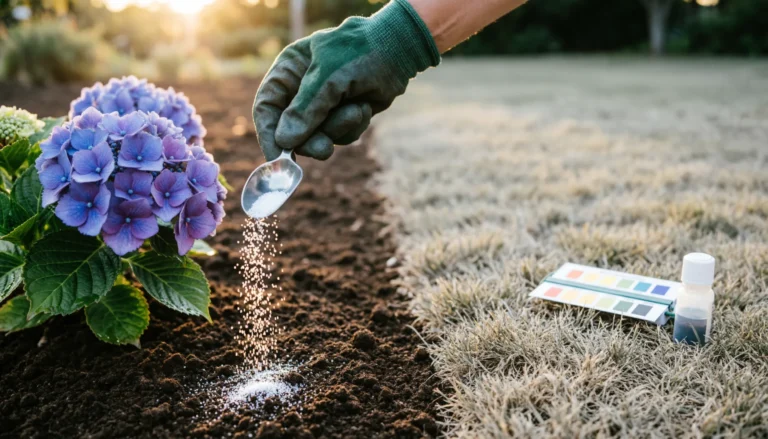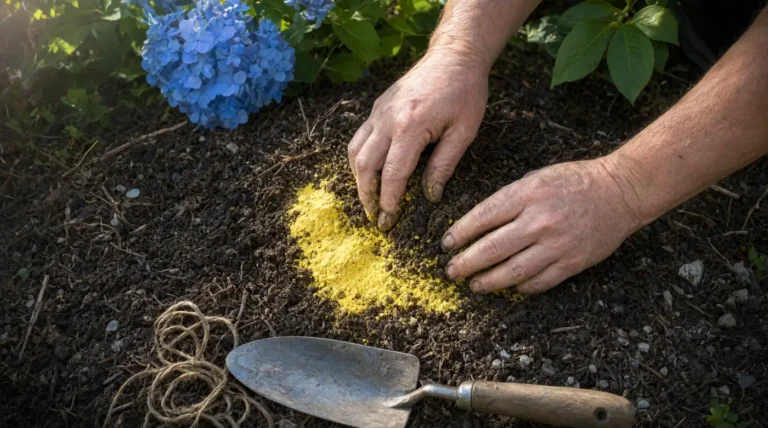
If you are searching for how to lower soil pH fast because your blueberries are yellowing, your hydrangeas are refusing to turn blue, or a recent soil test revealed your garden bed is too alkaline, you are in the right place. The honest truth is this: you can lower soil pH faster than many slow organic methods suggest, but you must never do it by shocking the soil with harsh, soluble chemicals. The most common and dangerous “quick fix” mistake is using liquid aluminum sulfate, which can drop pH rapidly but simultaneously creates salt burn, aluminum toxicity, and severe root stress.
Direct Answer: To safely and effectively learn how to lower ph in the soil, apply finely milled elemental sulfur combined with a microbial inoculant in calculated split doses. While chemical shortcuts like aluminum sulfate act faster, they risk severe root burn and heavy metal toxicity. Biologically activated elemental sulfur remains the agronomic standard for sustainable, long-term soil acidification across all soil textures.
This comprehensive guide focuses on how to lower pH in soil quickly while keeping your plants alive, their roots healthy, and the soil biology intact. Instead of one massive chemical dose that risks plant death, the fastest safe protocol utilizes finely milled elemental sulfur, a soil inoculant or active compost, consistent moisture, and split applications. This allows you to measure the change and adjust before the pH goes too far. If you are exploring comprehensive methods for decreasing soil pH, understanding the biological mechanisms behind acidification is your first step toward success.
Why Lowering Soil pH Quickly Is Inherently Risky
Agronomic Definition: Soil buffering capacity is the soil’s inherent ability to resist changes in pH, driven primarily by clay content, organic matter, and cation exchange capacity (CEC). Overcoming this buffer requires incremental, biologically activated amendments rather than sudden chemical shocks.
Soil pH is not just a random number; it is the master variable that controls nutrient availability, microbial activity, root health, and the solubility of toxic elements. When pH drops too quickly, plants can experience severe shock even if the final pH looks “perfect” on a laboratory report. Understanding the agronomic principles of soil reaction explains why speed must be balanced with biological safety.
Most garden soils are heavily buffered by clay particles, organic matter, calcium carbonate, magnesium, and microbial activity. This means the soil naturally resists sudden chemical changes. If you force the pH down too fast, you often create a hostile, toxic root environment long before the plant can benefit from improved nutrient availability.
Common symptoms of lowering soil pH too aggressively include:
- Brown, blackened, or slimy root tips
- Severe leaf margin burn and necrosis
- Sudden wilting despite the soil being wet
- New yellowing caused by micronutrient lockout or toxicity
- Stunted growth after an initially “green” response
- Increased susceptibility to drought stress and soil-borne diseases
If your primary goal is figuring out how to lower soil pH fast, your first priority must be speed combined with control. Fast does not mean reckless. Fast means using the correct form of sulfur, maximizing microbial activity, and applying smaller, calculated doses repeatedly instead of gambling with one giant application.
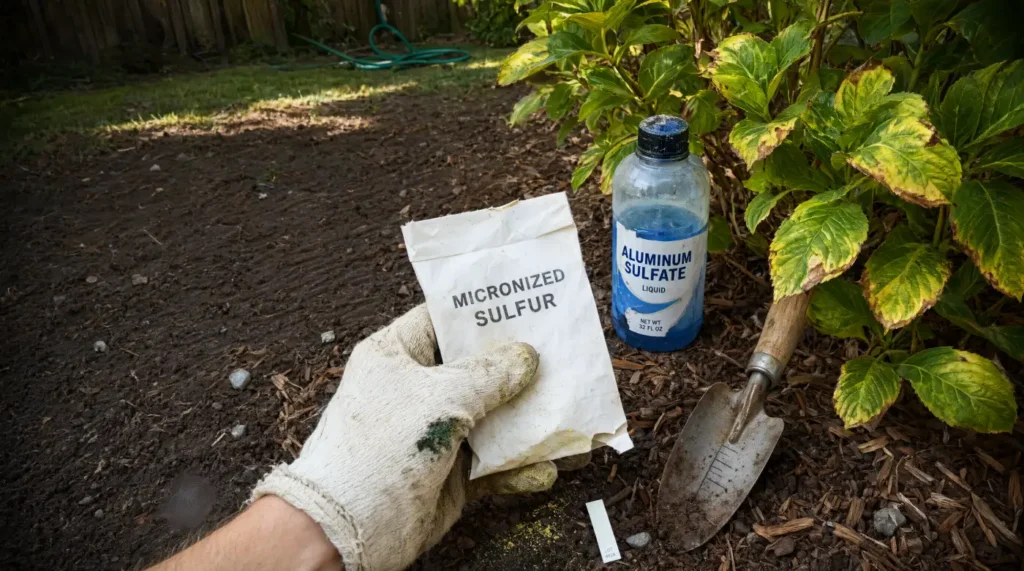
The Fast-but-Dangerous Shortcut: Liquid Aluminum Sulfate
Liquid aluminum sulfate is frequently marketed as a rapid pH reducer, especially for hydrangeas, azaleas, and blueberries. It does work quickly. When aluminum sulfate dissolves in water, the aluminum ions react with moisture and release acidity, which can lower soil pH in a matter of days. This is why it looks incredibly appealing when you need a quick correction.
However, there is a serious and often irreversible downside. Recognizing early aluminum toxicity symptoms is critical, as the damage often occurs below the soil surface before foliar signs appear.
Why Liquid Aluminum Sulfate Can Hurt or Kill Plants
- Salt burn: Aluminum sulfate drastically increases soluble salts in the root zone. In containers, sandy soils, or dry conditions, this can quickly burn and destroy fine feeder roots.
- Aluminum toxicity: Soluble aluminum can physically damage root tips, block phosphorus uptake, and stunt plants, especially in soils that are already acidic or only mildly alkaline.
- pH overshoot: Because it acts so quickly, it can easily push pH below the target range before you realize what has happened, requiring you to then apply lime to raise it back up.
- Poor soil biology: A sudden acid shock can suppress beneficial microbes, including the very bacteria that help convert sulfur into plant-available acidity.
- Container danger: Pots have vastly less buffering capacity than in-ground soil. Aluminum sulfate in containers is especially dangerous because salts accumulate rapidly with no place to leach.
If you are asking how to lower pH in soil quickly because your plants are already stressed, aluminum sulfate is almost always the wrong answer. It may temporarily satisfy a soil test, but it can severely injure the exact plant you are trying to save.
The Fastest Safe Method: Finely Milled Elemental Sulfur + Soil Inoculant + Split Doses
The absolute best balance of speed and safety is a protocol built around elemental sulfur. If you want to know exactly how to lower ph in the soil without collateral damage, this is the gold standard. Elemental sulfur does not acidify soil directly the moment it touches the ground. Instead, specialized soil bacteria oxidize the sulfur and gradually produce sulfuric acid. That biological process is slightly slower than aluminum sulfate, but it is much more plant-safe, long-lasting, and predictable when managed correctly.
The secret to making elemental sulfur work faster is to optimize four critical factors:
- Particle size: Finely milled (micronized) sulfur reacts much faster than coarse prills because microbes have exponentially more surface area to attack. Understanding the differences between elemental vs. sulfate forms is crucial for selecting the right product.
- Microbial activity: A sulfur-oxidizing inoculant or highly active compost introduces and supports the specific bacteria needed for rapid conversion.
- Moisture: The oxidation process requires evenly moist soil. Bone-dry soil halts the process; waterlogged soil drowns the roots.
- Split dosing: Smaller, repeated applications reduce the risk of root burn, pH crash, and wasted amendment.
This is the fastest safe method for home gardens, raised beds, container mixes, and acid-loving plants.
What You Need for the Protocol
- Finely milled elemental sulfur (often sold as micronized sulfur, dust, or fine sulfur powder). Avoid large, coarse prills if speed is your main goal.
- Soil inoculant containing sulfur-oxidizing bacteria (like Thiobacillus), or high-quality, biologically active finished compost.
- Reliable soil pH test kit or, ideally, a professional laboratory soil test.
- Calibrated digital pH meter or high-quality test strips for frequent monitoring.
- Organic mulch to stabilize moisture and soil temperature.
Step-by-Step Protocol: How to Lower Soil pH Fast and Safely
Step 1: Test the Soil Before You Touch Anything
Never guess. If you want to know how to lower soil pH fast without damaging your plants, you must start with an accurate soil test. A lab test is best because it identifies pH, buffering capacity, organic matter, salinity, and nutrient imbalances.
For a quick field check, take several small soil samples from the root zone, mix them thoroughly, and test the blended sample. Avoid testing immediately after applying fertilizer, compost, or irrigation water, as these can temporarily skew results.
Know your exact target pH before applying anything by referencing a definitive soil pH chart:
- Most vegetables and lawns: 6.0 to 7.0
- Blueberries: 4.5 to 5.5 (See our dedicated guide on making soil acidic for blueberries)
- Azaleas and rhododendrons: 4.5 to 6.0
- Hydrangeas (for blue flowers): 5.2 to 5.5 (Follow our specific hydrangea acidification protocols)
- Camellias: 5.0 to 6.5
Do not try to force soil below the target range. Lower is not always better; many nutrients become locked out when pH drops too low.
Step 2: Calculate a Conservative Elemental Sulfur Rate
Elemental sulfur rates depend on current pH, target pH, soil texture, and buffering capacity. Clay soils and high-organic soils require more sulfur than sandy soils, but they also resist sudden change.
The following table gives a cautious starting range for lowering mineral soil pH by about one full point. Always check your product label, as sulfur products vary in concentration.
| Soil Type | First Split Application | Approximate Total for a 1-Point pH Drop |
|---|---|---|
| Sandy soil | 0.25 to 0.5 lb per 100 sq ft | 0.75 to 1.5 lb per 100 sq ft |
| Loam | 0.5 to 1 lb per 100 sq ft | 1.5 to 2.5 lb per 100 sq ft |
| Clay soil | 0.75 to 1.5 lb per 100 sq ft | 2.5 to 4 lb per 100 sq ft |
| High-organic soil | 0.5 to 1 lb per 100 sq ft | 2 to 4 lb per 100 sq ft |
Do not apply the full estimated total at once. Split it into several smaller doses. That is the core of the safe, fast method.
Step 3: Apply Only the First Split Dose
For most garden beds, a safe first move is to apply no more than 0.5 lb of finely milled elemental sulfur per 100 square feet for loam or sandy soil, and no more than 1 lb per 100 square feet for heavy clay.
Work the sulfur gently into the top 2 to 4 inches of soil. Avoid deep, aggressive tilling around established plants, as root damage will stress them more than the pH problem itself. If plants are already in the bed, apply carefully around the drip line and water in gently. Never pile sulfur directly against stems or trunks.
Step 4: Add a Soil Inoculant or Active Compost
Elemental sulfur requires microbial oxidation. To speed up the process, add one of the following. Utilizing alternative sulfur oxidation strategies ensures the bacteria have the environment they need to thrive:
- A commercial sulfur-oxidizing inoculant containing Thiobacillus species.
- A thin layer (1/4 to 1/2 inch) of high-quality finished compost.
- Worm castings or compost tea from a biologically active source.
Apply the compost or inoculant after the sulfur is lightly incorporated, then water gently. The goal is to introduce biology without smothering roots.
Step 5: Keep the Soil Evenly Moist
Sulfur oxidation is a biological process. If the soil dries out completely, the bacteria go dormant and the process halts. If the soil stays saturated, roots may rot.
Aim for evenly moist soil. Water deeply but allow slight surface drying between irrigation cycles. Mulching helps stabilize moisture and temperature, making the pH-lowering process much more consistent. Note that in cold soil (below 50°F), microbial activity slows significantly, so do not expect rapid results in early spring.
Step 6: Retest After 2 to 3 Weeks
This is where many gardeners fail. They apply one product, panic when it doesn’t work in 48 hours, apply another product, and then burn the plants.
Wait 14 to 21 days, then retest the soil. If the pH is still above target and the plants look healthy, apply the second split dose. If the pH is approaching the target, stop. If plants show stress, pause and investigate before applying more.
Step 7: Repeat Split Doses Until Target pH Is Reached
For most soils, use 2 to 4 split applications spaced 2 to 4 weeks apart. A safe example schedule for a loamy garden bed looks like this:
- Day 0: Apply first split dose of finely milled elemental sulfur, add inoculant, water gently.
- Day 14 to 21: Test pH. If still too high and plants are healthy, apply second split dose.
- Day 28 to 35: Test again. If still above target, apply third split dose.
- Day 45 to 60: Reassess. If target is reached, switch to maintenance mode.
This method can begin showing measurable movement within 2 to 4 weeks under warm, moist conditions. More importantly, it lowers pH without destroying the root system.
What to Add to Soil to Increase Acidity (Alternative Amendments)
Agronomic Definition: Acidifying soil amendments are materials added to the soil profile to increase hydrogen ion concentration, thereby lowering pH. These range from rapid-acting chemical compounds like elemental sulfur to slow-release organic matter like sphagnum peat moss.
When researching what to add to soil to increase acidity, gardeners often look beyond elemental sulfur. While sulfur is the most efficient bulk amendment for rapid correction, other soil amendments for acidic soil can provide supplemental benefits, improve soil structure, or offer immediate nutrient rescue. Exploring natural soil acidifying amendments helps build a resilient, long-term soil ecosystem.
- Sphagnum Peat Moss: An excellent soil amendment for acidic soil that physically lowers pH (typically ranging from 3.0 to 4.5) while vastly increasing water retention. It is highly effective in sandy soils but difficult to incorporate into heavy clay beds without causing drainage issues.
- Organic Acids (Humic and Fulvic): These do not drastically shift bulk soil pH, but they chelate micronutrients, making them available to plants even in slightly alkaline conditions. They are excellent rescue treatments for chlorotic plants.
- Acidifying Fertilizers: Using ammonium sulfate or sulfur-coated urea provides nitrogen while gradually releasing hydrogen ions during the nitrification process. This is an excellent maintenance strategy once your target pH is reached.
How to Make Soil More Acidic Organically at Home
If your long-term goal is how to make soil more acidic organically, you must focus on building a biological system that naturally cycles organic acids. Learning how to make soil acidic naturally at home requires patience, as biological processes operate on a seasonal timeline rather than a daily one.
- Composting with Acidic Biomass: The myth that pine needles and oak leaves drastically acidify soil is exaggerated (they lose most acidity as they decompose). However, incorporating them into your compost pile adds valuable organic matter that improves the soil’s cation exchange capacity (CEC), allowing it to hold onto acidifying ions longer.
- Ericaceous Compost: For container gardening, using a dedicated ericaceous (acid-loving) compost mix is the most reliable natural way to make soil acidic without relying on chemical interventions.
- Fungal-Dominated Mulching: Maintaining a thick layer of woody organic mulch (like arborist wood chips) encourages fungal-dominated soil biology. Fungi naturally produce weak organic acids as they break down lignin, providing a very slow, steady downward drift in soil pH over several years.
Information Gain: Soil-Texture-Adjusted Amendment Matrix
Not all acidifiers behave identically across different soil profiles. The following matrix compares the four most common amendments used to decrease soil alkalinity, adjusted for speed, risk, and texture-specific application rates.
| Amendment Type | Mechanism & Speed | Risk Profile | Sandy Soil (1 pt drop) | Loam (1 pt drop) | Clay Soil (1 pt drop) |
|---|---|---|---|---|---|
| Elemental Sulfur (Micronized) | Biological oxidation (2-8 Weeks) | Low (if split-dosed) | 0.75 – 1.5 lbs | 1.5 – 2.5 lbs | 2.5 – 4.0 lbs |
| Aluminum Sulfate | Chemical hydrolysis (Days) | High (Salt/Al Toxicity) | 2.0 – 4.0 lbs | 4.0 – 6.0 lbs | 6.0+ lbs (Not Recommended) |
| Sphagnum Peat Moss | Physical incorporation (1-2 Seasons) | Very Low | 2-3 cu ft (Top 6″) | 3-4 cu ft (Top 6″) | Poor Drainage Risk |
| Ammonium Sulfate | Nitrification (1-3 Months) | Moderate (Salt build-up) | 1.0 lbs | 1.5 lbs | 2.0 lbs |
Soil Acidification Calculator: Adjusting for Buffer pH and CEC
Manual Soil Acidification Calculator Logic
Professional agronomists do not rely solely on basic texture charts to calculate sulfur requirements. To calculate your exact sulfur requirement, you must use the Buffer pH (often listed as SMP Buffer, Sikora Buffer, or Mehlich Buffer on professional lab tests).
While “Active pH” tells you the current acidity of the soil water, the “Buffer pH” measures the soil’s hidden lime reserves (CEC). If your soil test shows an Active pH of 7.5 but a Buffer pH of 6.8, your soil has low reserves and requires very little sulfur to drop the active pH. If the Buffer pH is 7.4, your soil is heavily loaded with limestone, and you will need to apply the maximum texture-adjusted rates listed in our matrix above, spread over multiple seasons.
Emergency Rescue: What to Do While Waiting for pH to Drop
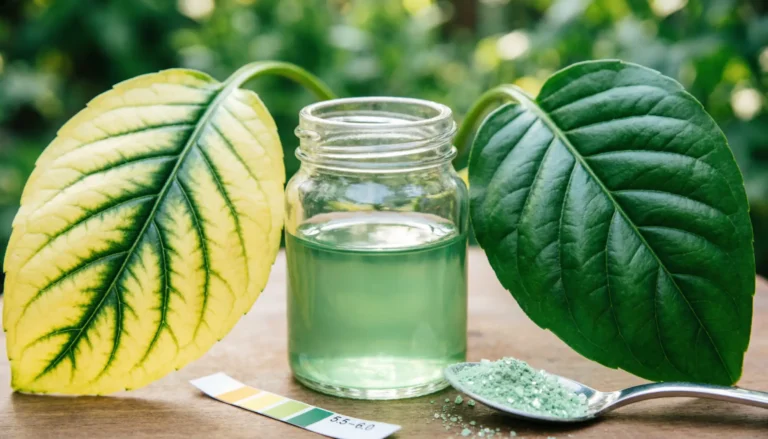
Sometimes the reason you are searching how to lower pH in soil quickly is that plants are already showing severe deficiency symptoms. In alkaline soil, iron, manganese, and zinc become unavailable, causing yellow leaves with green veins (interveinal chlorosis).
While your sulfur protocol works over the next few weeks, use these safer short-term rescue methods:
Use Chelated Iron Foliar Spray
If leaves are yellowing from iron deficiency, a foliar spray of chelated iron (like Fe-EDDHA or Fe-DTPA) can provide temporary green-up within days while the soil pH is being corrected. Spray in cool morning conditions to avoid leaf burn.
Acidify Irrigation Water Carefully
For containers and small beds, slightly acidifying irrigation water can help maintain nutrient availability while sulfur works. Aim for irrigation water around pH 5.5 to 6.0. Use a commercial pH-down product designed for hydroponics, utilize a precision pH down calculator, follow label rates strictly, and monitor closely.
Use Acidifying Fertilizers
Switch to fertilizers that have an acidifying effect, such as those containing ammonium sulfate or urea. As the plants take up the ammonium, they release hydrogen ions into the soil, gently lowering the pH over time.
What Not to Do When Trying to Lower Soil pH Fast
- Do not use liquid aluminum sulfate as your first solution. The risk of salt burn and aluminum toxicity is too high for most gardens.
- Do not apply one massive dose of sulfur. Split applications are safer and more controllable.
- Do not combine multiple acidifying products at once. Sulfur, acid fertilizers, and aluminum products should not be stacked blindly.
- Do not ignore irrigation water pH. If your tap water is highly alkaline, soil pH will rebound even after you lower it.
- Do not use vinegar as a soil drench. Vinegar can temporarily lower pH in water, but it is not stable, kills soil microbes, and can severely damage roots.
- Do not expect a one-point pH drop overnight. Safe biological movement is measured in weeks, not hours.
Bottom Line: Fast Does Not Have to Mean Dangerous
If you want to know how to lower soil pH fast, the safest high-speed strategy is not liquid aluminum sulfate or vinegar. The proven, agronomically sound protocol is this:
- Test the soil and set a realistic target pH.
- Use finely milled elemental sulfur, not coarse prills.
- Apply in split doses rather than one massive, risky dose.
- Add a sulfur-oxidizing inoculant or active compost to fuel the bacteria.
- Keep the soil evenly moist and warm to maximize microbial activity.
- Retest every 2 to 3 weeks to track progress.
- Stop applying sulfur the moment the target is reached.
This method answers how to lower pH in soil quickly without turning your soil into a toxic, salt-heavy root zone. It respects the biology of the soil, protects your plants from chemical shock, and gives you a measurable, reliable path toward stable, plant-friendly acidity.
Plan Your Acidic Garden: The Comprehensive Plant Database
Once you have successfully lowered your soil pH to the optimal target range, the next step is selecting the right acid-loving species to thrive in your newly amended beds. Guessing which plants prefer your specific soil chemistry often leads to nutrient lockout, stunted roots, and poor growth.
Explore the Comprehensive Plant Database
Stop guessing which plants will thrive in your acidic soil. Search and filter our extensive agronomic database by exact soil pH requirements, sunlight needs, functional traits, ecology, and safety profiles covering every plant type.
Whether you are designing a low-pH ericaceous border, planning a high-yield blueberry patch, or looking for pet-safe acid-loving groundcovers, this tool ensures your plant selections are perfectly matched to your soil’s new chemical environment.