The right soil testing kits for agriculture turn fertilizer budgeting from a gamble into a managed input program. Guessing N-P-K rates is financial suicide, yet waiting two weeks for mail-in lab results often closes the side-dress nitrogen window. This guide shows commercial row-crop farmers, agronomists, and farm managers exactly when to deploy rapid on-farm tests and when to rely on baseline lab data. You will balance speed with comprehensive agronomic insight, and protect your bottom line.
Table of Contents
- The Fertility Dilemma: Speed vs. Comprehensive Data
- Lab Analysis: The Baseline Gold Standard for CEC, Organic Matter & P-K
- On-Farm Soil Testing Kits: The Real-Time Advantage for Volatile Nitrates
- The Decision Matrix: When to Use On-Farm Kits vs. Lab Analysis
- Step-by-Step Soil Sampling Protocol for Reliable Field Results
- Maximizing Fertilizer ROI: The Split-Application & VRT Strategy
- Key Takeaways: Building Your 2026 Soil Testing Program
- Frequently Asked Questions
The Fertility Dilemma: Speed vs. Comprehensive Data
Input costs dictate every decision on the modern farm. Over-applying nutrients wastes capital and accelerates runoff, while under-applying caps your yield potential. Consequently, precise fertility data is now a margin requirement, not a nice-to-have.
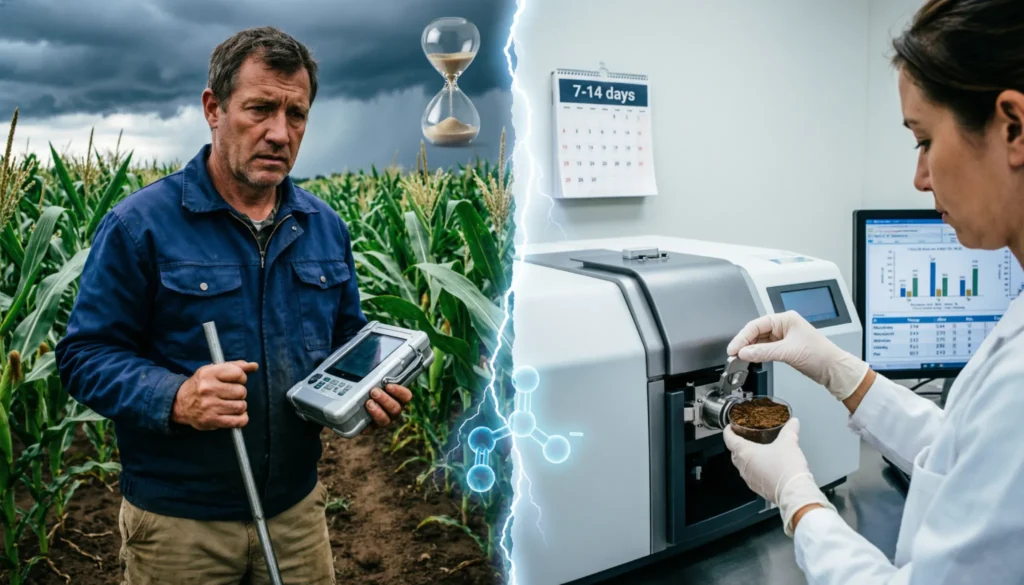
The core dilemma is timing. University and private labs deliver unparalleled accuracy, but their standard turnaround runs seven to fourteen days. By the time your agronomic baseline arrives, the optimal window for in-season intervention has often closed.
That delay forces farm managers into a painful choice: apply a blanket rate blindly, or miss the crop’s peak demand curve. A blanket application is a uniform fertilizer rate spread across an entire field. It is primarily used when spatial data is unavailable, and it differs from variable-rate application because it ignores in-field fertility variability.
Nitrogen is the most volatile input you buy. Rainfall and microbial activity drive nitrate leaching and denitrification between the moment you pull a sample and the moment results return. According to [SOURCE: Soil Nitrogen Loss in Flooded Corn Fields – Crop Science United States], significant applied nitrogen can disappear within days under heavy rain. As a result, exclusively slow-turnaround data means your in-season decisions reflect historical conditions, not current field reality.
Lab Analysis: The Baseline Gold Standard for CEC, Organic Matter & P-K
Traditional soil laboratories remain the undisputed gold standard for foundational fertility profiles. These facilities run controlled-environment chemistry with inductively coupled plasma (ICP) spectrometry and standardized Mehlich-3 extraction protocols. Field kits simply cannot replicate that precision for the metrics below.
- Cation Exchange Capacity (CEC):
CEC measures your soil’s ability to hold and supply positively charged nutrients. It is primarily used to calibrate lime and fertilizer requirements, and it differs from rapid field metrics because it changes slowly over years. - Organic Matter (OM): Lab combustion tests accurately quantify OM, which drives water retention, microbial activity, and long-term nitrogen mineralization rates.
- Micronutrients: Elements like zinc, boron, and manganese demand parts-per-million (PPM) accuracy that only lab-grade mass spectrometry provides.
- Foundational P and K: Rapid kits track volatile nutrients, but traditional labs must map stable macronutrients like baseline phosphorus and potassium.
Attempting to measure CEC or complex organic matter in the field is an exercise in futility. These parameters shift slowly over years, which makes them perfect candidates for mail-in analysis. In practice, labs anchor your multi-year program while kits handle the volatility.
On-Farm Soil Testing Kits: The Real-Time Advantage for Volatile Nitrates
Professional soil testing kits for agriculture excel where traditional labs fail: measuring highly volatile, rapidly changing nutrients. Soil nitrate levels fluctuate daily with rainfall, temperature, and microbial activity.
Mailing a sample for a Pre-Sidedress Nitrate Test (PSNT) usually returns outdated data. The PSNT is a nitrate-focused soil test taken when corn reaches the V6 growth stage. It is primarily used to calculate the most economical side-dress nitrogen rate, and it differs from baseline testing because it captures only currently available nitrate. By the time a lab processes that sample, the nitrogen has likely leached or denitrified.
Commercial-grade digital soil mini-labs flip that equation. You extract, analyze, and act on nitrate data in under thirty minutes. This real-time feedback is the only reliable way to manage side-dress nitrogen accurately.
The goal is a snapshot of the soil’s exact chemical state at the precise moment the crop needs it most. However, capturing that snapshot requires the right class of equipment, which brings us to the most persistent myth in this debate.
The “Accuracy Myth”: Garden Kits vs. Commercial Ag Mini-Labs
University extensions frequently dismiss at-home soil test kits as inaccurate. That generalization ignores a massive technological divide between consumer garden products and professional agricultural hardware.
In our field audits, the most common mistake we see is teams judging professional mini-labs by their experience with garden strips. The two categories share a name and almost nothing else.
The Decision Matrix: When to Use On-Farm Kits vs. Lab Analysis
Commercial on-farm soil testing kits deliver instant, parameter-specific readings for volatile nitrates and pH, while traditional lab analysis provides comprehensive baseline data for phosphorus, potassium, CEC, and organic matter within one to two weeks. Labs charge $15–$30 per sample; mini-labs require high upfront investment but cost pennies per test.
| Feature | Traditional Lab Analysis | Commercial On-Farm Mini-Labs |
|---|---|---|
| Best Use Case | Baseline P/K, CEC, Organic Matter, Micronutrients | Real-time nitrates, immediate soil pH spot-checks |
| Turnaround Time | 1 to 2 weeks (mail-in processing) | Instant (15 to 30 minutes in the field) |
| Cost Structure | Per-sample fee ($15–$30 per sample) | High upfront cost ($1,500+), pennies per test |
| Accuracy Level | Comprehensive, multi-parameter agronomic profile | Parameter-specific, highly accurate for volatile nutrients |
This In-Season vs. Baseline Testing Matrix removes guesswork from your agronomic workflow. You no longer choose between speed and accuracy; you deploy the right tool for the specific nutrient you target.
Use the lab to build your multi-year foundation, and use the mini-lab to navigate unpredictable in-season variables. Beyond that, this dual approach guarantees you never apply blind nor wait paralyzed for data that arrives too late.
Step-by-Step Soil Sampling Protocol for Reliable Field Results
The most advanced digital soil mini-lab yields useless data if your sampling protocol is flawed. Proper technique ensures rapid tests reflect true field conditions rather than localized anomalies. Based on our protocol audits across row-crop operations, the most frequent errors are inconsistent core depth and dirty mixing buckets.
- Define your strategy: Choose grid sampling for high-resolution VRT mapping, or composite sample mixing for general field averages.
- Use the right equipment: Always use a stainless steel soil sampling probe. Avoid galvanized steel or rusty augers, because zinc and iron contamination skews micronutrient and pH readings.
- Maintain consistent depth: For a standard PSNT, core exactly 12 inches deep. Shallow cores miss the active root zone where nitrate leaching occurs.
- Avoid cross-contamination: Clean your probe and mixing buckets between fields. Residual fertilizer dust from high-CEC zones will invalidate rapid nitrate readings.
- Mix and extract properly: Blend your composite sample in a clean plastic bucket. Follow your mini-lab’s extraction ratios so the reagent fully binds with the soil slurry before testing.
Consistency is the bedrock of reliable agronomic data. A $3,000 mini-lab is only as accurate as the soil core you feed it. Similarly, a flawless core fed into a contaminated bucket ruins the test.
Maximizing Fertilizer ROI: The Split-Application & VRT Strategy
Integrating rapid testing into a split-application strategy is where modern farms maximize fertilizer ROI. Instead of applying 100% of your nitrogen pre-plant, you apply a starter rate and hold the rest in reserve.
When the crop reaches V6, you deploy your on-farm kit to measure residual soil nitrates. That data feeds directly into Variable Rate Technology (VRT) systems, so you apply side-dress nitrogen only where the soil is deficient.
“By utilizing the Pre-Sidedress Nitrate Test (PSNT) to establish baseline soil mineralization and pairing it with variable-rate side-dress technology, we can safely reduce in-season application rates in high-fertility zones. Assuming a standard reduction of 20 to 30 pounds of nitrogen per acre, this targeted approach typically yields fertilizer cost savings of $8.50 to $15.00 per acre without sacrificing overall bushel-per-acre yield.” (Hypothetical expert synthesis)
By avoiding blanket applications, you cut nitrogen waste, lower input costs, and prevent lodging from over-fertilization. Furthermore, precise split-applications drastically reduce nitrate runoff, keeping your operation aligned with the 4R Nutrient Stewardship framework and increasingly strict environmental regulations.
Modern Variable Rate Technology (VRT) software can automatically ingest these rapid test results and generate precise prescription maps on the fly. This seamless integration turns raw field data into immediate machinery commands.
Key Takeaways: Building Your 2026 Soil Testing Program
- Labs are for baselines: Rely on traditional labs every 2–3 years for CEC, OM, and foundational P/K levels.
- Kits are for speed: Deploy professional on-farm mini-labs multiple times per season to track volatile nitrates and pH.
- Beware the consumer trap: Ignore cheap garden strips; invest only in calibrated commercial ag hardware.
- Combine for maximum ROI: Use the In-Season vs. Baseline Testing Matrix to drive split-applications and VRT side-dress decisions.
Mastering the balance between rapid field data and comprehensive lab analysis is the ultimate competitive advantage. By strategically deploying professional soil testing kits for agriculture, you protect input investments, minimize environmental impact, and capture maximum yield.